
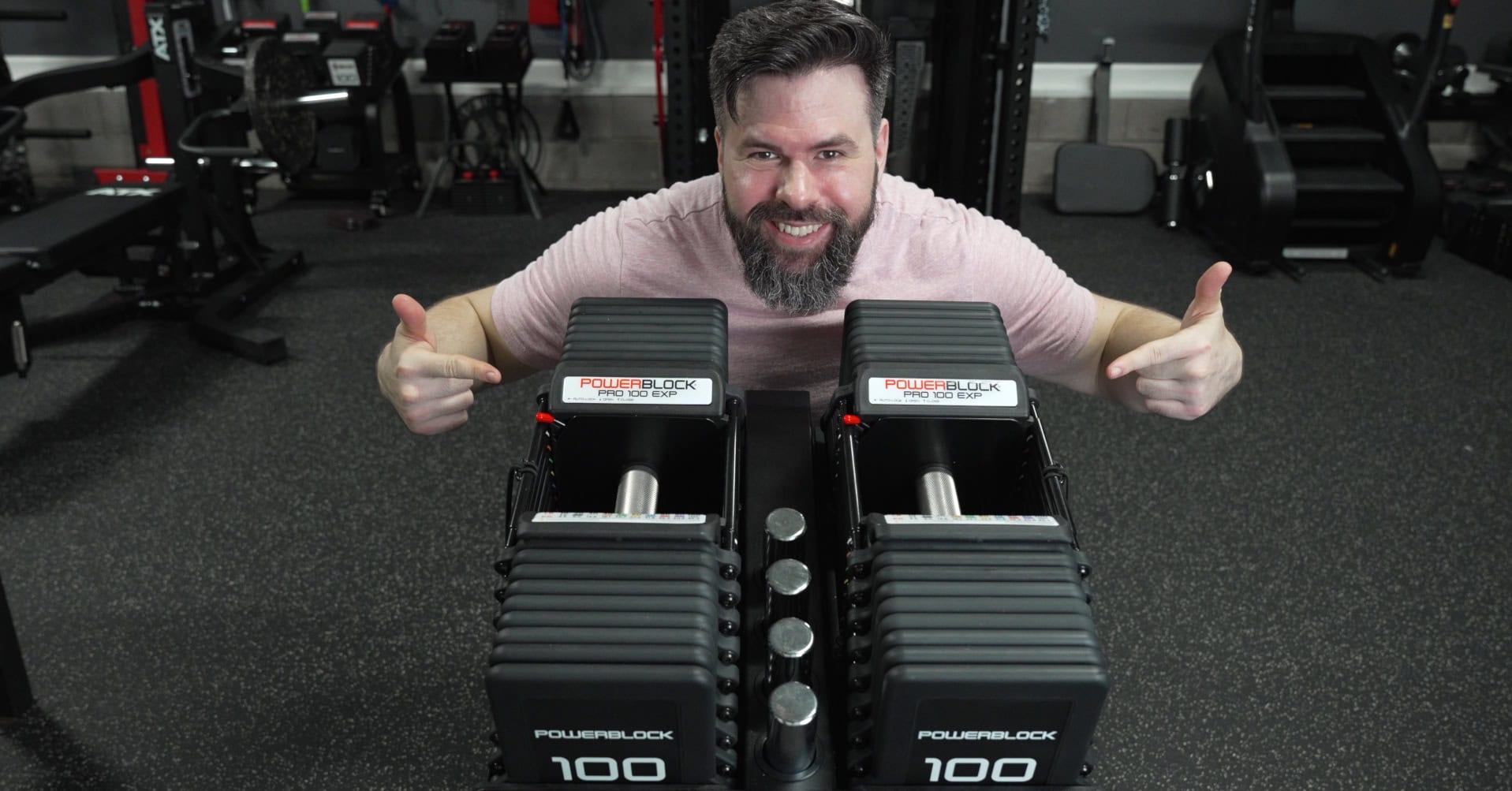
The PowerBlock Pro 100 EXP is the model I recommend to most serious lifters. I’ve tested every current PowerBlock set side by side in my own gym, and this is the one that fits the widest range of committed home gym owners.
It’s the heaviest residential set that PowerBlock makes, it expands in four stages where other models use three, and it’s the only PowerBlock that lets you choose between knurled steel or rubber grips.
This PowerBlock Pro 100 EXP review covers which stage to start with, how it performs in training, how the balance feels, the trade-offs of its length, what a complete setup costs, and whether the Commercial Pro 100 is worth upgrading to.
| Model | Pros & Cons | Rating |
|---|---|---|
PowerBlock Pro 100 EXP | Pros:
| Rated 4.6 out of 5 |
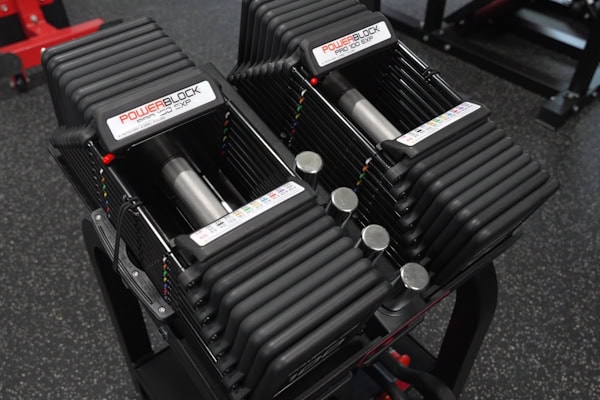


Table of Contents
Why It’s My Pick for Most Lifters
Three things put the Pro 100 EXP ahead of the rest of the residential lineup:
It goes to 100 lbs per hand. The Elite models stop at 90. Once you’ve been training for a while, that last 10 lbs can make a difference on rows, presses, and shrugs.
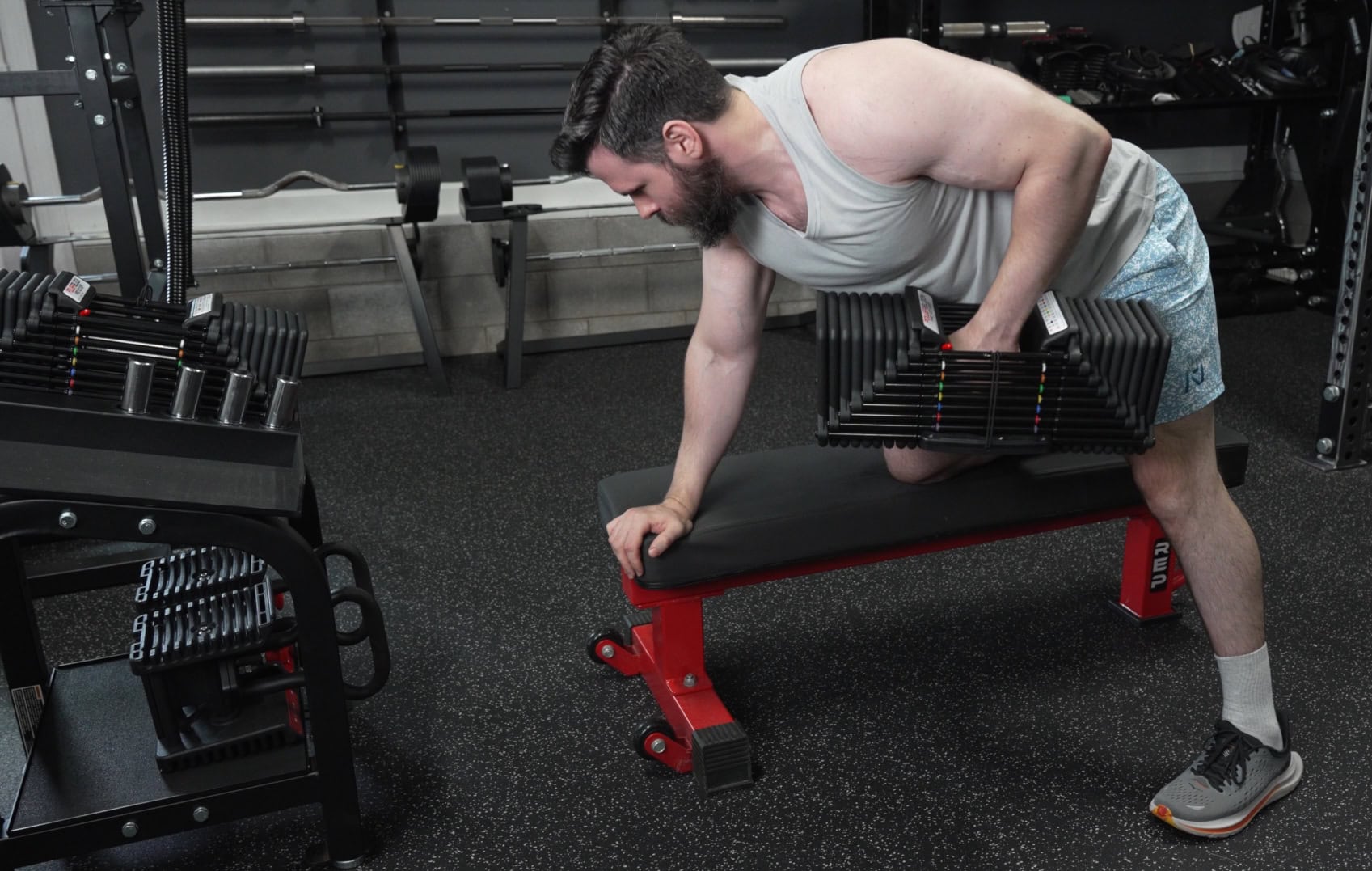
The build is a step up from steel. While some people prefer the rigidity and ruggedness of the all-steel plate models, the urethane-coated plates on the Pro 100 EXP make racking quieter and are more comfortable to rest on your thighs. And the colored ring indicators sit on both sides of the blocks so you can read your weight from either direction; something you can’t do with the Elites.
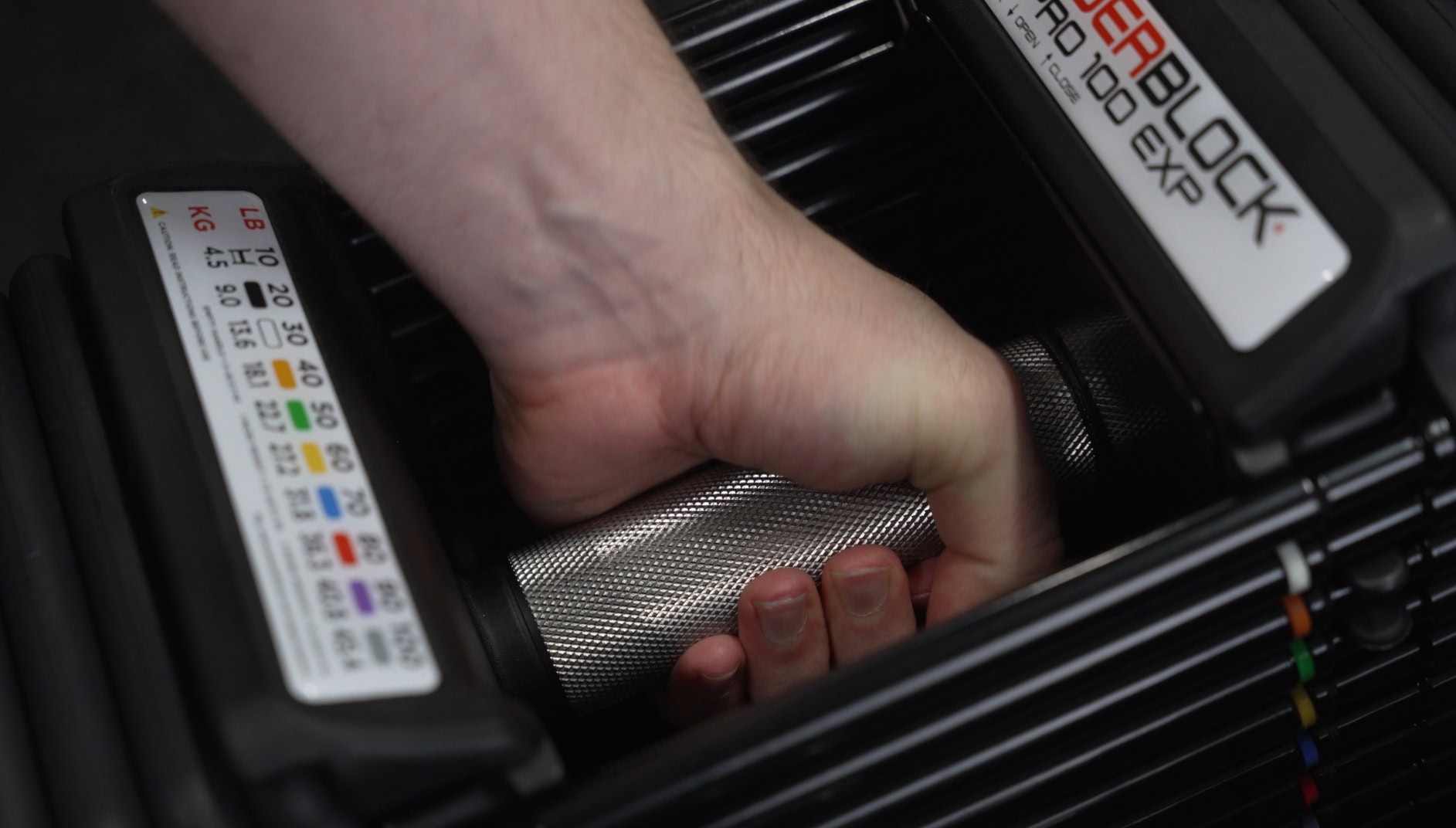
The grip is the best in the residential line. At 38 mm, it’s thicker than anything else PowerBlock sells for home use. While it is on the larger side, I prefer to thinner-diameter grips. You can order the grips in knurled stainless steel at no extra charge at checkout, or get the basic TPR grip if you prefer.
There’s a better PowerBlock above the Pro 100 EXP, and that’s the Commercial Pro 100, which is my personal favorite. But the step up to the commercial version costs more than most people will want to pay for what it adds. I break that comparison down later on in this review.
PowerBlock Pro 100 EXP Specs
| Spec | Detail |
|---|---|
| Weight range | 5 to 100 lbs per hand |
| Increments | 2.5 lbs (skips one step roughly every 10 lbs) |
| Stages | 40 lb base plus three expansion kits: 60, 80, 100 lbs |
| Adjustment | Selector pin plus micro-weights with auto-lock |
| Grip | 38 mm knurled stainless steel, or contoured TPR |
| Handle | Wedge-shaped, open |
| Plates | Urethane-coated steel, flex frame |
| Weight indicators | Colored rings, both sides |
| Rail hardware | Black zinc plated |
| Dimensions (L×W×H) | 19.21″ × 7.63″ × 7.72″ at 100 lbs |
| Stand | Sold separately |
| Warranty | 5 years residential |
| Price | $539 base, $1,196 maxed, $219 per expansion kit |
Four Stages: Where to Start
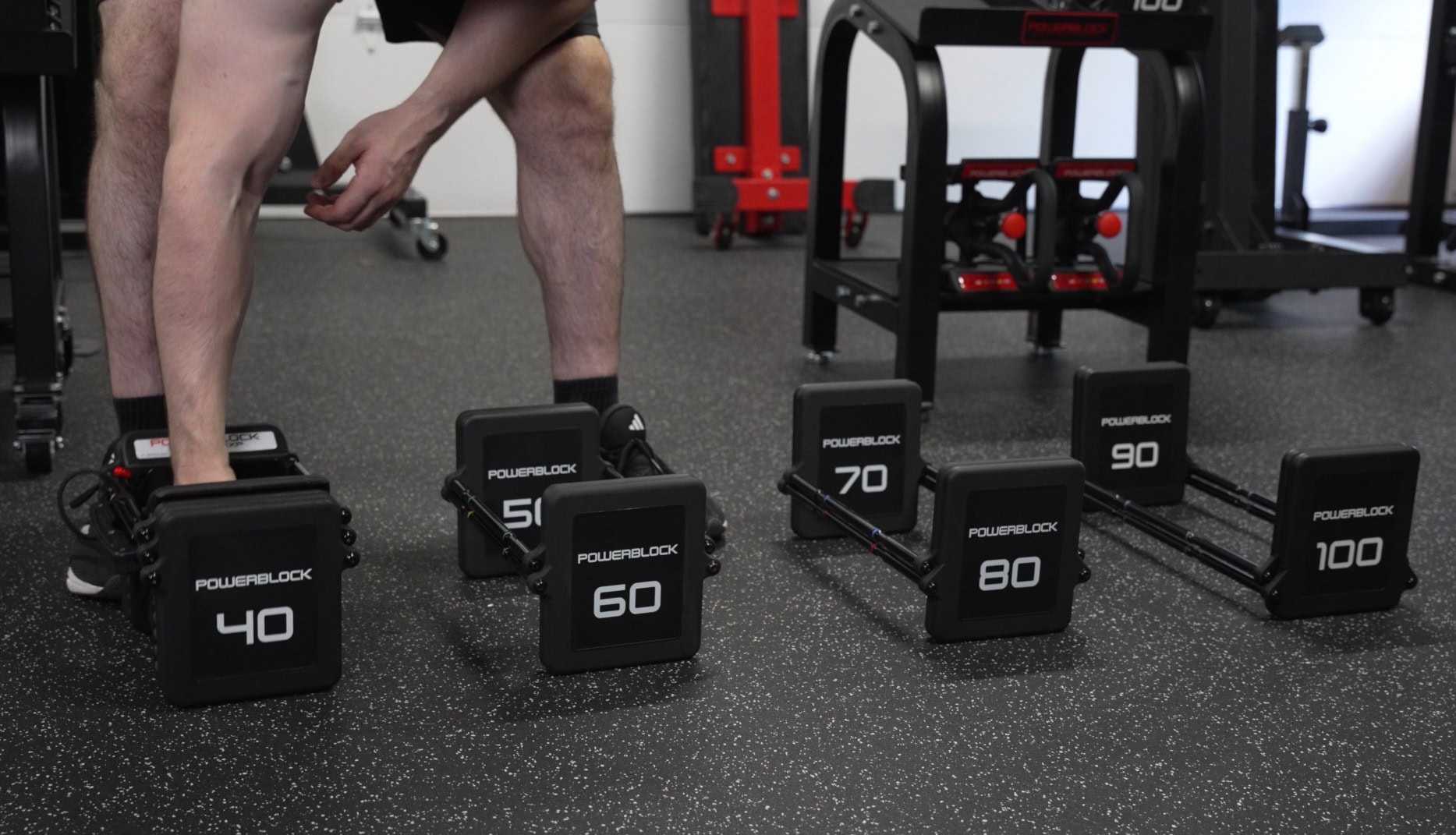
The PowerBlock Pro 100 EXP has four stages where every other expandable residential PowerBlock has three. That gives you a lower buy-in and a higher weight ceiling than the rest of the residential lineup.
| Stage | Max per hand | Total price |
|---|---|---|
| Base set | 40 lbs | $539 |
| Stage 2 | 60 lbs | $758 |
| Stage 3 | 80 lbs | $977 |
| Stage 4 | 100 lbs | $1,196 |
Each expansion kit costs $219 and adds one stage, and the price totals come out identical either way. If you buy the 40 lb base and add all three kits over time, you’ll have spent $1,196. That’s the exact same as buying the 100 lb set from the start.
Which Stage to Buy
My rule is the same one I use for every expandable PowerBlock. If you can afford it and you know you’ll use the weight, buy it maxed and never think about it again. Only stage it out over time if money is tight or you’re not sure you’ll need the top end weight.
If you do buy it in stages, start with at least 10 lbs of headroom above your heaviest current dumbbell lift, which for most people is a row or a press:
| Your heaviest dumbbell lift today | Start with |
|---|---|
| Under 30 lbs | 40 lb base ($539) |
| 30 to 50 lbs | 60 lbs ($758) |
| 50 to 70 lbs | 80 lbs ($977) |
| Over 70 lbs, or progressing quickly | 100 lbs ($1,196) |
When you do expand, buy the kit made for the Pro 100 EXP. PowerBlock’s expansion kits don’t cross over between model families, and that brings up a potential mix-up with this set when it comes to expansion kits that I’ll address next.
Don’t Confuse It With the Pro EXP
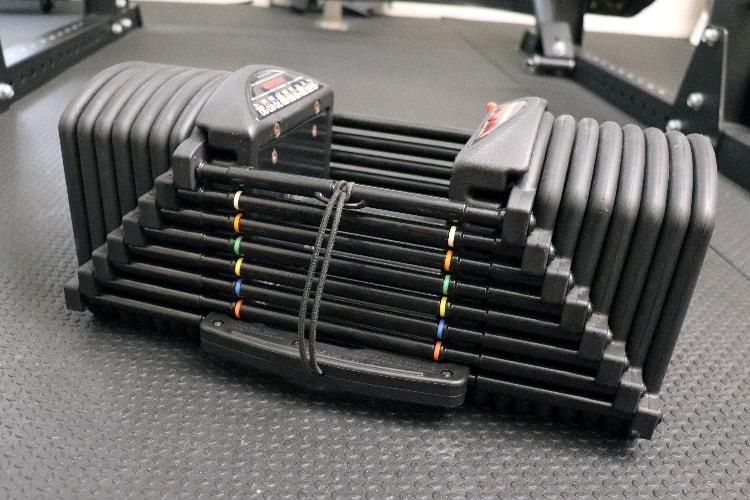
PowerBlock’s naming can trip people up, and this model has a near-twin name.
The Pro EXP is a discontinued residential set that went to 90 lbs. It belongs to PowerBlock’s Pro Series, alongside the current Pro 50 and Commercial Pro 50. I’ve owned one for many years, and my Pro EXP review covers it in detail.
The Pro 100 EXP is the current model reviewed on this page, and it’s part of its own Pro 100 Series, which also includes the Commercial Pro 100.
The names are one number apart, but the parts aren’t interchangeable. Pro EXP expansion kits and Pro Series attachments won’t work on a Pro 100 EXP, and the reverse is also true. If you’re shopping used or buying add-ons for a set you already own, double-check which model you have before you order.
How the Adjustment Works
Changing the weight takes a few seconds. You slide the magnetic nylon selector pin into the rail at the weight you want, lift the handle out, and the rest of the plates stay behind.
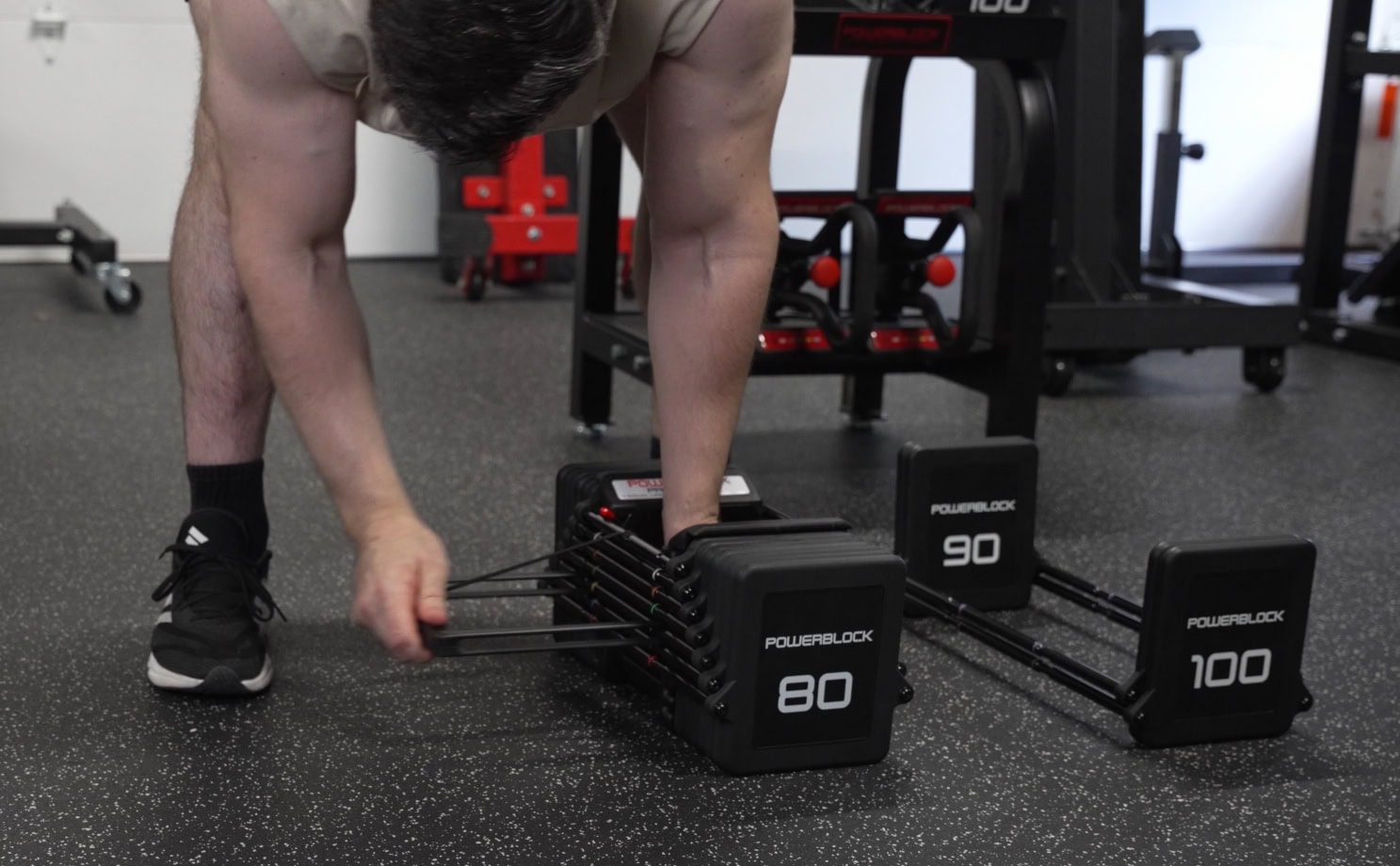
Like every PowerBlock, the PowerBlock Pro 100 EXP is self-contained, so you can adjust it on the floor, on a bench, or wherever you can find a flat surface. Handle-twist and dial-based adjustable dumbbells need to sit in their cradle before you can change anything. That makes the Pro 100 EXP easier to use for drop sets and for training away from wherever your stand sits.
Micro-Weights and Auto-Lock
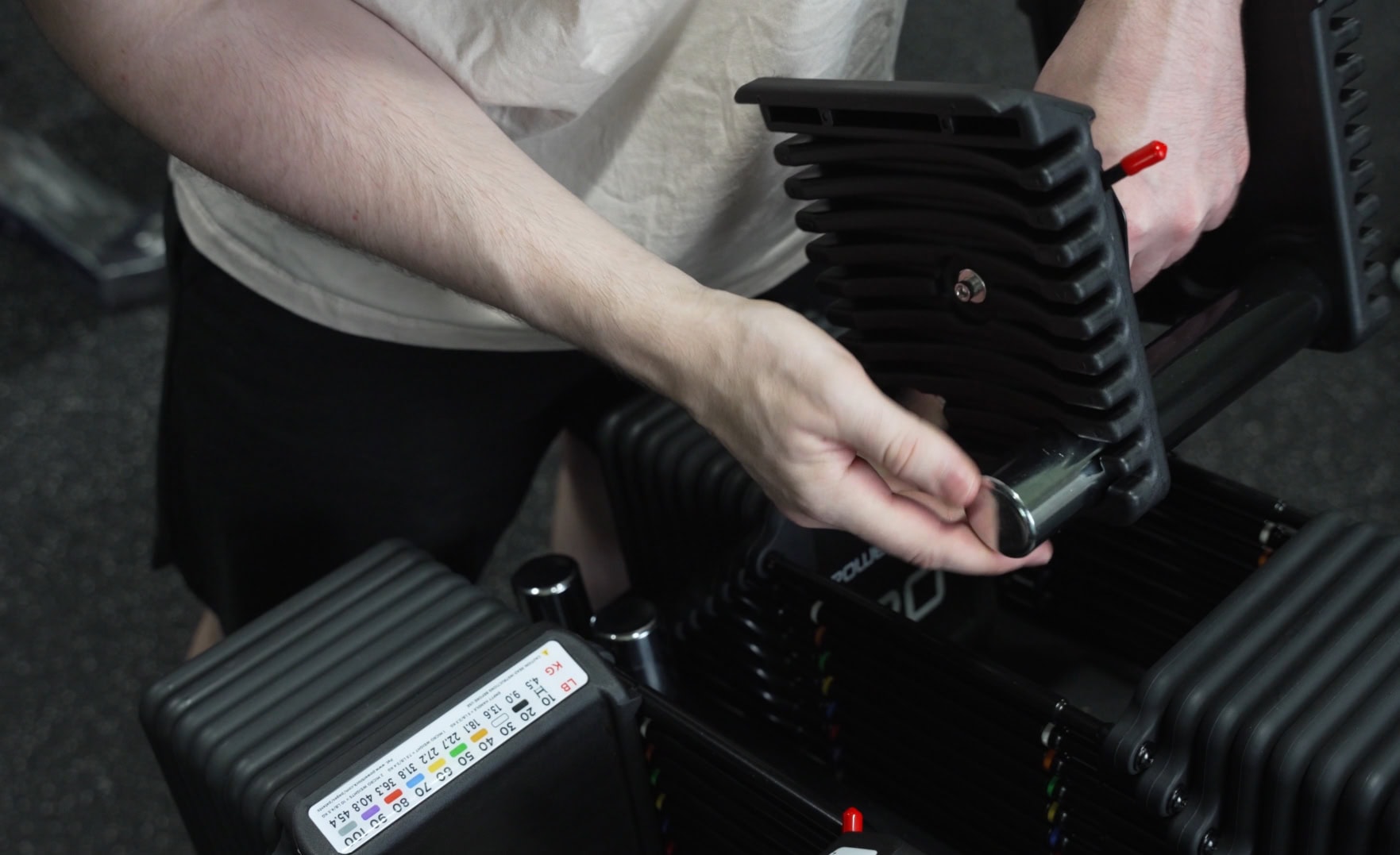
The main plates give you 10 lb increments. To hit the weights between them, you drop 2.5 lb steel cylinders called micro-weights into the slots in the bottom of the handle.
The PowerBlock Pro 100 EXP has an “auto-lock” lever on that slot, which the Elite USA doesn’t. You push the lever to open the slot and load the cylinders. But when you drop the handle back into the blocks, the top rail pushes the lever closed for you. The one exception is lifting the handle with micro-weights and no blocks selected. With no block rail to push the lever, you lock it by hand.
The Skipped Increments
Like every expandable micro-weight set, the PowerBlock Pro 100 EXP skips a 2.5 lb step roughly every 10 lbs. You can’t select 7.5, 12.5, 22.5, 32.5, 42.5, 52.5, 62.5, 72.5, 82.5, or 92.5 lbs.
In practice, that means an occasional 5 lb jump where you wanted 2.5. For most lifters, it rarely comes up. If you want every weight available, the non-expandable Pro 50 is the only PowerBlock with no skipped steps, but it maxes out at just 50 lbs.
Knurled or TPR: The Grip Choice
No other PowerBlock dumbbell model lets you choose the grip material when you order. But on the PowerBlock Pro 100 EXP, you can pick between knurled stainless steel and contoured TPR rubber.
Knurled stainless steel is what I chose, and it’s what I’d recommend to most people. It has a medium-intensity volcano knurl, the same pattern PowerBlock uses on the Elite USA and the knurled commercial sets. It let’s you more securely grip the dumbbells at 100 lbs without tearing up your hands on higher-rep sets, and at 38 mm it fills the hand in a way the 32 mm Elite grip doesn’t. Though, I will say the grip diameter is more of a personal preference.
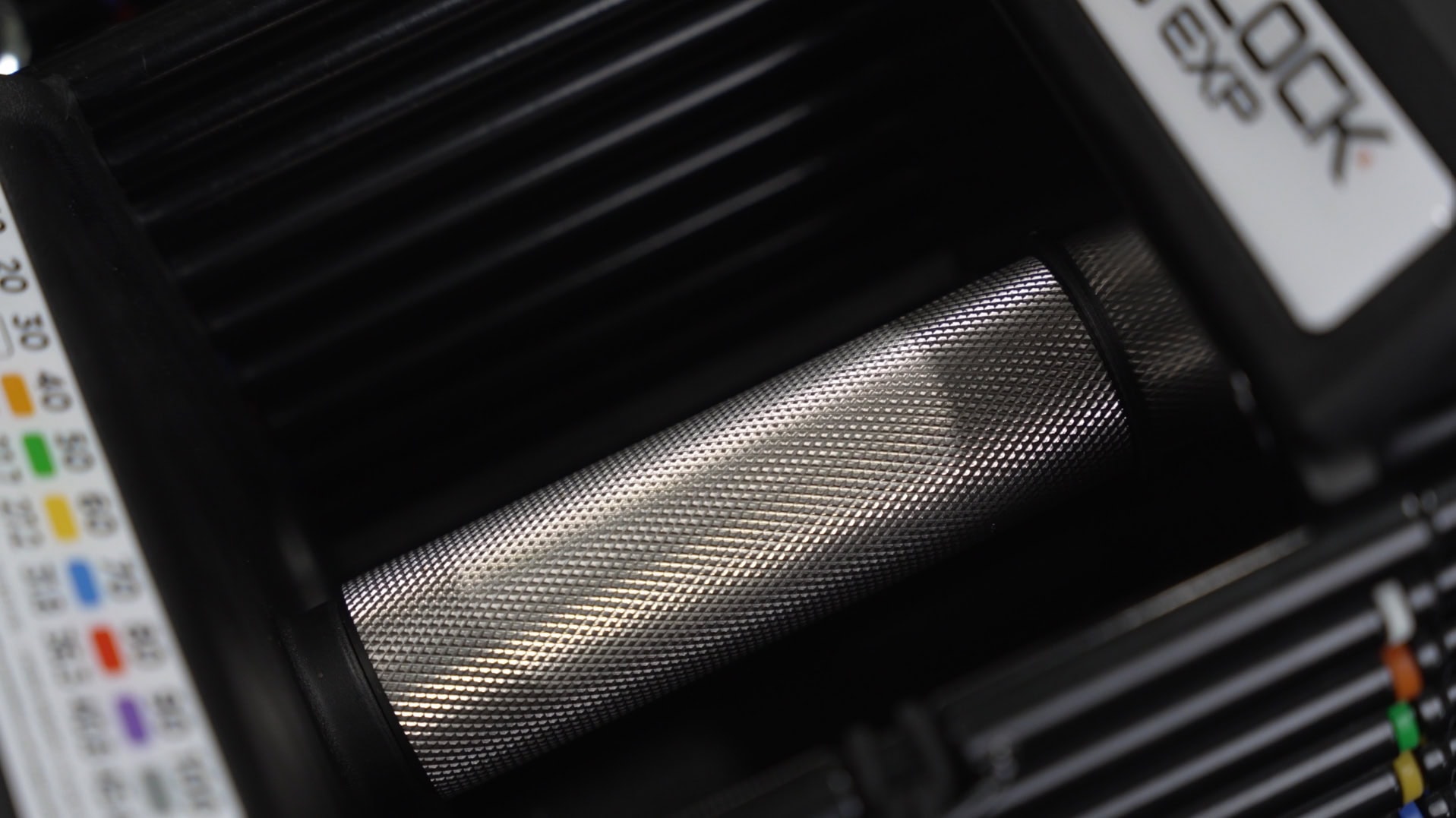
Contoured TPR is the rubber option. It’s softer and doesn’t feel cold in an unheated garage the way bare steel does, though that’s reaching to call that a benefit. Still, if you prefer a rubber grip, it’s nice to have the option.
If you order TPR and change your mind, PowerBlock sells knurled grips for the Pro 100 EXP separately for about $109 a pair. You can pretty easily swap them in with an Allen key in a couple of minutes.
PRO TIP: If you do prefer a thinner grip diameter, PowerBlock also makes a 32 mm knurled grip you can buy separately for the Pro 100 EXP. They don’t advertise this fact prominently, so it’s easy to miss. In fact, I didn’t know about it until just recently, so I wanted to share that info here.
My knurled handles review covers all things PowerBlock grips-related in detail.
Build Quality
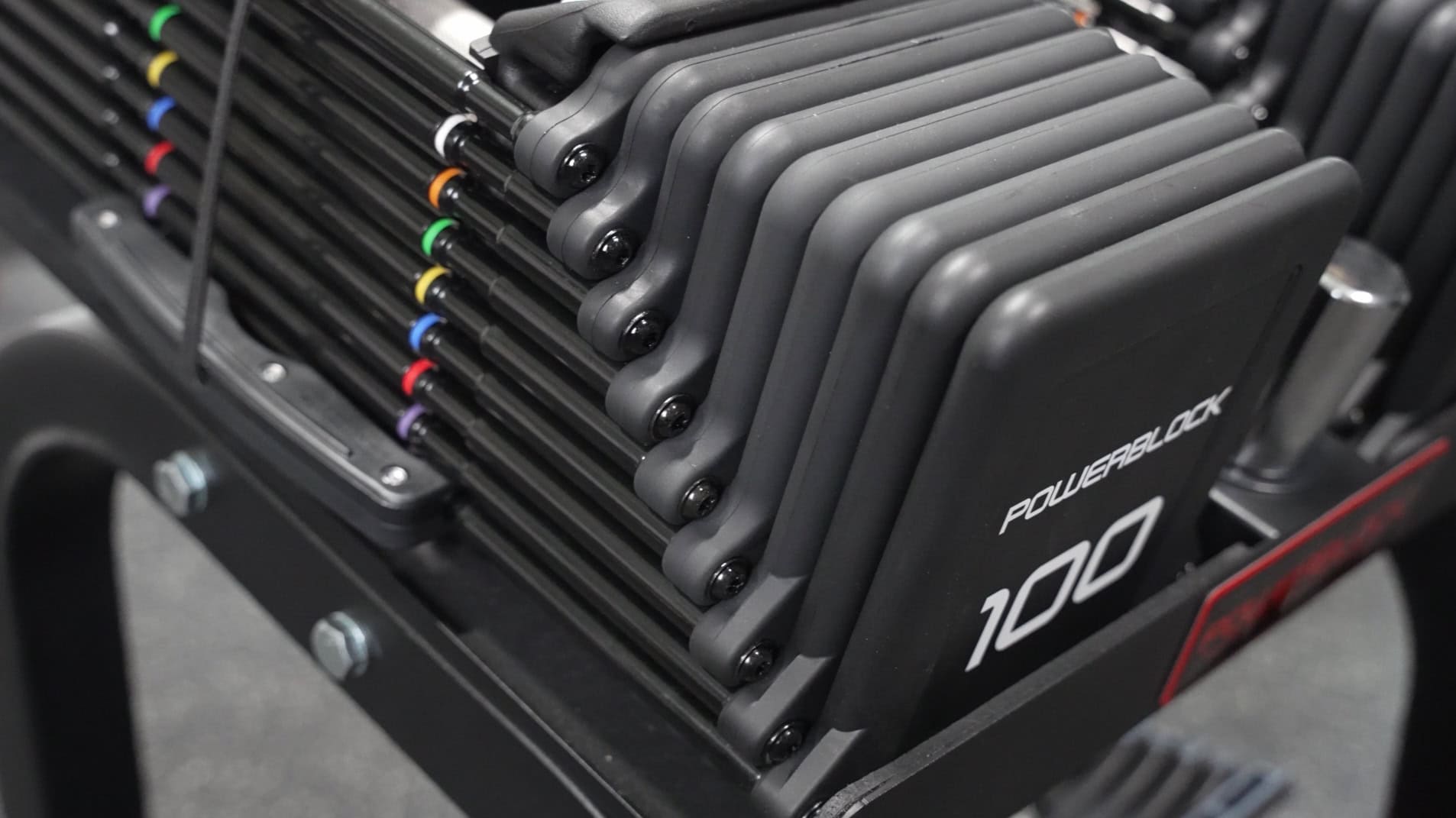
The plates are urethane-coated steel on PowerBlock’s flex frame, where the rails pass through urethane tabs so each end of the block flexes slightly and absorbs impact.
The coating keeps racking quiet and makes the dumbbells comfortable to rest on your thighs between sets. It also looks more finished and premium than the powder-coated steel plates on the Elite models.
The weight indicators are colored rings embedded in the rails. They appear on both sides of the blocks, so you can grab the dumbbell from either direction and still see your weight. The strip indicators on the Elite models and Sport 24 only appear on one side and can slide out of position over time.
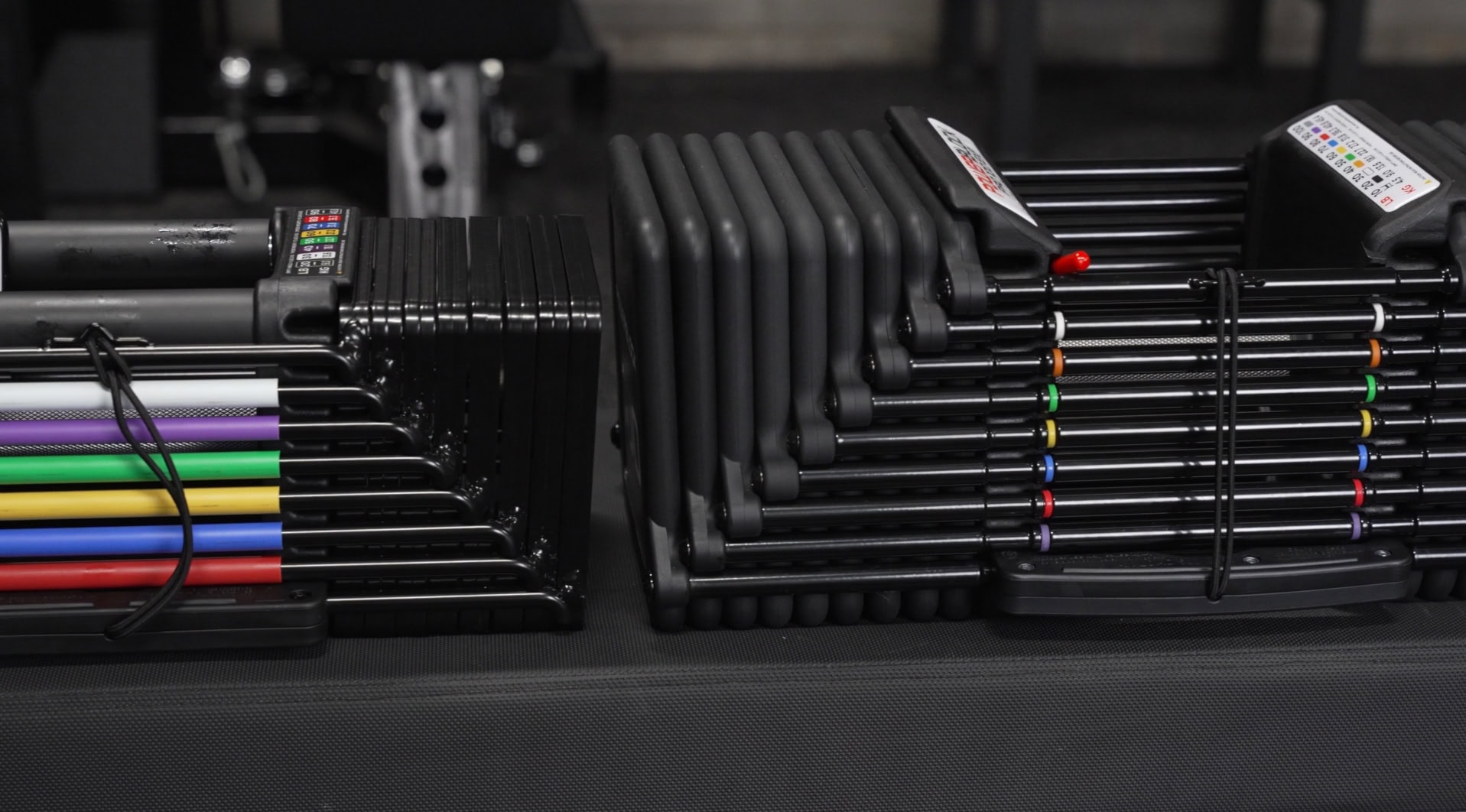
One small detail where the residential version differs from the commercial version is the hardware joining the rails to the urethane. It’s black zinc plated here and stainless steel on the Commercial Pro 100. You won’t notice it right away, but stainless steel will resist rust better over years in a humid garage.
Handle, Balance, and Length
Handle
The PowerBlock Pro 100 EXP uses a wedge-shaped open handle design. Your hand and forearm have room to move side to side, and I’ve found that the wedge gives you a natural place to brace your wrist on lateral raises, bent-over lateral raises, and sometimes one-arm rows.
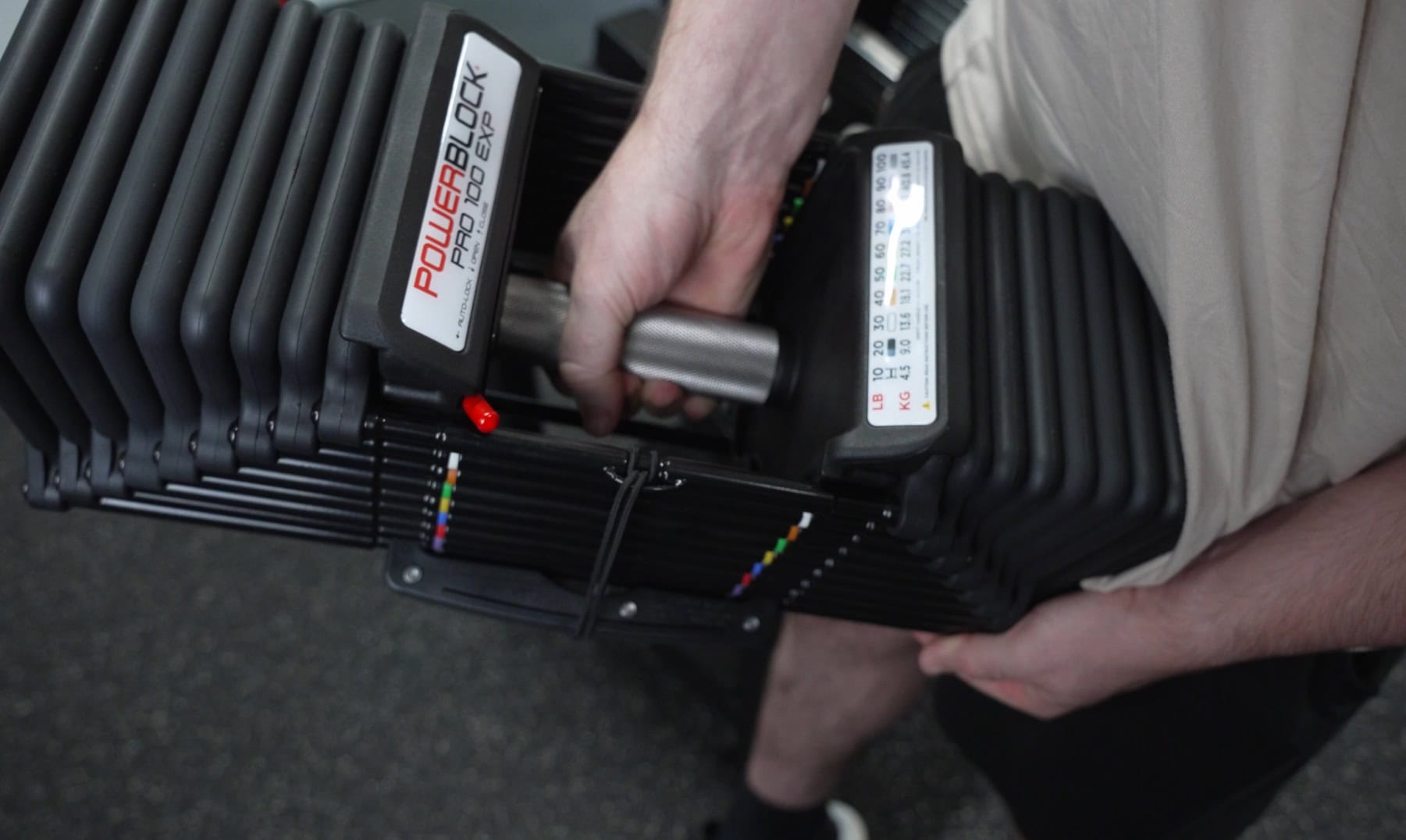
I prefer it to the closed handle on the Elite models. The Elite’s padded wrist supports do add some stability and leverage on curls and lateral raises, but lifters with bigger hands often find them cramped. The open wedge doesn’t have that problem, and it’s easier to wear a watch with the extra room as well.
Balance
For this PowerBlock Pro 100 EXP review, I paid close attention to how it balances next to the Elites, because I expected the extra length to hurt it. Surprisingly, it doesn’t. In fact, I found the Pro 100 EXP to be ever so slightly better balanced than the much more compact Elite models.
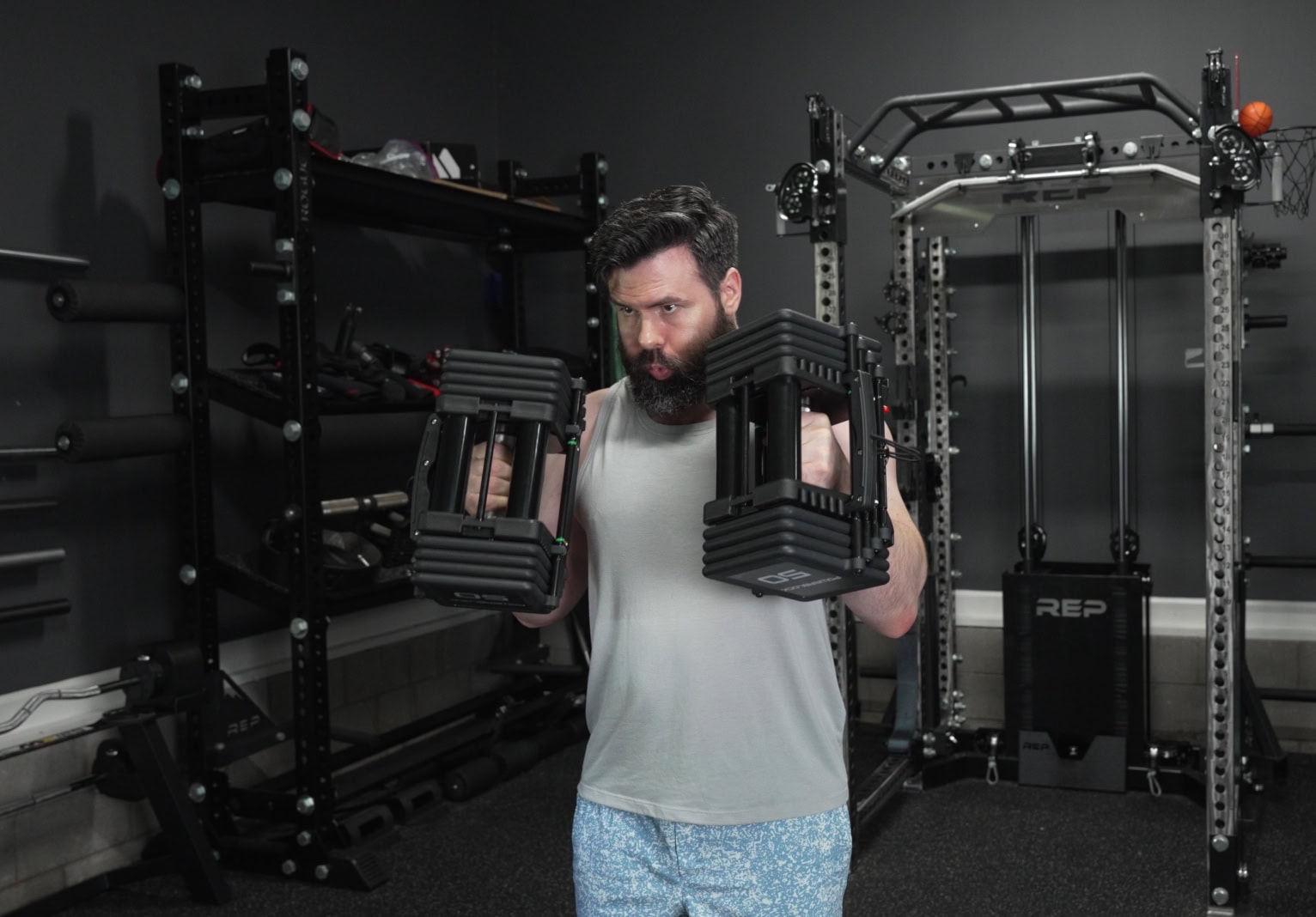
That said, no PowerBlock dumbbell feels exactly like a fixed one, since some of the weight sits out in the side rails.
The micro-weights add a second variable: they put a little extra mass in the handle, and the center of gravity shifts slightly, especially if you load just one in. You notice it most on movements where you rotate the dumbbell, like supinating curls. It’s a mild effect, not a dealbreaker for most people, but it is noticeable.
The Commercial Pro 100 skips micro-weights entirely, which is why the balance feels better, and one reason why it’s my personal favorite PowerBlock dumbbell model.
Length
At 100 lbs, the PowerBlock Pro 100 EXP measures 19.21 inches long. That’s the cost of the urethane coating.
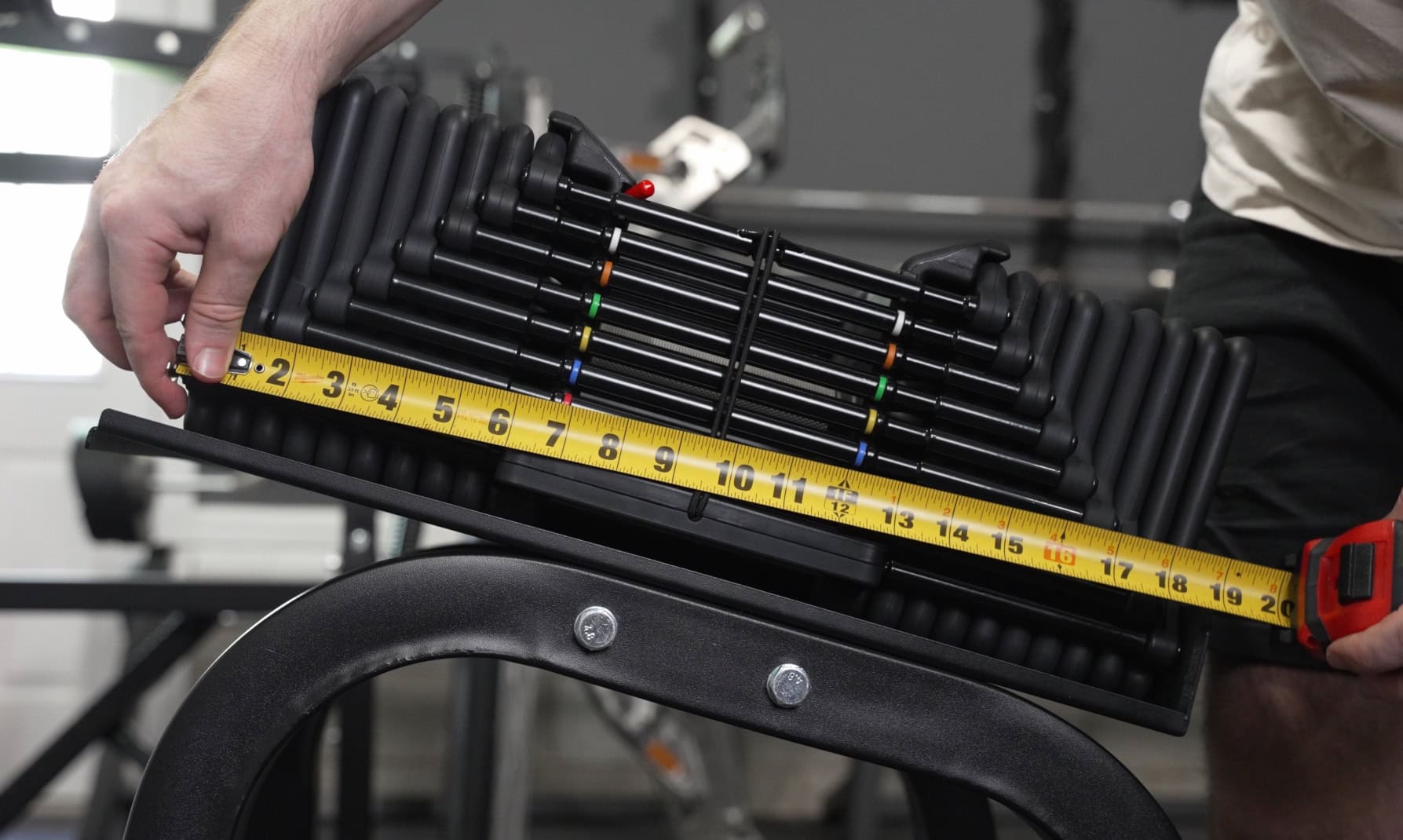
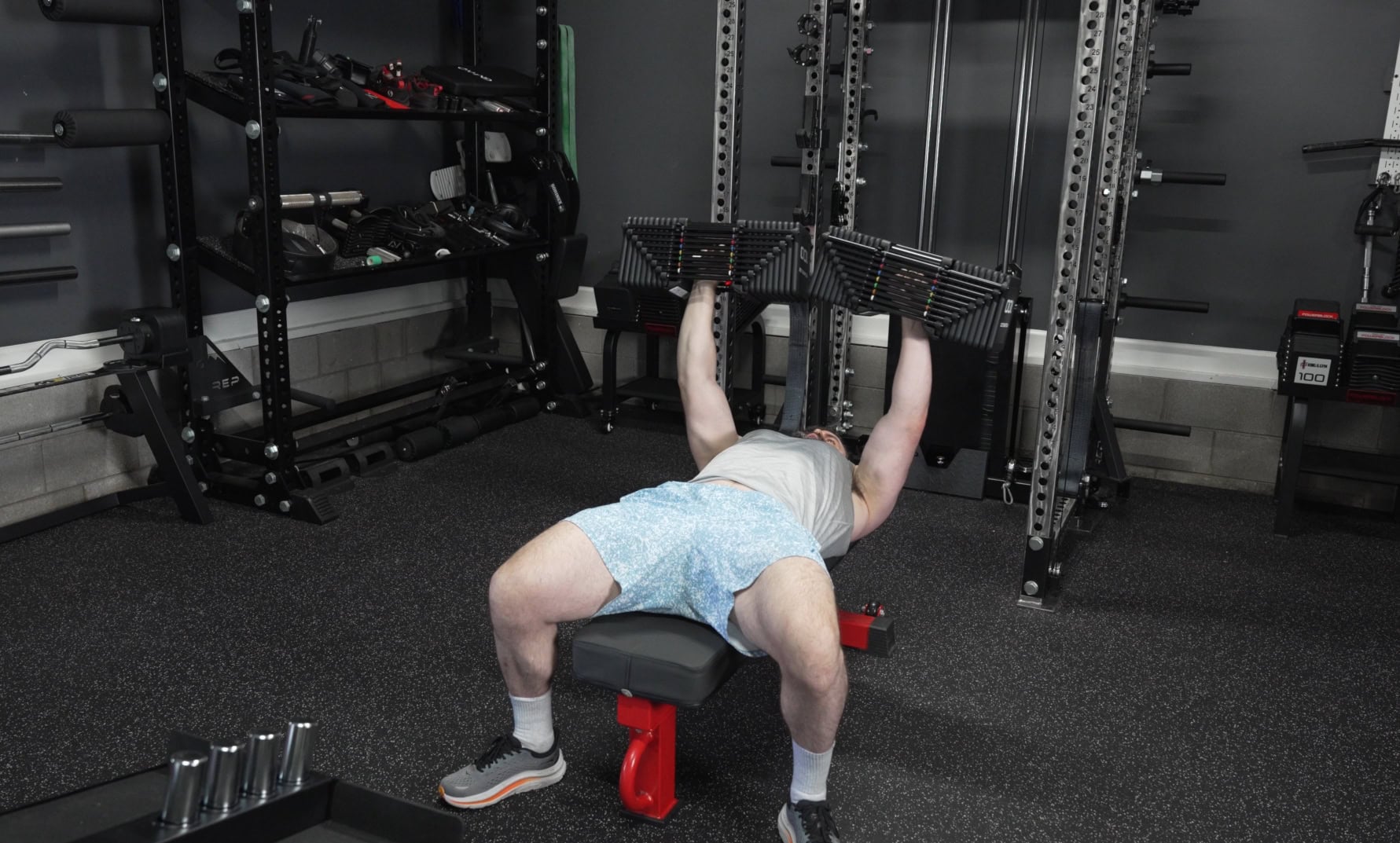
I’ve found the length only gets in the way when you bring the dumbbells together at the top of a heavy bench press. You can still lock out fully; you just can’t close the gap as much as you might want. Angling the dumbbells in slightly, which is a more natural pressing position anyway, takes care of most of it. Outside of that, the length hasn’t bothered me.
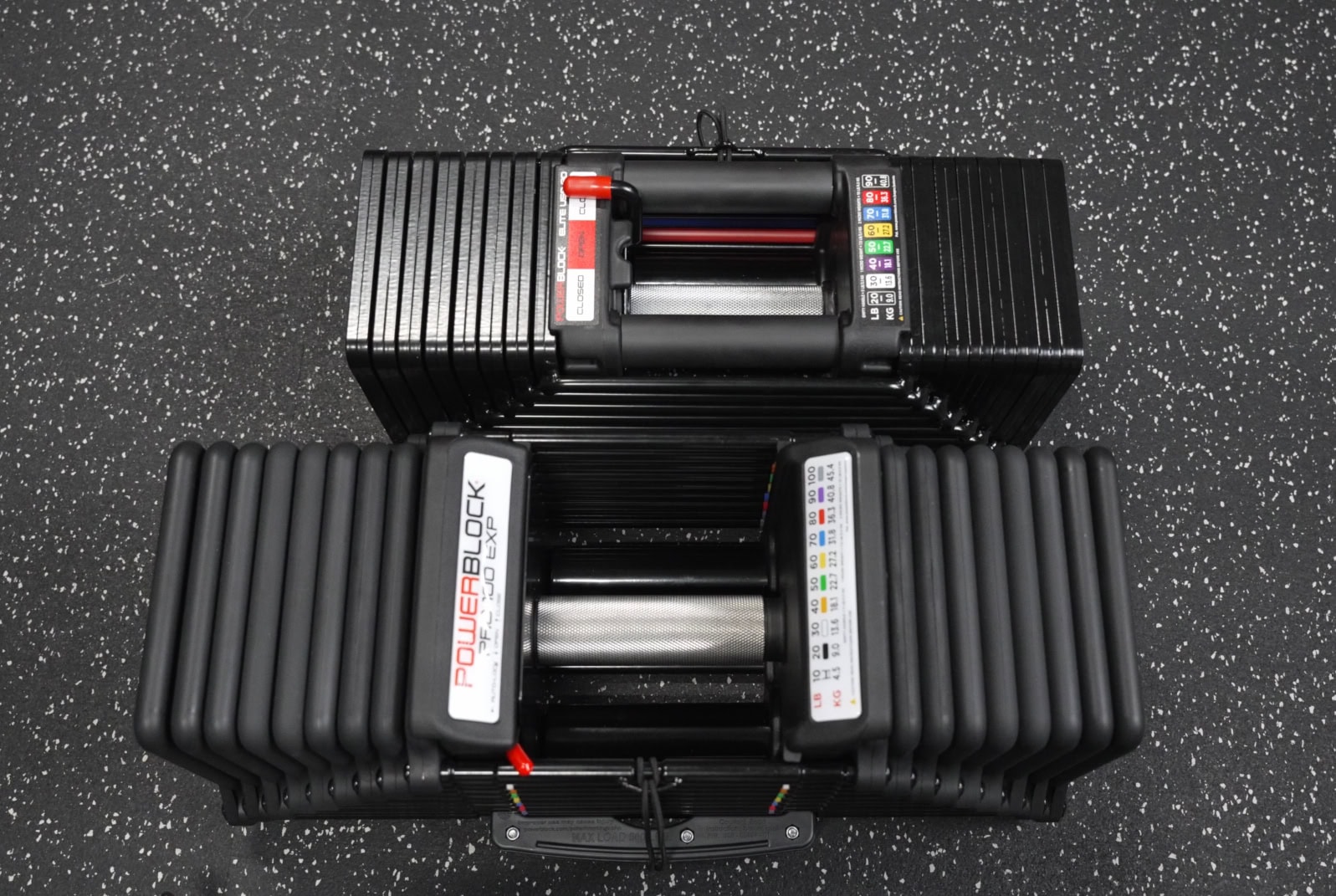
If a compact footprint is your top priority, the Elite USA 90 is 16 inches long at 90 lbs. Almost all of that 3.21 inch difference comes from the Elite’s steel-only plates.
Attachments

The PowerBlock Pro 100 EXP works with the full Pro 100 attachment family. That’s an advantage over the Pro 32 and the Commercial Pro 125/175, both of which have no attachments at all.
| Attachment | Price | Notes |
|---|---|---|
| Kettlebell handle | $149 each | Rotates 90 degrees |
| Straight bar | $199 | 33 inches, loads to about 215 lbs |
| EZ curl bar | $199 | 33 inches, loads to about 215 lbs |
The kettlebell handle is the one I’d buy first, if you get any at all. A good adjustable kettlebell is useful, and most home gyms don’t have one. This handle rotates 90 degrees, so you can turn the blocks to clear your legs on swings. The older fixed Pro Series handle can’t do that, and once you load it heavy, the blocks start hitting your legs.
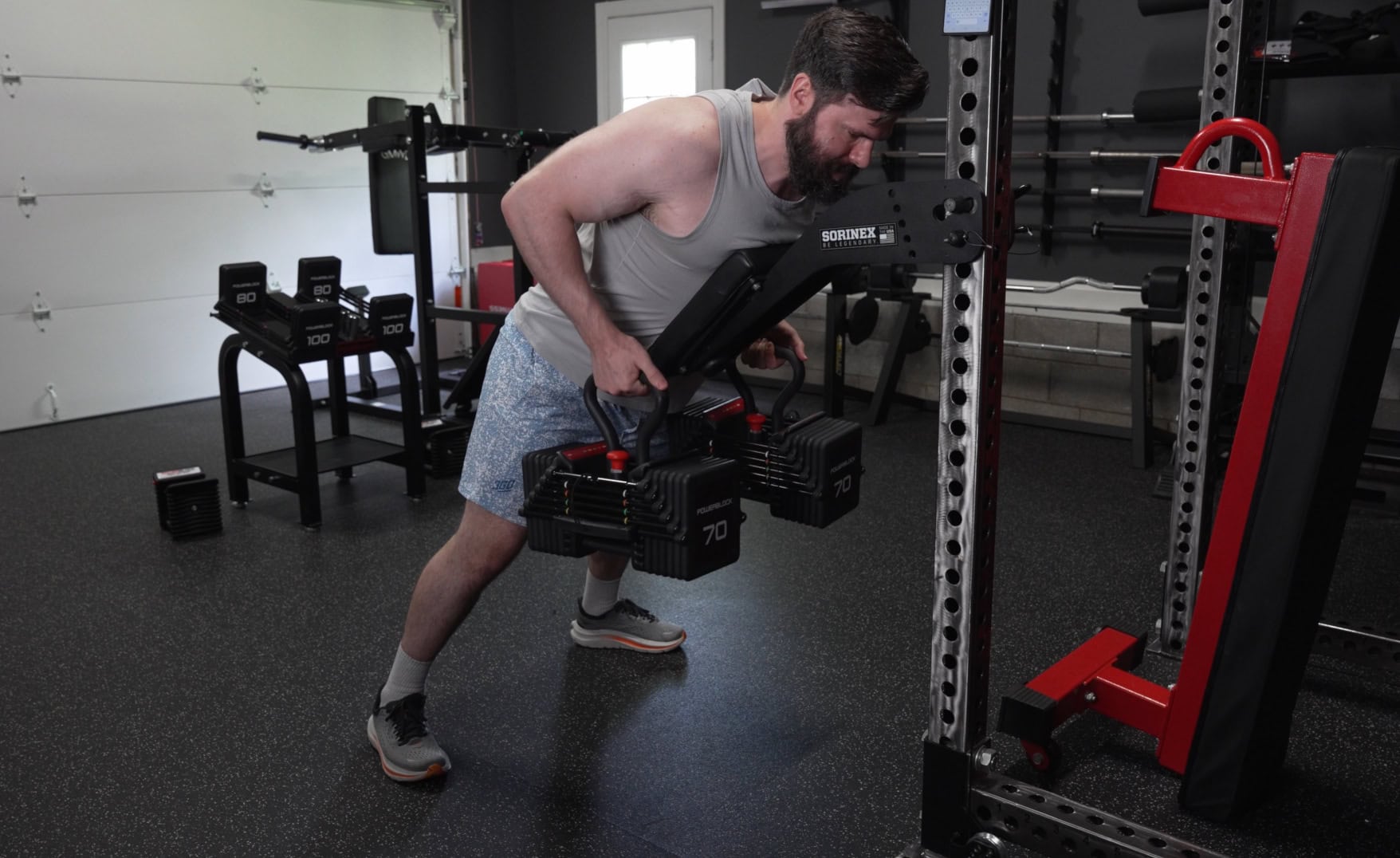
Just know that these kettlebell handles aren’t ideal for using overhead (i.e. in the rack postion; against your forearm) at heavier weights because the plate rails press against your forearm, which is uncomfortable. For everything else, though, they’re great.
The bars are more situational; I can’t broadly recommend them.
I own the older Pro Series versions, and they don’t feel like a real barbell. With large oblong plates hanging off each end, the balance is off quite a bit, and you can feel the bar trying to rotate on anything that isn’t a straight vertical path. I’d only buy them if you’re going all-in on PowerBlock and don’t have room for an Olympic bar and plates.
If you do get the bars, I strongly recommend considering the Barbell Stand as well. It holds the blocks at the right spacing and height, so you’re not bending down to the floor every time you change the weight. Changing them on the floor is a major hassle in my experience.
What a Complete Setup Costs
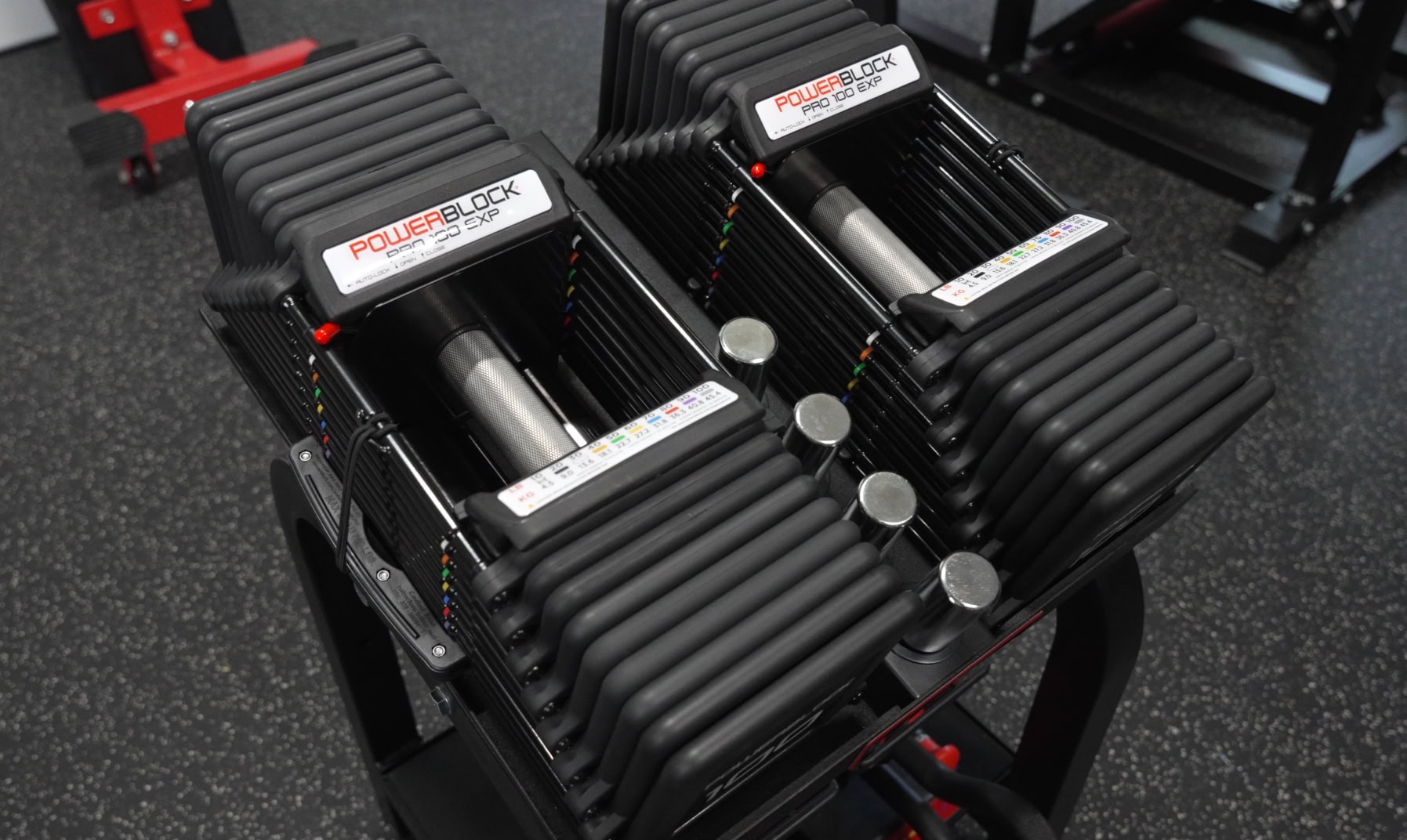
The PowerBlock Pro 100 EXP set doesn’t include a stand, and only two PowerBlock stands will accommodate it, since the stand needs both room for a pair of 19-inch dumbbells and storage ports for the micro-weights:
- Home Rack Stand ($279): my pick. It takes up less floor space while also having a lower shelf for accessories.
- PowerMax 2.0 ($199): the other option. Step-in design, which is nice, but it has a bigger footprint and no lower storage shelf. But it does save you $80, which will make it worth it for some.
The Column Stand and Large Compact Stand are both capped at 90 lbs, so neither of those will work.
Here’s what a full setup adds up to:
| Setup | Total |
|---|---|
| Pro 100 EXP maxed + PowerMax 2.0 | $1,395 |
| Pro 100 EXP maxed + Home Rack Stand | $1,475 |
| Add a pair of Pro 100 kettlebell handles | +$298 |
| Commercial Pro 100 with Pro Rack Stand (for comparison) | $1,649 |
That last row in the table above is where the comparison with the commercial version gets interesting, which I’ll get into next.
PowerBlock Pro 100 EXP vs Commercial Pro 100
No PowerBlock Pro 100 EXP review would be complete without comparing it to the Commercial Pro 100, because the two sets share nearly every part.
They use the same urethane flex-frame plates, the same 38 mm knurled grip, the same open wedge handle, the same 100 lb max weight, and the same 19.21″ × 7.63″ × 7.72″ dimensions. The handles are interchangeable, and the Pro 100 attachments fit both.
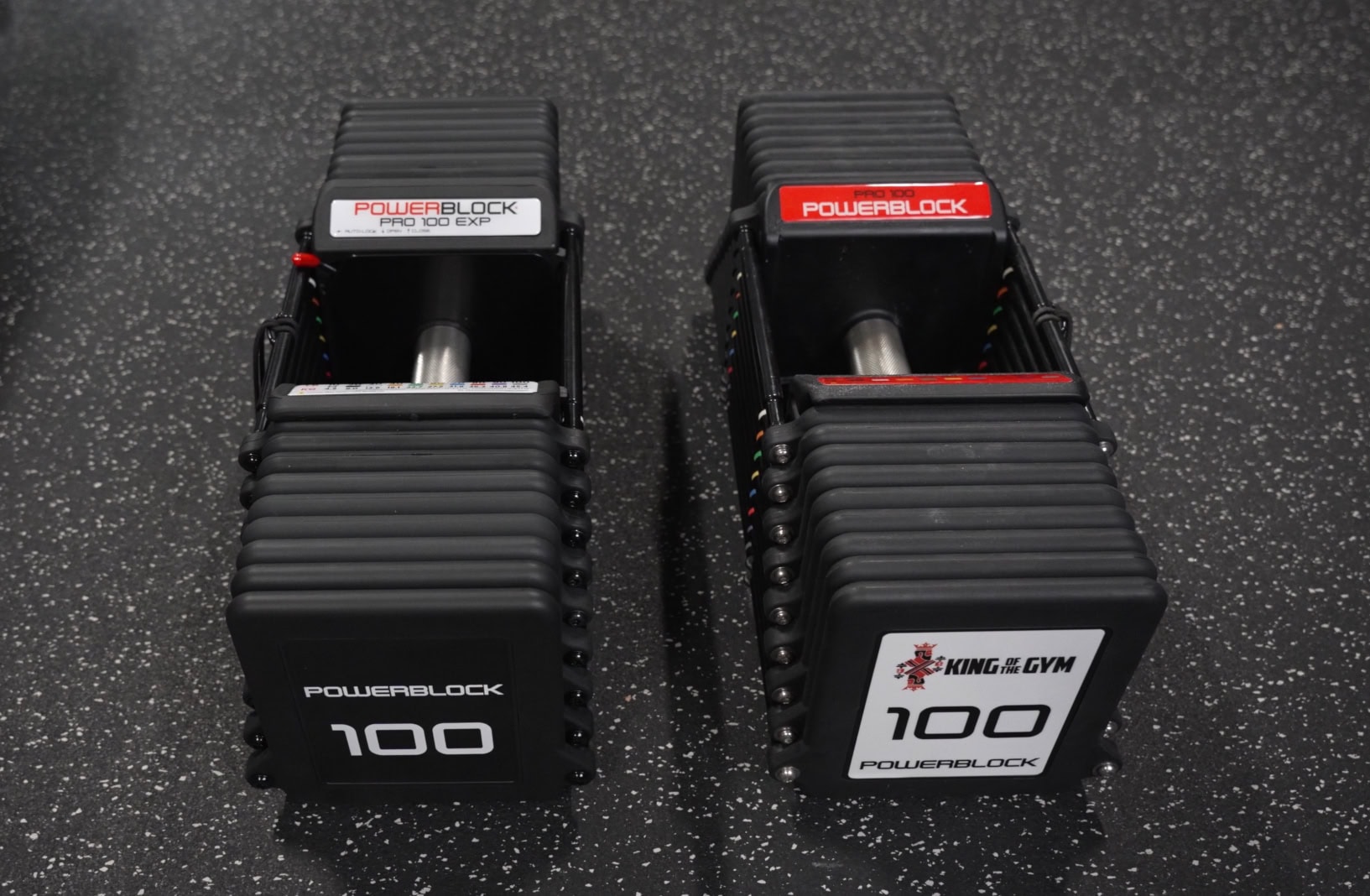
Three things separate them.
- Adjustment. The Commercial Pro 100 uses both a 5 lb and a 10 lb pair of handles instead of micro-weights. You move the pin for 10 lb increments and swap handles for 5 lb jumps. It’s faster and cleaner, and after using it, the micro-weights on my other sets feel tedious. The tradeoff is that you lose 2.5 lb increments.
- Balance. With no micro-weights in the handle, the Commercial Pro 100 is the best-balanced PowerBlock I’ve used.
- Hardware. Stainless steel instead of black zinc.
On price, the sticker gap of $453 overstates the difference, because the commercial set includes a stand. If you stand-match the Commercial Pro 100 against the Pro 100 EXP + Home Rack Stand setup (as shown in the table above), the price gap is about $175. Against the PowerMax 2.0 setup, it’s about $255.
Also, the price difference can be even greater if you were planning on building a DIY stand for the Pro 100 EXP (or finding something used or third-party).
So the question is whether faster adjustments, better balance, and stainless hardware are worth roughly $175 to $255 (or more) to you, given that you also give up 2.5 lb increments. For me, they are, which is why the Commercial Pro 100 is my favorite PowerBlock. For most people, though, I believe the Pro 100 EXP is the better use of the money.
My Commercial Pro 100 review covers that set in depth if you’re interested in learning more about it.
PowerBlock Pro 100 EXP vs Elite USA 90
The Elite USA 90 is the best value in the PowerBlock lineup at $867 fully maxed out, which is $329 less than the Pro 100 EXP.
Choosing the Elite means giving up 10 lbs of capacity, the urethane coating, the double-sided ring indicators, the thicker grip, the open handle, and auto-lock lever, since the Elite USA uses an older three-position manual lever.

In return, you get a dumbbell that’s 3.21 inches shorter, weight plates made in the USA (in Owatonna, Minnesota specifically), knurled grips as standard, and welded all-steel construction with no coating to wear over time.
Pick the Elite USA if 90 lbs covers you, space is tight, or you’d rather keep the $329. Pick the Pro 100 EXP if you want the extra weight and the more refined feel. My Pro vs Elite comparison goes further on this topic, and my in-depth PowerBlock Elite USA 90 review provides more details on that model.
PowerBlock Pro 100 EXP Pros and Cons
Here’s the short version of this PowerBlock Pro 100 EXP review.
Pros:
- Goes to 100 lbs per hand, the heaviest residential PowerBlock
- Only PowerBlock with a choice of knurled or TPR grips
- Thick 38 mm grip
- 2.5 lb increments with auto-lock micro-weights
- Slightly better balanced than the Elite models
- Quiet, comfortable urethane-coated plates
- Ring-style weight indicators on both sides of the plates
- Roomy wedge-shaped open handle
- Works with Pro 100 bars and the rotating kettlebell handle
Cons:
- Pretty long at 19.21 inches when maxed out
- Skips a 2.5 lb step roughly every 10 lbs
- Micro-weights are slower to change than swappable handles
- Not as well balanced as the Commercial Pro 100
- Most expensive residential model
Who Should Buy the PowerBlock Pro 100 EXP
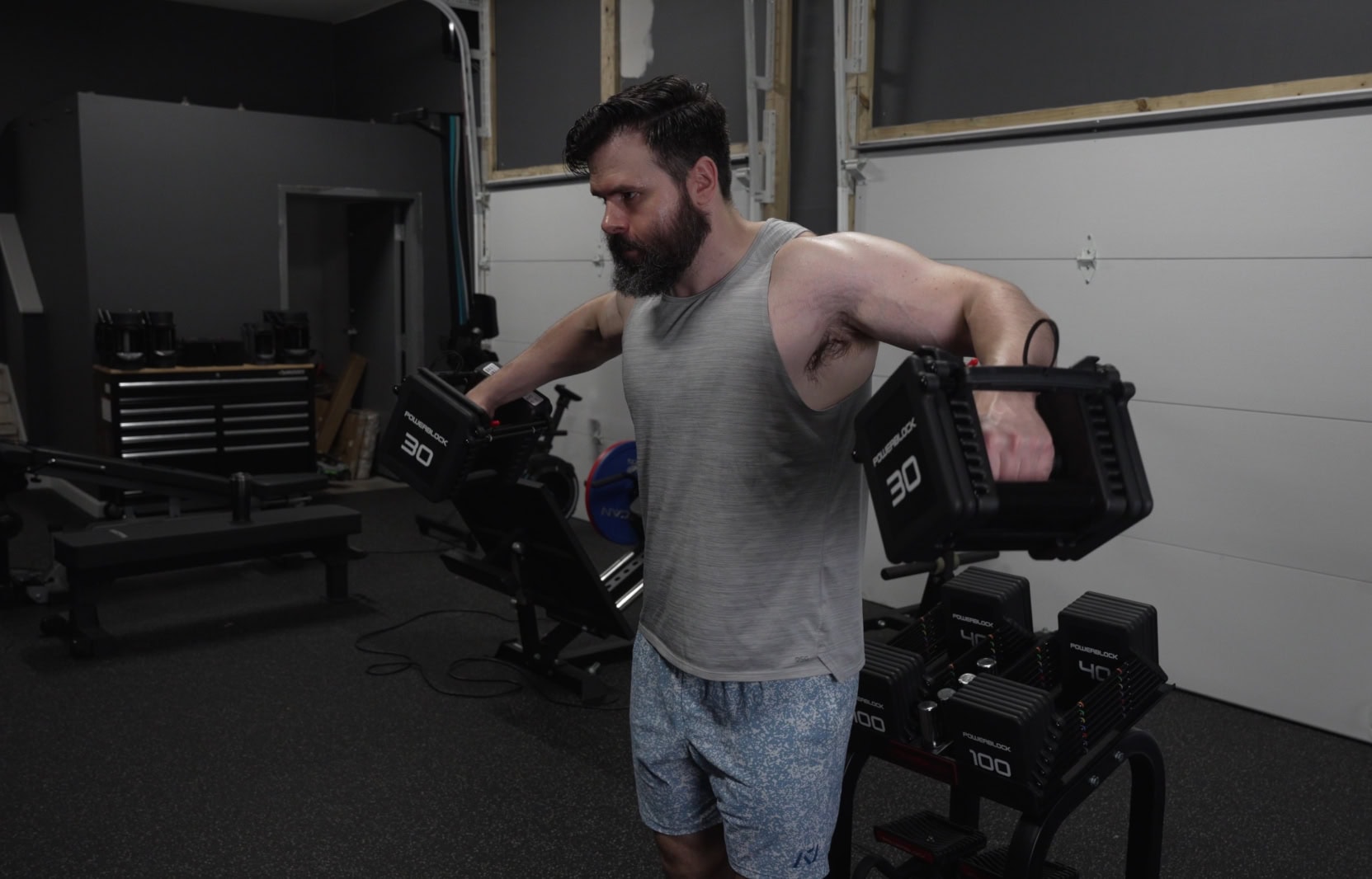
Buy the PowerBlock Pro 100 EXP if:
- You’re a serious lifter who will use weights above 90 lbs
- You want 2.5 lb increments for steady, precise progression
- You want a knurled 38 mm grip without paying the commercial premium
- You want access to bar and/or kettlebell attachments
- You’d rather start at a lower stage and expand as your budget allows
Look elsewhere if:
- 90 lbs is your ceiling, and you’d rather save $329, in which case get the Elite USA 90
- You want the fastest adjustments and best balance, in which case get the Commercial Pro 100
- You need more than 100 lbs per hand, in which case the Commercial Pro 125/175 is your only option
PowerBlock Pro 100 EXP FAQ
Is the PowerBlock Pro 100 EXP worth it?
For most serious lifters, yes. It’s the heaviest residential PowerBlock, it moves in 2.5 lb steps, and it costs about $175 to $255 less than a stand-matched Commercial Pro 100. If 90 lbs is enough for you, the Elite USA 90 saves $329.
Which stage of the Pro 100 EXP should I buy?
Buy it maxed if you can afford it and know you’ll use 100 lbs. Otherwise, pick the stage that leaves at least 10 lbs of headroom above your heaviest current dumbbell lift. The total cost is the same whether you buy maxed or expand later.
Can you expand the PowerBlock Pro 100 EXP later?
Yes. Each $219 kit adds one stage, taking it from 40 to 60, 80, and 100 lbs. Buy kits made for the Pro 100 EXP specifically, since kits don’t cross over between PowerBlock model families.
Is the Pro 100 EXP the same as the Pro EXP?
No. The Pro EXP is a discontinued Pro Series set that went to 90 lbs. The Pro 100 EXP is the current Pro 100 Series model. Their expansion kits and attachments aren’t interchangeable.
Does the PowerBlock Pro 100 EXP come with a stand?
No, it’s sold separately, and only two PowerBlock stands fit it: the Home Rack Stand at $279 and the PowerMax 2.0 at $199. Both have storage ports for the micro-weights.
Should I get the knurled or TPR grip?
I recommend knurled for most people. It holds better under heavy loads. TPR is softer, which some may prefer. If you pick TPR and change your mind, knurled replacement grips cost about $109 a pair.
How long is the PowerBlock Pro 100 EXP?
19.21 inches at 100 lbs, with a full footprint of 19.21″ × 7.63″ × 7.72″ per dumbbell. The only place I’ve felt the length being a negative is that you can’t bring the dumbbells as close together at the top of a heavy bench press, but the exercise is still very much doable.
What’s the difference between the Pro 100 EXP and the Commercial Pro 100?
They share the same plates, grip, handle design, dimensions, and 100 lb max weight. The commercial version uses swappable handles instead of using micro-weights. This makes adjustment faster, and the dumbbells feel better balanced, but the increments are 5 lbs instead of 2.5 lbs. It also has stainless steel hardware and includes a stand.
My Rating
PowerBlock Pro 100 EXP
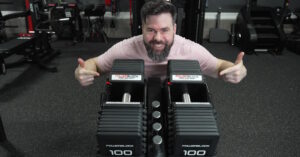
The PowerBlock Pro 100 EXP is the heaviest residential PowerBlock and my top pick for most serious lifters. It expands from 40 to 100 lbs per hand across four stages with $219 kits, and it adjusts in 2.5 lb increments using micro weights. It has urethane-coated plates, ring indicators on both rails and an open wedge handle. You choose between a 38 mm knurled stainless grip and a contoured TPR grip. At about 19 inches maxed out, it's long, which mostly shows up when you bring the dumbbells together on heavy presses. It works with PowerBlock's Pro 100 bar attachments and the rotating kettlebell handle.
4.6
Pros
- Goes to 100 lbs per hand, the heaviest residential PowerBlock
- Only PowerBlock with a choice of knurled or TPR grips
- Thick 38 mm grip
- 2.5 lb increments with auto-lock micro-weights
- Slightly better balanced than the Elite models
- Quiet, comfortable urethane-coated plates
- Ring-style weight indicators on both sides of the plates
- Roomy wedge-shaped open handle
- Works with Pro 100 bars and the rotating kettlebell handle
Cons
- Pretty long at 19.21 inches when maxed out
- Skips a 2.5 lb step roughly every 10 lbs
- Micro-weights are slower to change than swappable handles
- Not as well balanced as the Commercial Pro 100
- Most expensive residential model
PowerBlock Pro 100 EXP Review: Final Verdict
The Pro 100 EXP sits in the sweet spot of the PowerBlock lineup. It goes heavy enough for almost anyone; the urethane build and 38 mm knurled grip feel premium, it balances better than its length suggests, and the four-stage expansion lets you buy in at whatever your budget allows.

The length is my one real complaint, and it only shows up on heavy pressing. The skipped increments are a minor annoyance, but that’s common to all expandable residential models. Neither issue changes my recommendation.
If budget isn’t a constraint and you want the best PowerBlock experience overall, get the Commercial Pro 100. If you want the most for your money, get the Elite USA 90.
For everyone in between, which is most serious lifters, the PowerBlock Pro 100 EXP is the one to buy.
You can check out the Pro 100 EXP on PowerBlock’s site here, and if you decide to buy, remember that my code KING20 gets you $20 off any order over $200.
Related PowerBlock Reviews
- PowerBlock Dumbbells: The Complete Buying Guide
- PowerBlock Dumbbells Review: Pros & Cons
- PowerBlock Commercial Pro 125/175 Review
- PowerBlock Commercial Pro 100 Review
- PowerBlock Elite USA 90 Review
- PowerBlock Elite EXP Review
- PowerBlock Commercial Pro 50 Review
- PowerBlock Pro 50 Review
- PowerBlock Pro 32 Review
- PowerBlock Sport 24 Review
- PowerBlock Pro vs Sport
- PowerBlock Pro vs Elite
- PowerBlock Elite vs Sport
- PowerBlock Knurled Handles Review
- Best Adjustable Dumbbells (All Brands)