
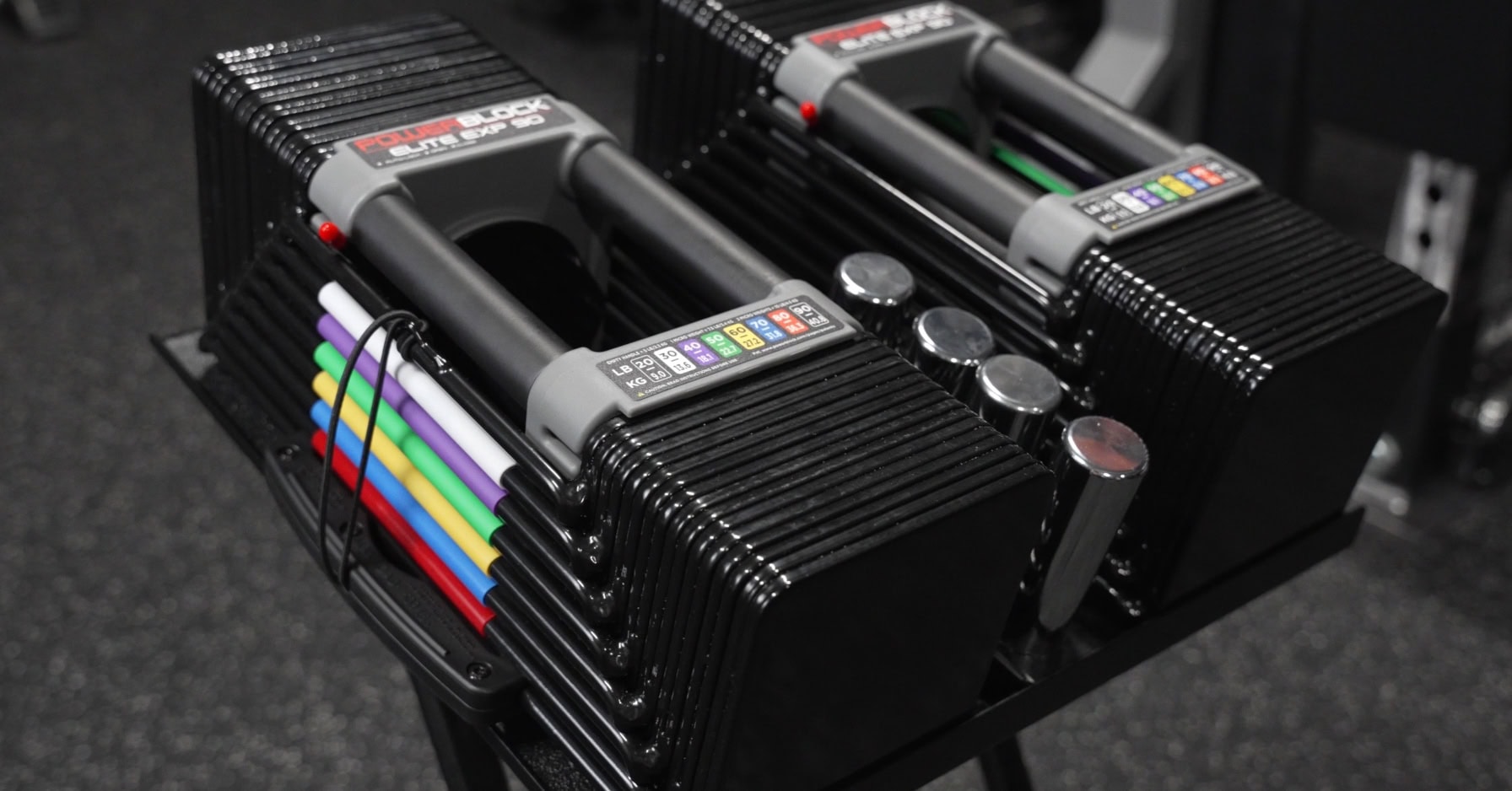
The PowerBlock Elite EXP is the only current PowerBlock you can’t buy direct from PowerBlock. It’s sold through retailers like Amazon and Dick’s Sporting Goods, and it’s nearly identical to the Elite USA, which PowerBlock does sell. I’ve tested both side by side along with every other current PowerBlock.
This PowerBlock Elite EXP review covers what buying through a retailer changes, the one feature it has that the Elite USA doesn’t, the grip tradeoff that decides most purchases, and how to avoid the expansion kit mistake that costs Elite owners money.
| Model | Pros & Cons | Rating |
|---|---|---|
PowerBlock Elite EXP | Pros:
| Rated 4.2 out of 5 |


Table of Contents
The Short Answer
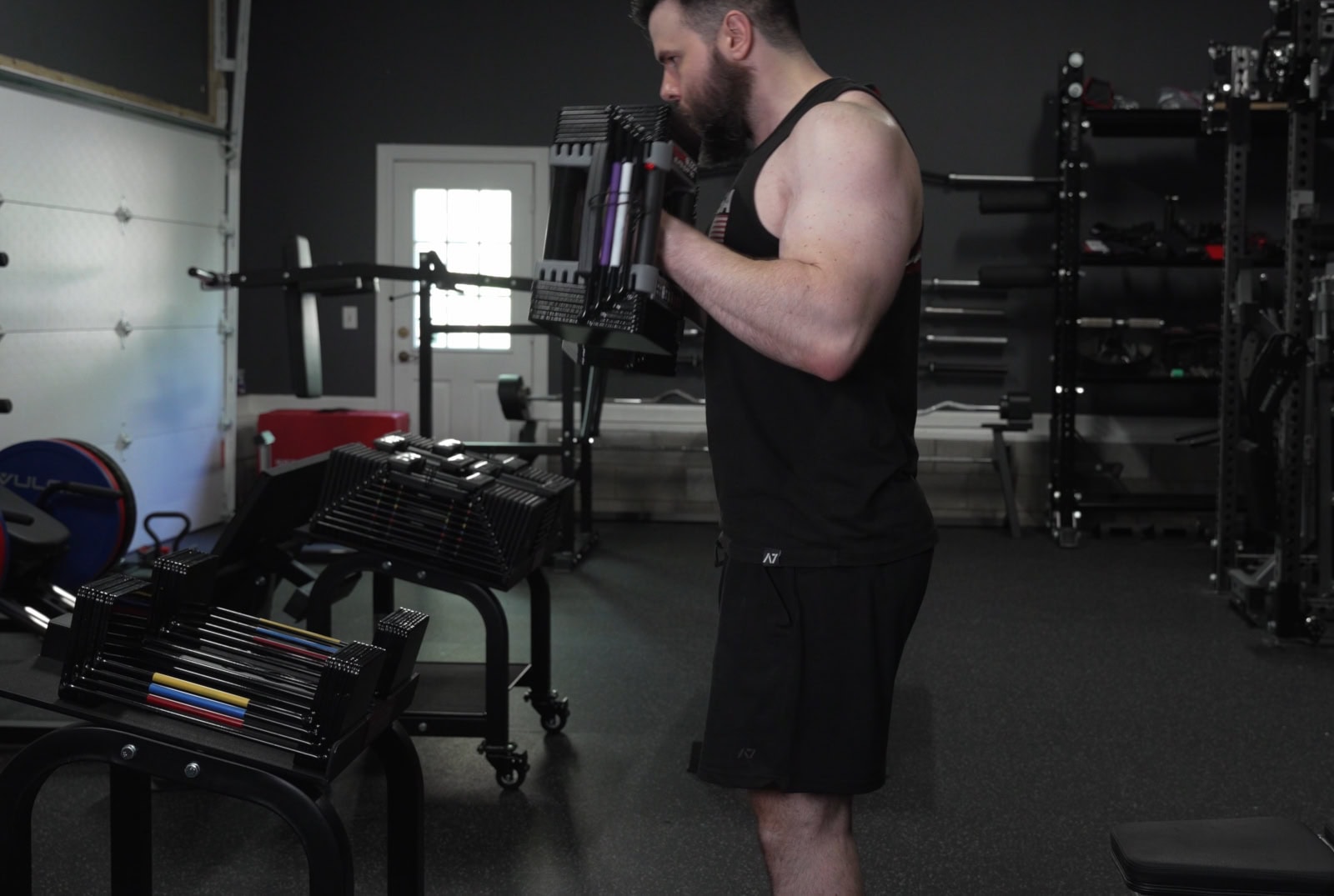
The PowerBlock Elite EXP makes sense if you don’t mind having rubber grips. In that case, it costs about $50 to $70 less than the Elite USA. And it has the auto-lock feature for closing the micro-weight slots, which the Elite USA doesn’t (it has a manual locking lever instead).
If you want knurled steel grips, buy the Elite USA instead. PowerBlock doesn’t make knurled grips for the EXP, and adding third-party ones pushes it past the price of an Elite USA, which comes with knurled grips from the factory.
That’s why I rate the Elite USA as the better value for most people.
PowerBlock Elite EXP Specs
| Spec | Detail |
|---|---|
| Weight range | 5 to 90 lbs per hand |
| Increments | 2.5 lbs (skips one step roughly every 10 lbs) |
| Stages | 50 lb base plus two expansion kits: 70, 90 lbs |
| Adjustment | Selector pin plus micro weights with auto-lock |
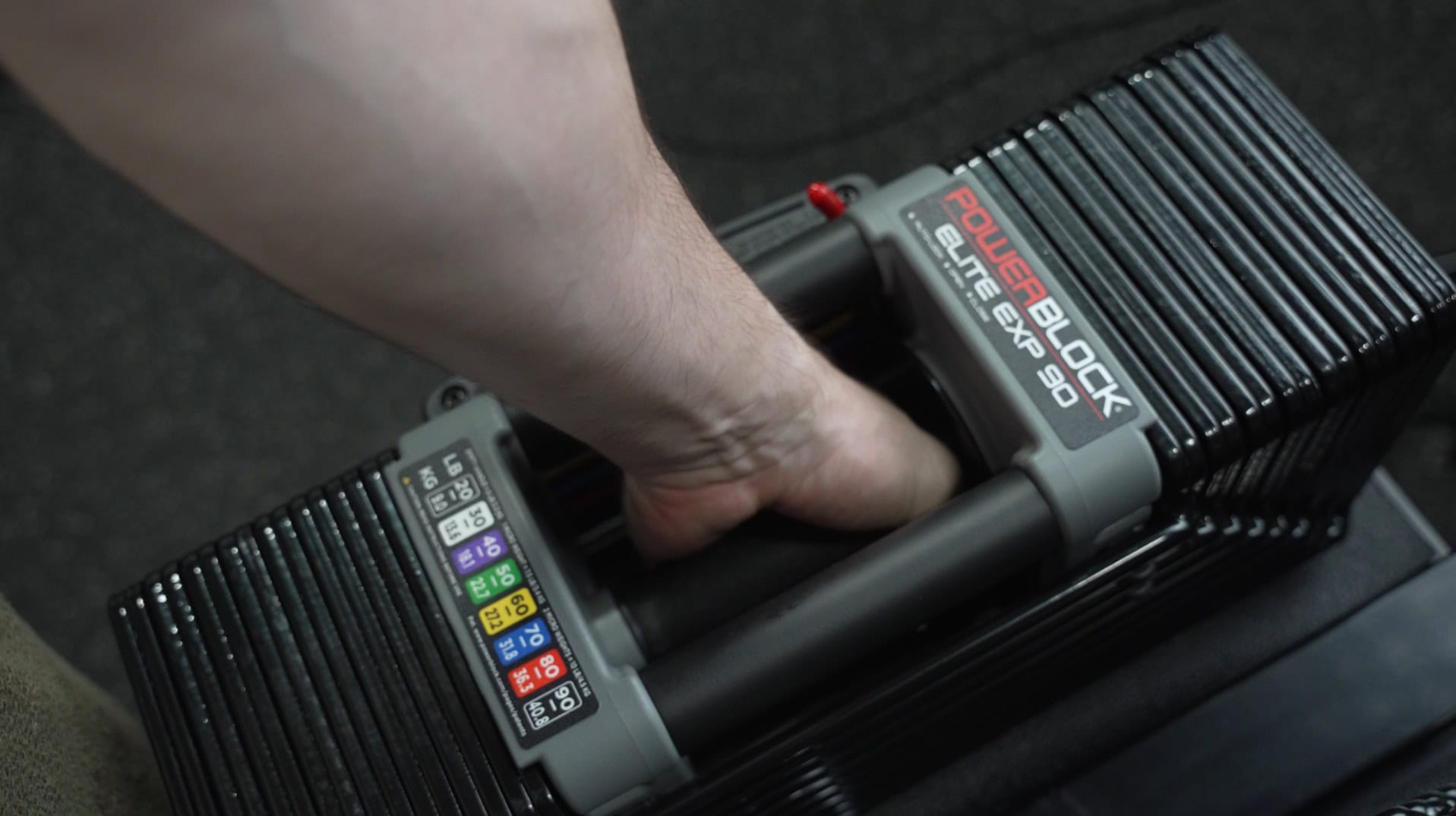
| Grip | 38 mm contoured TPR |
| Handle | Squared-off, closed, padded wrist supports |
| Plates | Welded all-steel, black powder coat |
| Weight indicators | Colored strips, one side |
| Dimensions (L×W×H) | 16″ × 6″ × 6.25″ at 90 lbs |
| Origin | Made in China |
| Where to buy | Amazon, Dick’s Sporting Goods, other retailers |
| Warranty | 5 years residential |
| Price | About $400 (50 lbs) to $800 (90 lbs), varies by retailer |
Not Sold by PowerBlock: What That Changes
The Elite EXP is sold only through retailers. Here’s what that changes:
- PowerBlock coupon codes don’t apply. Codes like mine work at PowerBlock.com, and the EXP isn’t sold there.
- Expansion kits come from retailers too. If you plan to start at 50 or 70 lbs and expand later, check that the kits are available before you commit to staging.
- Returns go through the seller. Keep your order confirmation, since it’s also your proof of purchase for any warranty claim.
Before you order, check two things on the listing:
- Confirm it says Elite EXP rather than Elite USA, since the two look almost identical in photos.
- Confirm the weight stage you’re buying and whether you need to buy the expansion kits separately.
Auto-Lock: The EXP’s Clear Advantage
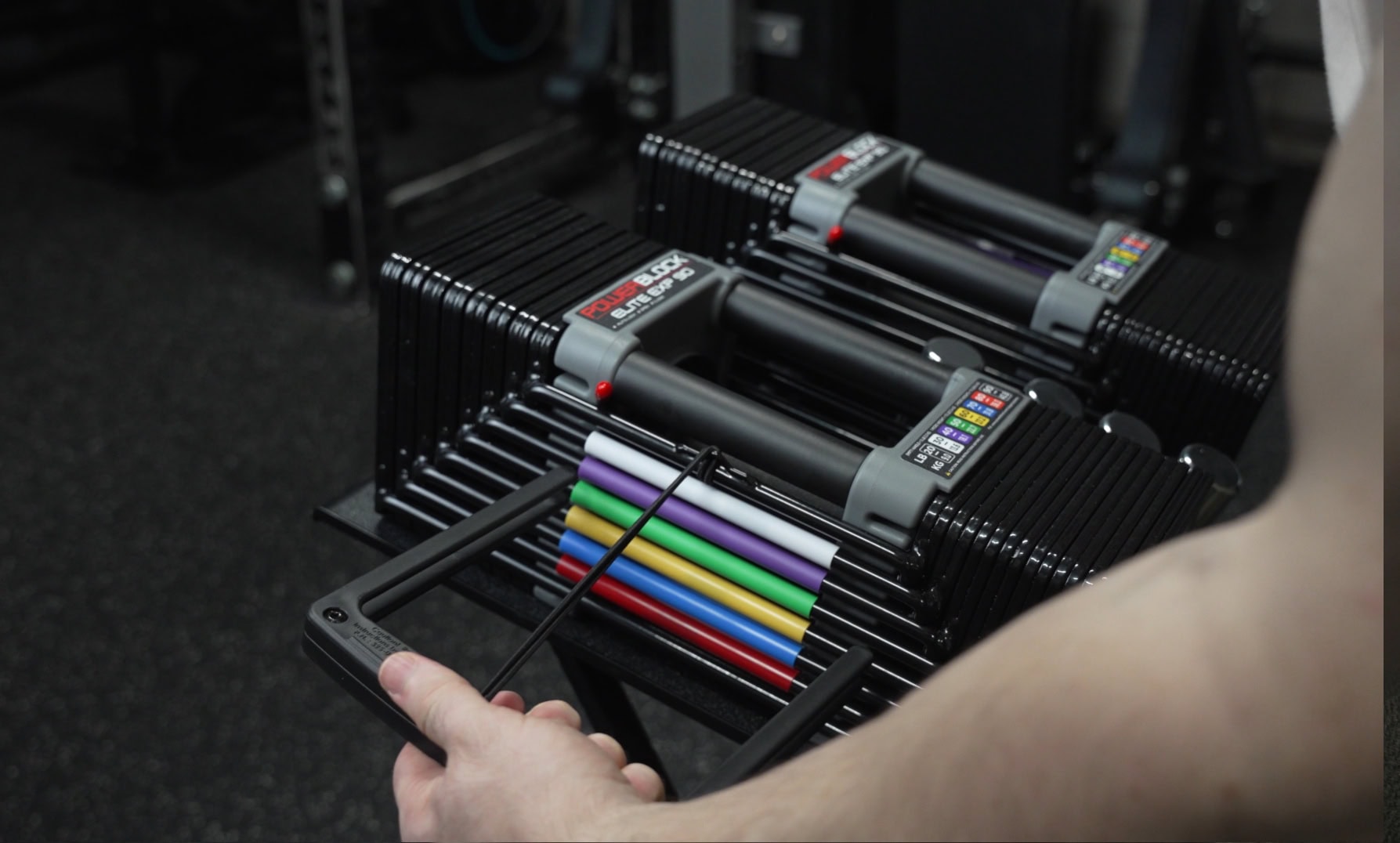
Micro weights are 2.5 lb steel cylinders that sit in the slots in the bottom of the handle. Those slots have to be locked closed before you lift, otherwise the cylinders can rattle during your lifts and fall out when you pull the handle from the stack.
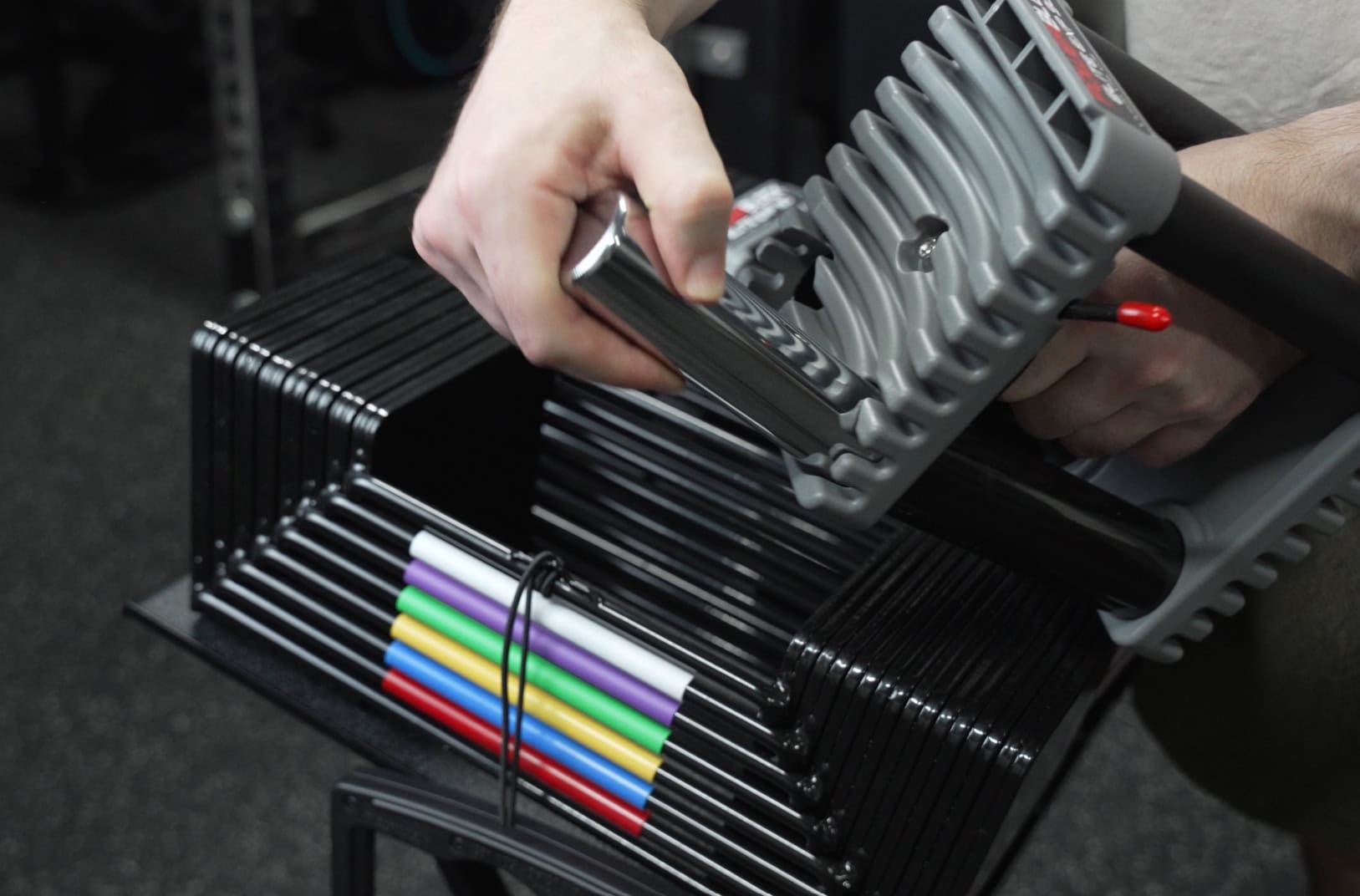
The Elite EXP locks it for you. When you drop the handle back into the blocks, the top rail pushes the lever closed. You don’t have to think about it.
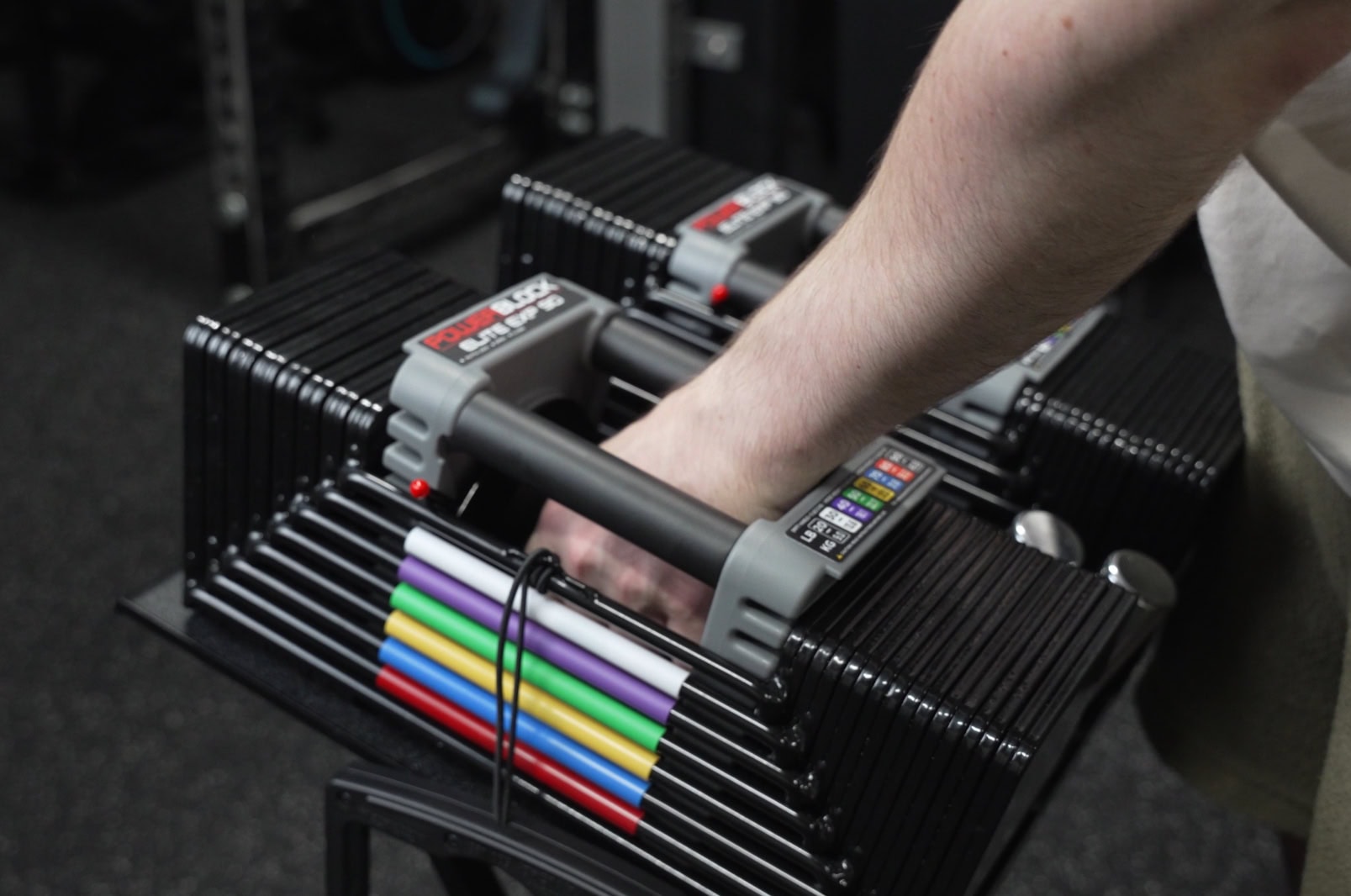
The Elite USA uses an older three-position manual lever. It works, but you have to remember to flip it every time you load micro weights.
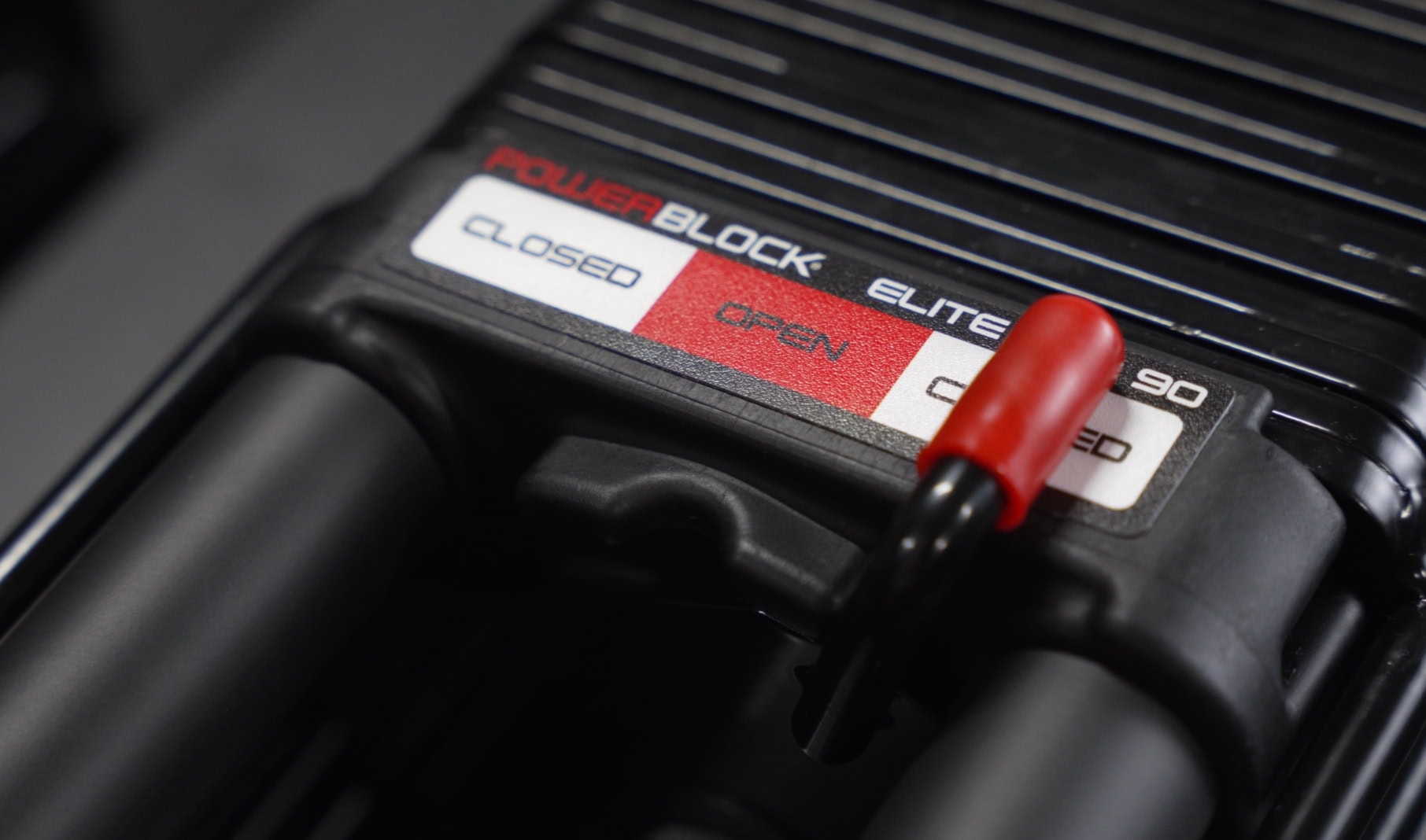
There’s one case where auto-lock can’t help on either model: when you’re lifting the handle with micro weights installed, but with no plates selected. With no plate rail to push the lever, you must lock it by hand.
The Grip: Why I Prefer the Elite USA
The grip is the main reason I recommend the Elite USA over the EXP in this PowerBlock Elite EXP review.
The PowerBlock Elite EXP ships with contoured TPR rubber grips. The Elite USA ships with knurled stainless steel grips.
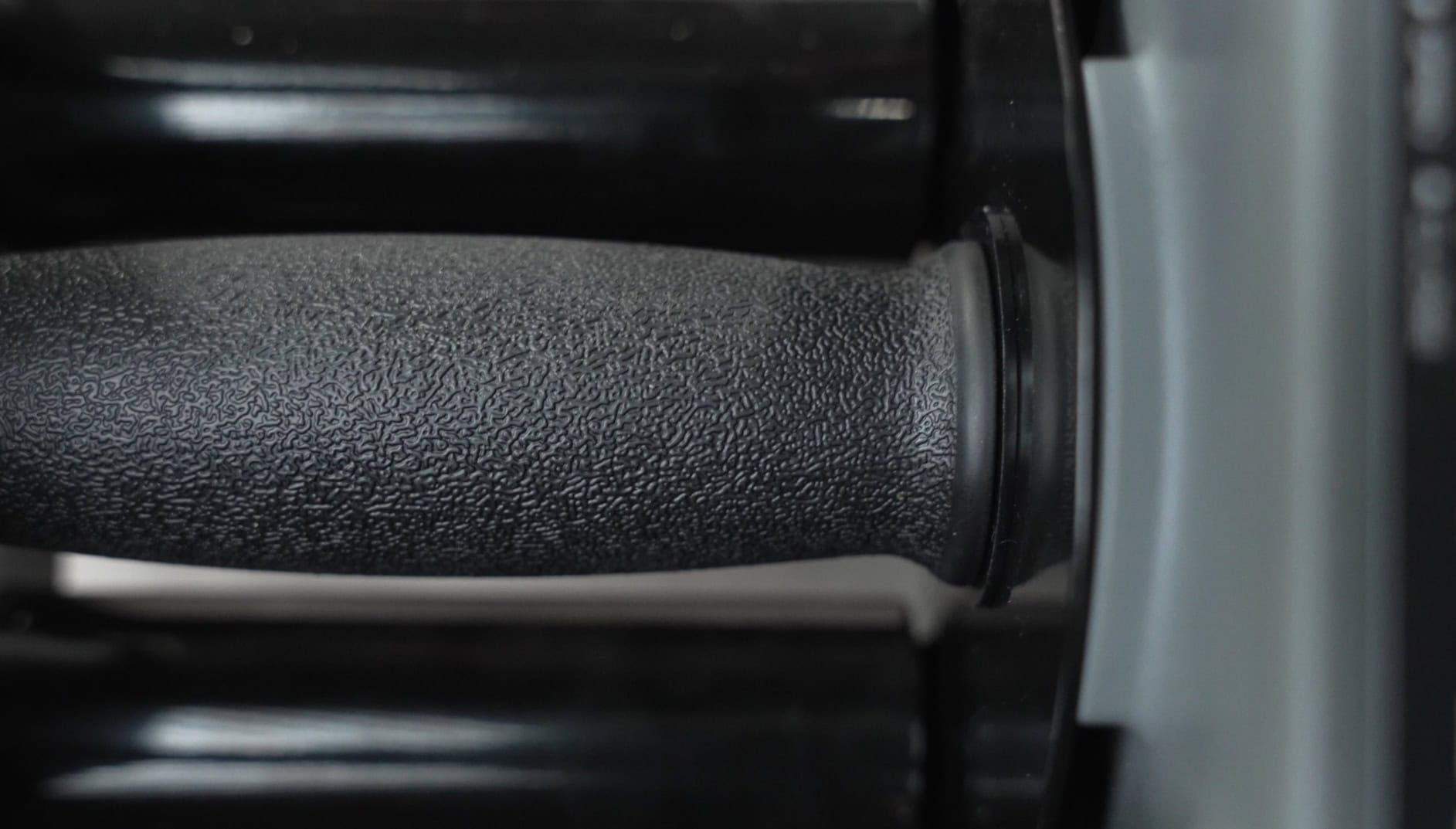
Knurled steel holds better under heavy loads and feels closer to a barbell. Most serious lifters prefer it, and so do I. TPR is softer, and it doesn’t feel cold in an unheated garage the way bare steel does, but that’s about where its advantages end.
The shape works against it too. A contoured grip is thickest in the middle and tapers toward the ends, and I don’t prefer that shape. It just doesn’t feel as natural as a straight grip, at least in my opinion.
However, if you don’t mind (or even prefer) rubber grips and a contoured grip shape, none of this is a negative and you won’t have to spend more on third-party knurled grips. Your all-in cost will legitimately be less.
If you want knurled steel, the math changes. PowerBlock doesn’t make knurled grips for the EXP, and the ones it sells for the Elite USA don’t fit it. Your options are third-party fabricators like JD Gym Equipped, at about $185 a pair or Average Joe Innovations at around $120. My knurled handles review covers the upgrade options.
Which Elite Model Costs Less for You
Here’s a comparison of costs for the two Elite models (when maxed to 90 lbs), both with default grip options and with third-party knurled options:
| Route | Grip | Approximate total |
|---|---|---|
| Elite EXP as shipped | 38 mm TPR | $800 |
| Elite USA 90 with code KING20 | 32 mm knurled | $847 |
| Elite EXP + Average Joe Innovations grips | Knurled | $920 |
| Elite EXP + JD Gym Equipped grips | Knurled | $985 |
If you’re fine with TPR, the Elite EXP is the cheaper set by about $50 to $70 (depending on coupon code usage), and you also get the auto-lock feature.
If you want knurled steel, the Elite USA costs at least $73 less than any knurled EXP setup at typical prices, and you avoid dealing with a third-party fabricator.
Construction: All-Steel, Welded
The PowerBlock Elite EXP has the same plate construction as the Elite USA: steel-only plates with welded rails and no urethane coating, square plate shape, and a black powder coat.
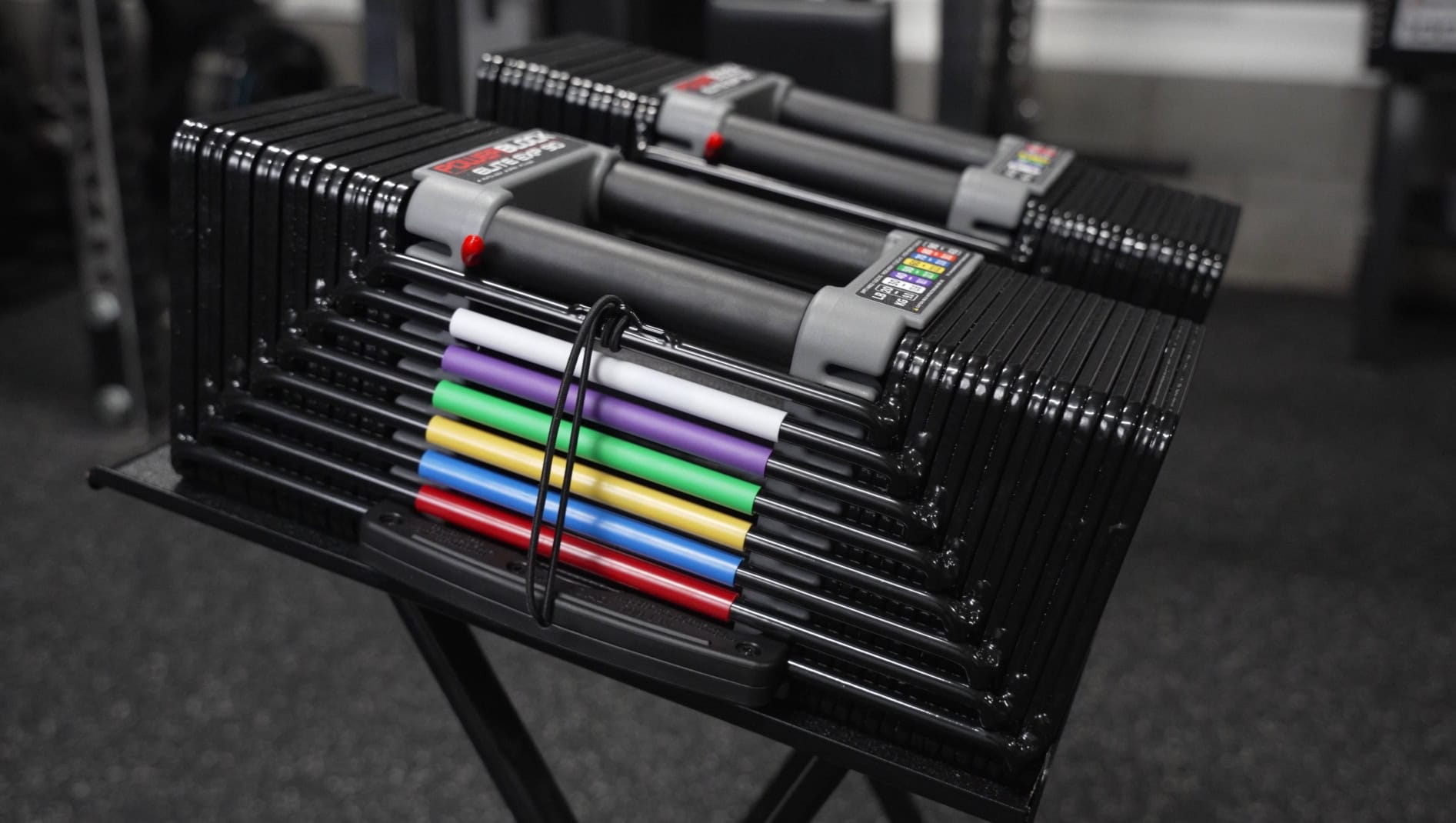
Some lifters prefer steel over urethane for long-term durability. A welded joint is permanent, and there’s no coating to scuff, peel, or crack. The Pro and Commercial models run their rails through urethane tabs that flex on every rep, and urethane ages over time (though, anecdotally, I’ve owned multiple urethane pairs for many years with zero degradation issues). Welded steel doesn’t have that wear potential.
The trade-offs are that steel is louder during use and when you rack it, it’s less comfortable when you drop or rest the dumbbells on your thighs, and it has no shock absorption at the ends when you set them down or bump them against your body.
The weight indicators are long colored strips along the rails. They only appear on one side of the blocks, so you have to keep the blocks facing the same way to read your weight, and the strips can slide out of position over time. The Pro models’ embedded indicator rings don’t have either problem.
Size, Handle, and Balance
At 90 lbs, the PowerBlock Elite EXP measures 16″ long, 6″ wide, and 6.25″ tall. That’s 3.21 inches shorter than a maxed Pro 100 EXP, and almost all of the difference comes from skipping urethane.
Shorter and more compact dumbbells like the Elite can come closer together at the top of a press and are generally a bit easier to maneuver.
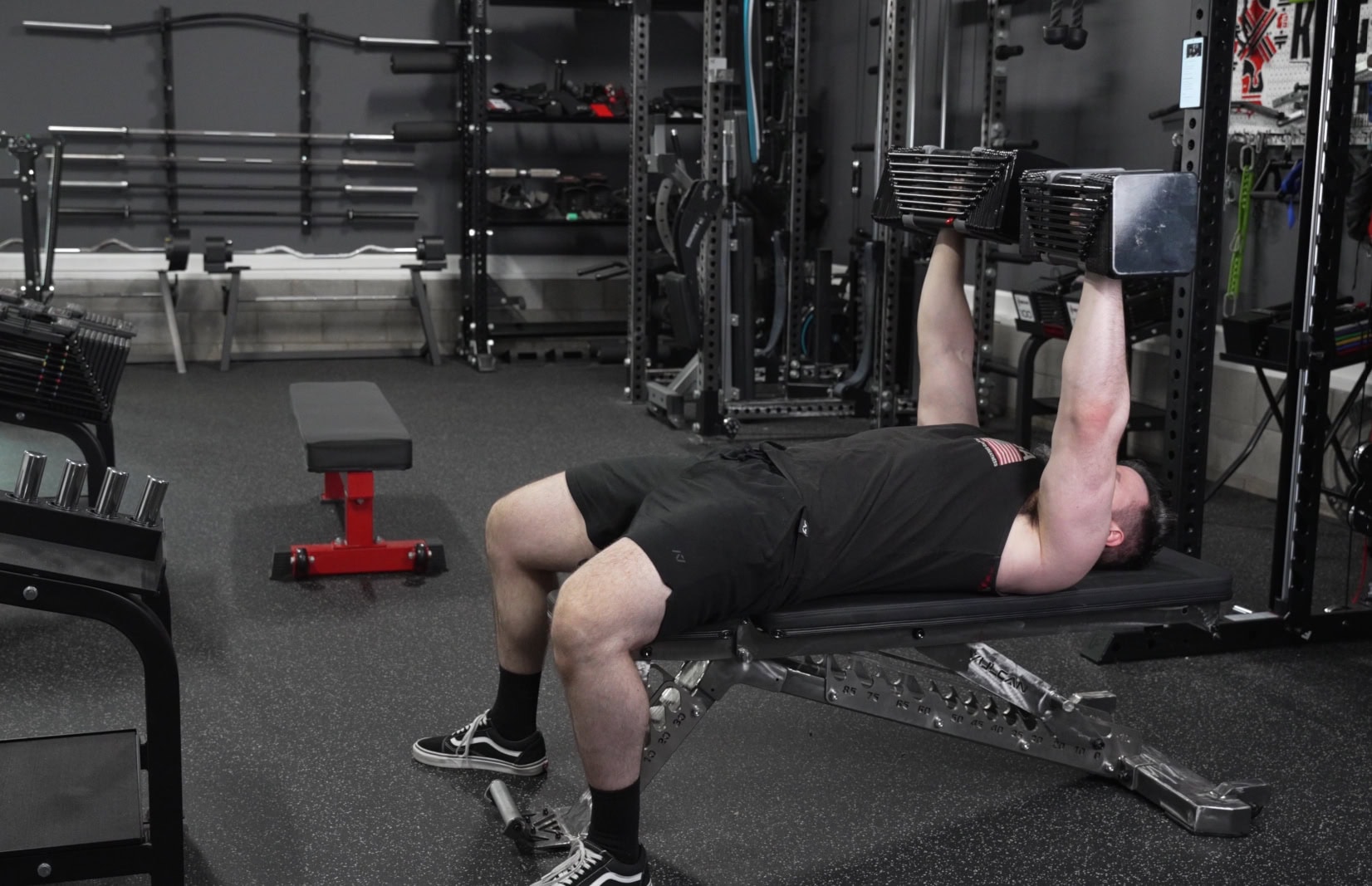
The handle is the same squared-off, closed design as the Elite USA, with padded wrist supports near the top. Some lifters like bracing their wrists against the supports on curls and lateral raises. Lifters with bigger hands or thicker forearms often find the enclosure limits how much the wrist can move side to side.
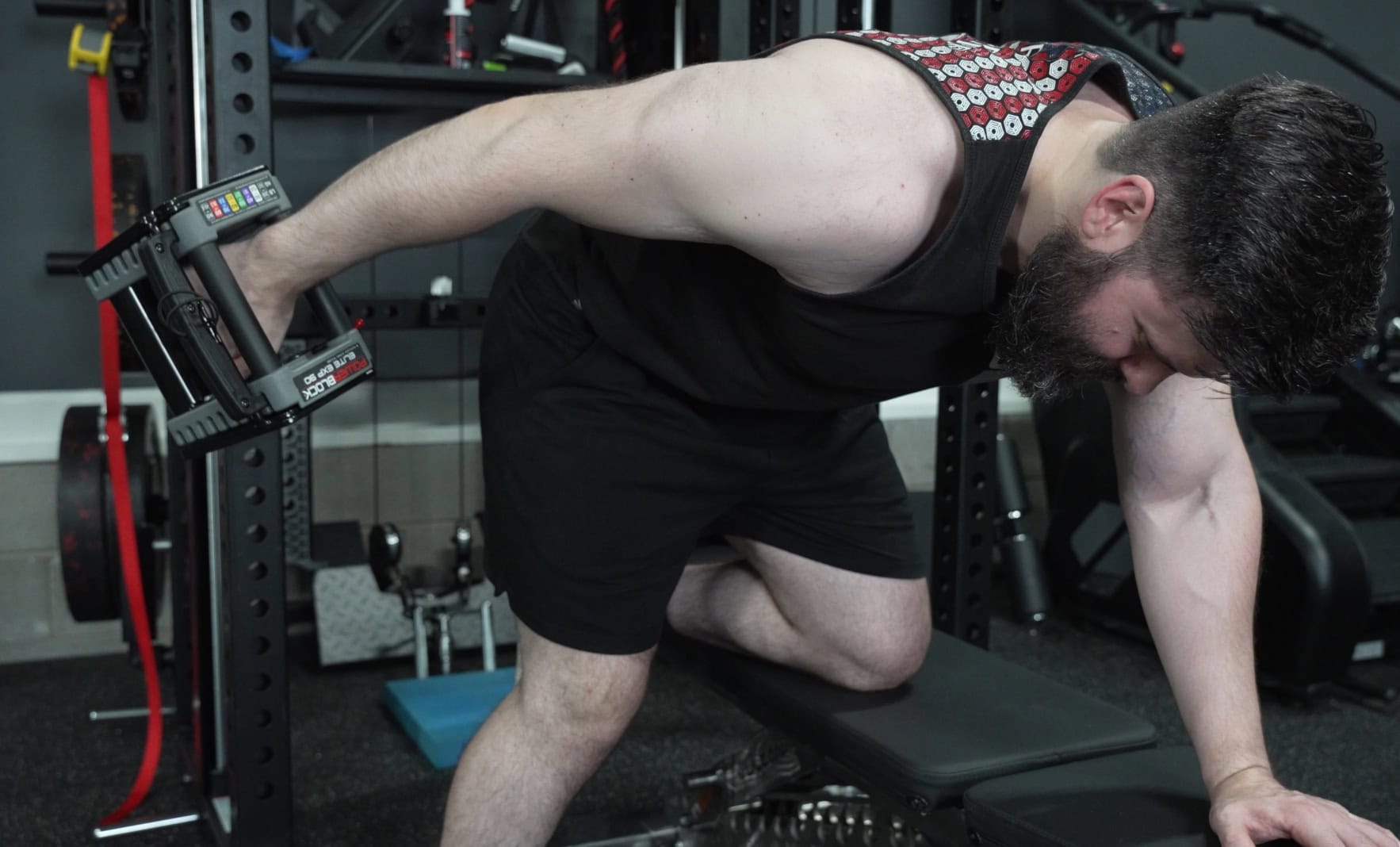
In terms of balance, it’s decent overall, but the micro-weights do shift the center of gravity slightly, especially if just one of them is loaded.
For this PowerBlock Elite EXP review, I compared the Elites’ balance against the Pro 100 EXP. Even though the Pro 100 EXP is over three inches longer, I found it slightly better balanced than the Elites. This was a surprising finding and I’m not quite sure what would cause the difference, but I wanted to mention it nonetheless.
Stages and Expansion Kits
The PowerBlock Elite EXP comes in three stages:
| Stage | Max per hand | Approximate price |
|---|---|---|
| Base set | 50 lbs | $400 |
| Stage 2 | 70 lbs | $600 |
| Stage 3 | 90 lbs | $800 |
Expansion kits run about $199 each. My rule for every expandable PowerBlock applies: if you can afford it and know you’ll use 90 lbs, then buy it maxed out now. Only buy it in stages over time if money is tight or you’re not sure you’ll need the top end weight.
Like every expandable residential PowerBlock, it adjusts in 2.5 lb steps but skips one roughly every 10 lbs, so you’ll occasionally make a 5 lb jump where you wanted 2.5.
The Expansion Kit Mistake to Avoid
Elite EXP and Elite USA expansion kits aren’t interchangeable.
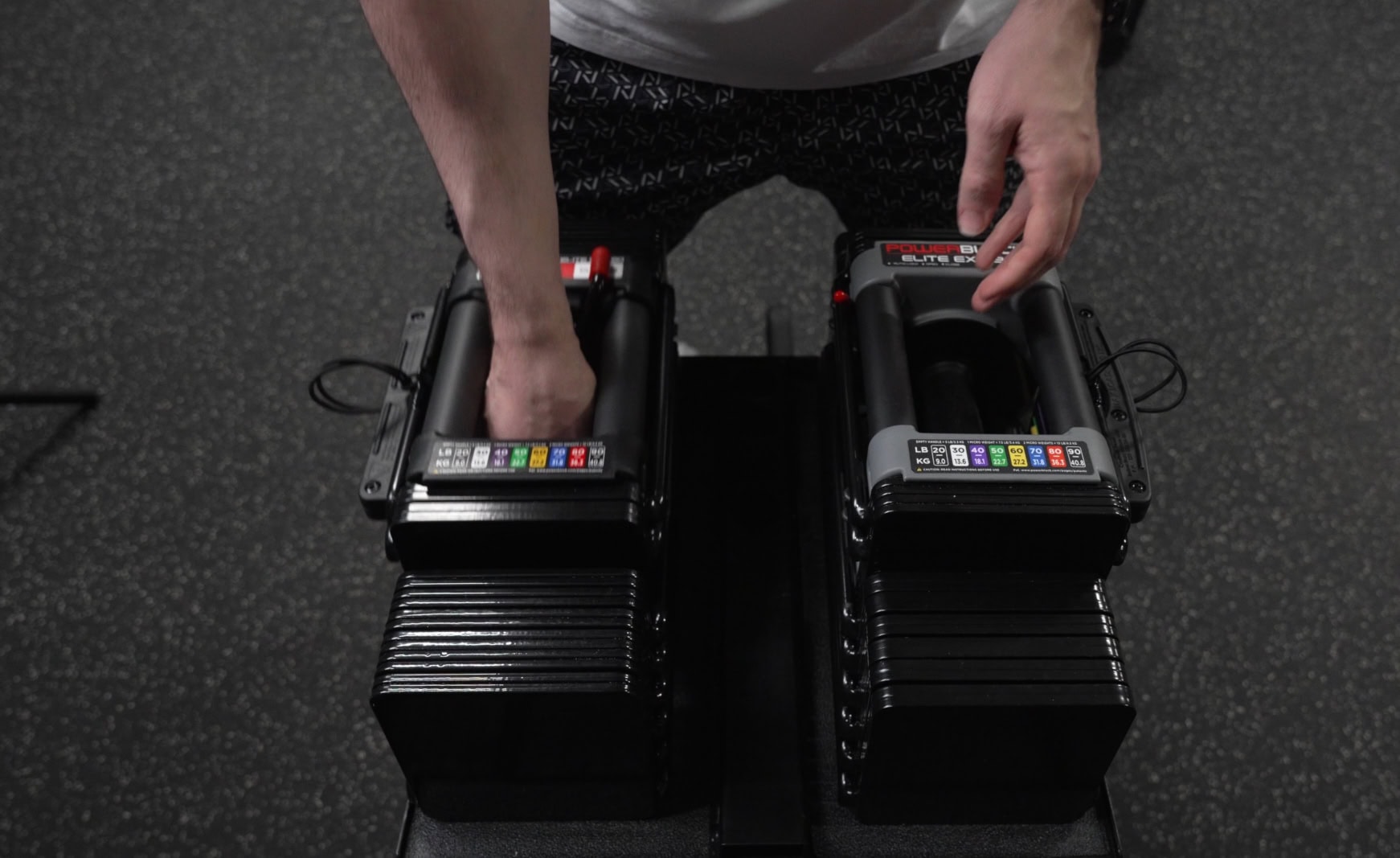
An Elite USA expansion kit won’t seat on an Elite EXP at all. Going the other direction, an Elite EXP expansion kit will physically fit onto an Elite USA base, but the expansion blocks sit above the rest of the stack with a visible gap.
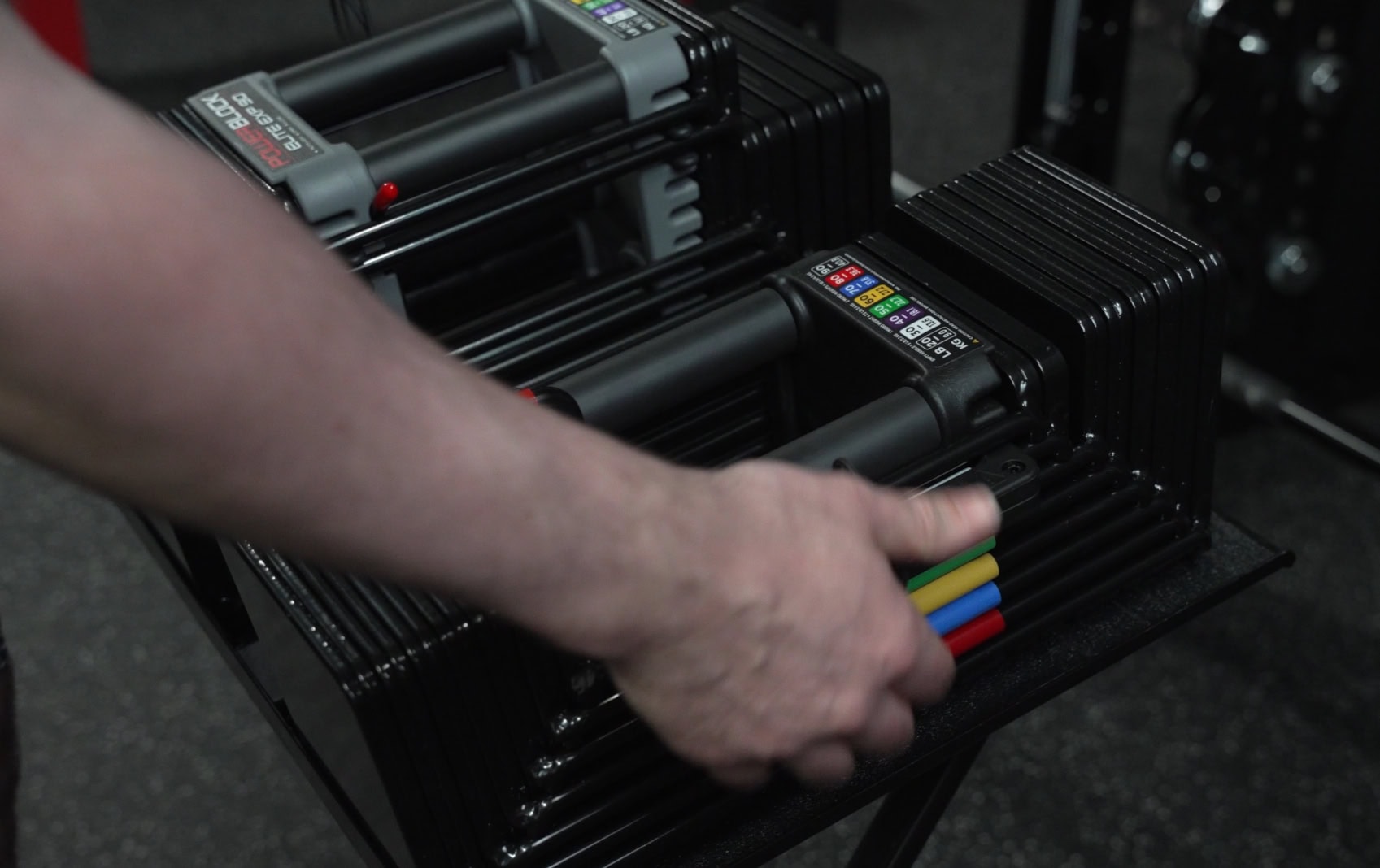
So be sure to buy the expansion kit that matches your model. If you’re not sure which one you own, the next section covers how to tell.
How to Tell an Elite EXP From an Elite USA
The two sets look almost the same, which causes trouble mainly when you’re buying used or ordering an expansion kit. There are few details that will help you tell them apart:
- The sticker/decal text is the most obvious giveaway. While decals have changed slightly over time, if you see an Elite handle with “USA” on it at all, it’s an Elite USA model.
- The lock lever is the most reliable tell. The Elite EXP has auto-lock, so the lever closes when you seat the handle in the blocks. The Elite USA has a manual three-position lever with a red middle position that marks it as open.
- The grip helps, with one caveat. The Elite EXP ships with a contoured 38 mm TPR grip. Current Elite USA sets ship with knurled steel. Older Elite USA sets shipped with a straight TPR grip, though, so a rubber grip alone doesn’t prove you have an EXP. A contoured grip points to the EXP.
- The color of the handle may help distinguish the two, but it’s not as reliable. As of 2026, PowerBlock changed the color of the Elite USA handle from gray to black, while the Elite EXP remains gray. So this only helps on the newest variations, but if you the handle is black (along with the other indicators), then it’s probably a USA.
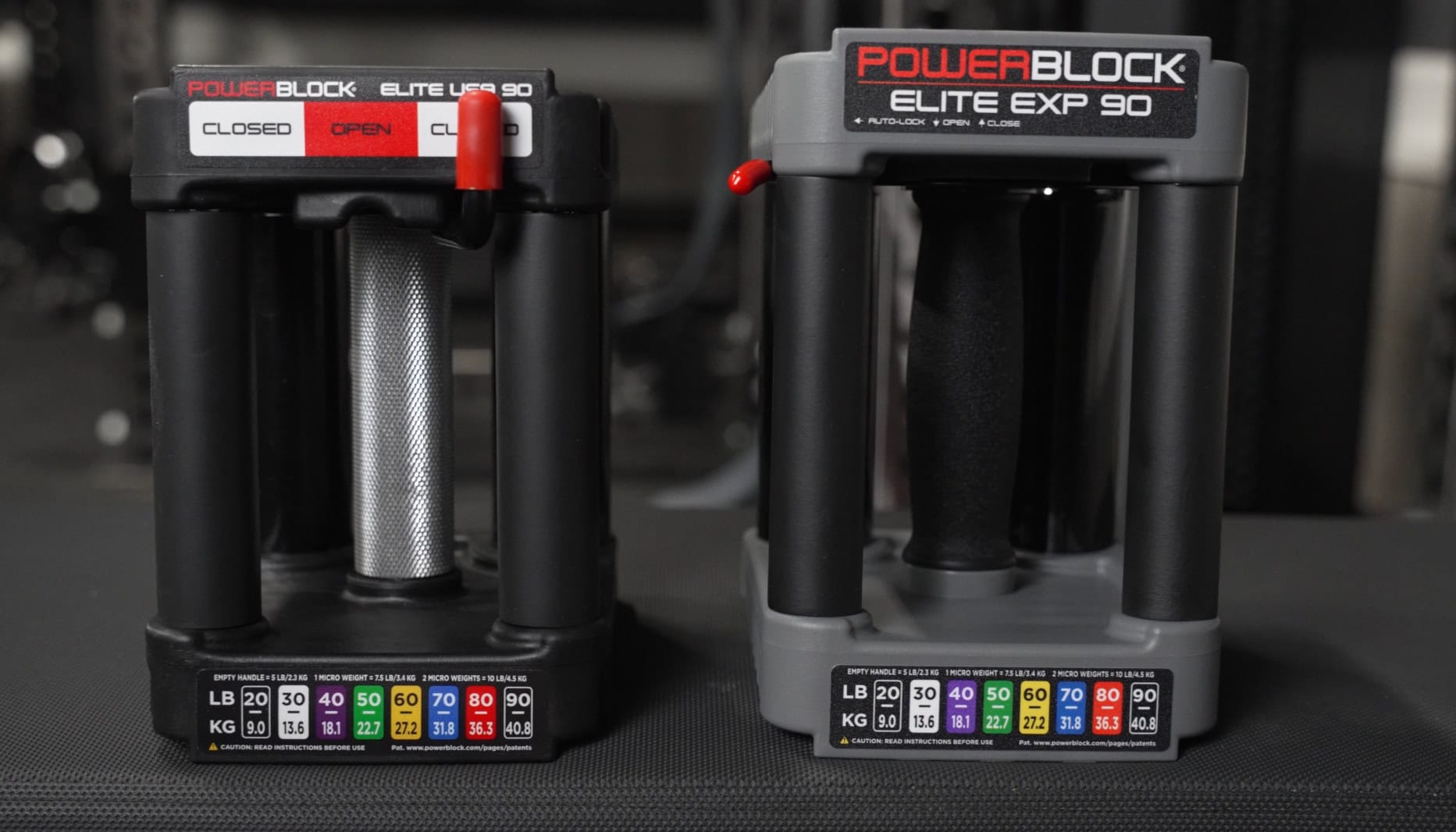
If you’re still unsure, send PowerBlock’s customer service a photo of your set and they’ll identify it. My Elite USA vs Elite EXP comparison covers the two models in more detail.
Attachments

The PowerBlock Elite EXP has its own attachment family: a straight bar, an EZ curl bar, and a kettlebell handle that rotates 90 degrees. They fit the Elite EXP only. Elite USA attachments won’t fit it, and Elite EXP attachments won’t fit an Elite USA.
The kettlebell handle is the one I’d buy. The 90 degree rotation lets you turn the blocks to clear your legs on swings. The older fixed Pro Series handle can’t do that, and the blocks start hitting your legs once you load it heavy.
I’d skip the bars unless you’re committing fully to PowerBlock and don’t have room for an Olympic bar and plates. I own the older Pro Series versions. With large oblong blocks hanging off each end, the balance is off, and the bar tries to rotate on anything that isn’t a straight vertical path.
Before ordering any attachment, confirm the listing says it’s for the Elite EXP.
Which Stand Is Best
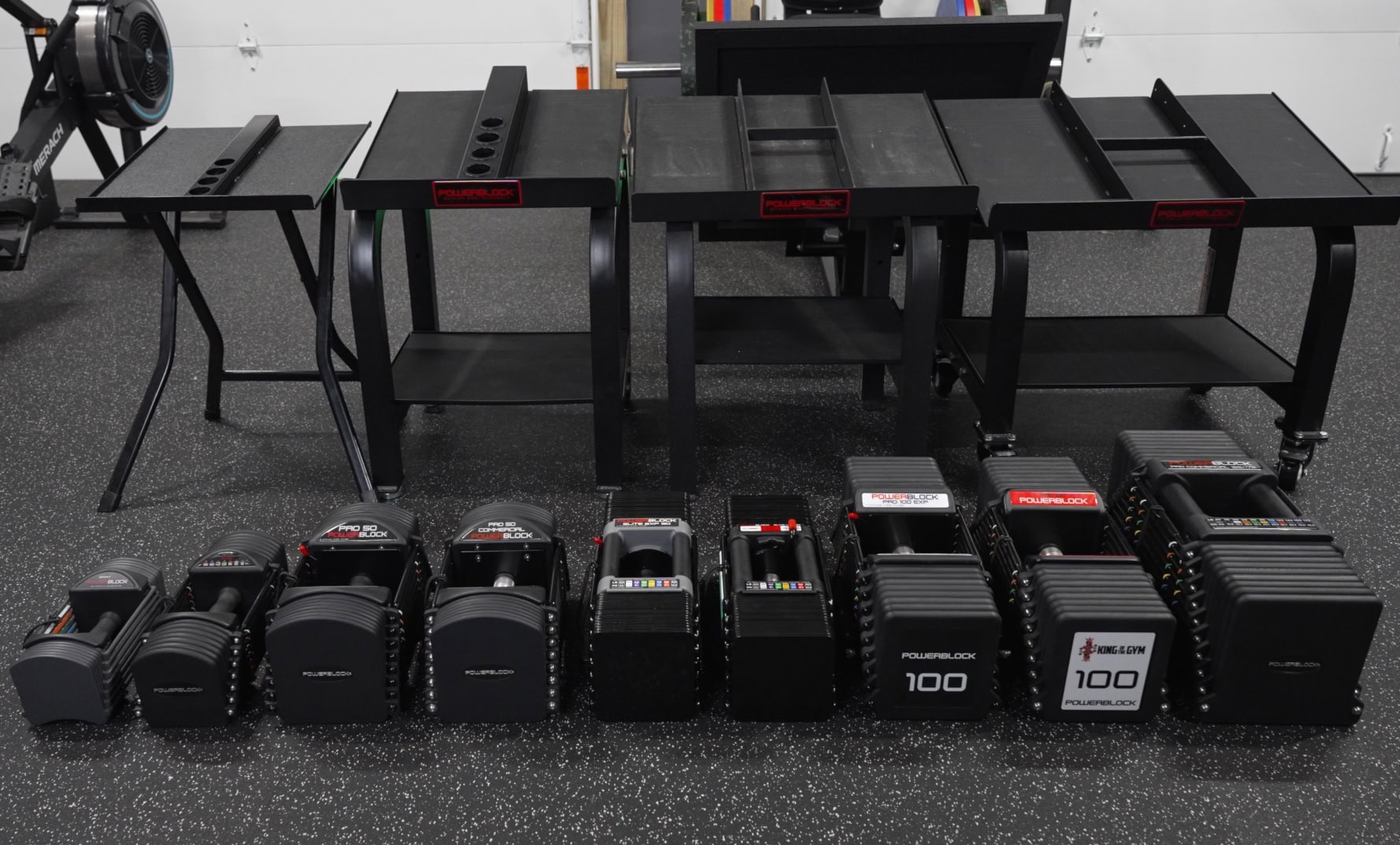
No stand is included. There are four PowerBlock stands that work with the Elite EXP, and a prerequisite feature for these stands is storage ports for the micro-weights:
- Home Rack Stand ($279): my pick. It’s the tallest and best-built option and it also has a convenient lower storage shelf.
- Large Compact Stand ($109): the budget option, and it folds flat.
- PowerMax 2.0 ($199): step-in design, no lower shelf.
- Column Stand ($199): an older design with no lower shelf; made in the USA, though.
The stands are sold on PowerBlock.com, so code KING20 does apply to them even though it doesn’t apply to the dumbbells.
One Elite-specific quirk: the bottom rail sits low on both Elite models, so a stand’s tray lip can make it awkward to pull the selector pin at the heaviest setting. The fix is to simply slide the dumbbell a bit toward the outer edge of the tray so the pin overhangs the lip.
Warranty
The PowerBlock Elite EXP carries a 5 year limited residential warranty, covering materials and workmanship defects. It excludes misuse, including drops from above 6 to 12 inches depending on the model.
Since you’re buying from a retailer rather than from PowerBlock, save your order confirmation. It’s your proof of purchase if you ever need to make a claim.
PowerBlock Elite EXP Pros and Cons
Here’s the condensed version of this review.
Pros:
- Auto-lock on the micro weight slot, which the Elite USA lacks
- About $50 to $70 less than the Elite USA if TPR grips suit you
- 2.5 lb increments with micro weights
- Compact at 16 inches, 3.21 inches shorter than a Pro 100 EXP
- Welded all-steel build for long-term durability
- Expandable to 90 lbs in three stages
- EZ bar, straight bar & rotating kettlebell handle attachments
Cons:
- TPR grips only, with no factory knurled option
- Third-party knurled grips push the total above an Elite USA
- PowerBlock coupon codes don’t apply to the dumbbells
- Louder and less comfortable on the thighs than urethane models
- Closed handle can feel restrictive for larger hands
PowerBlock Elite EXP vs Elite USA 90
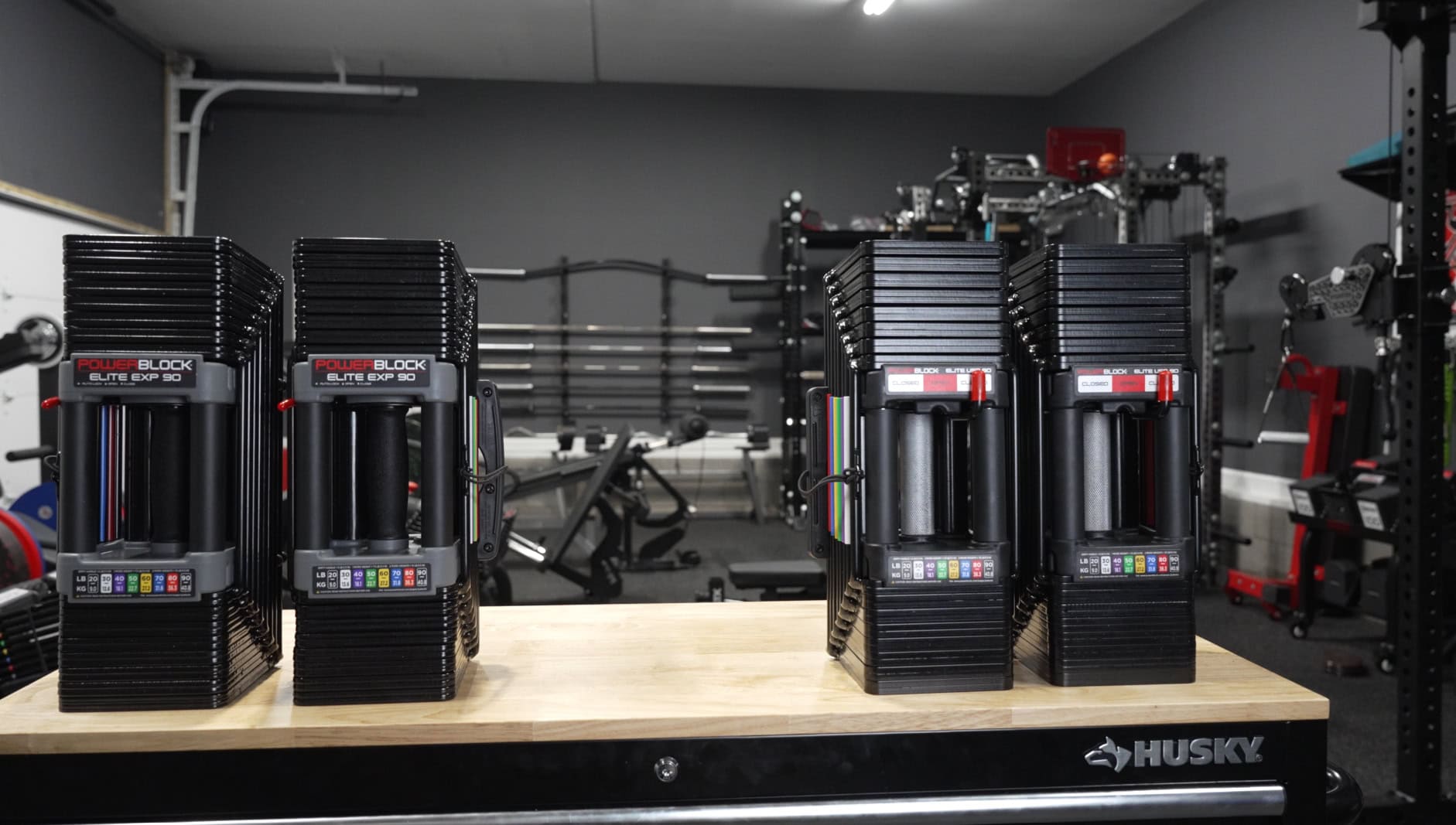
| Elite EXP | Elite USA 90 | |
|---|---|---|
| Grip | Contoured TPR, 38 mm | Knurled stainless, 32 mm |
| Micro weight lock | Auto-lock | Manual 3-position lever |
| Plate origin | China | Owatonna, Minnesota |
| Where to buy | Amazon, Dick’s, other retailers | PowerBlock.com |
| KING20 coupon | No | Yes |
| Dimensions at 90 lbs | 16″ × 6″ × 6.25″ | 16″ × 6″ × 6″ |
| Maxed price | About $800 | $867 |
These two models share the same weight range, increments, welded steel build, handle shape, and capacity. The decision comes down to grips versus auto-lock, and what you’ll pay once grips are settled.
Buy the Elite EXP if TPR grips suit you, you want auto-lock, or you find a strong retailer sale.
Buy the Elite USA if you want knurled steel, you’d rather buy direct from PowerBlock with coupon support, or US-made plates factor into your decision.
Who Should Buy the PowerBlock Elite EXP
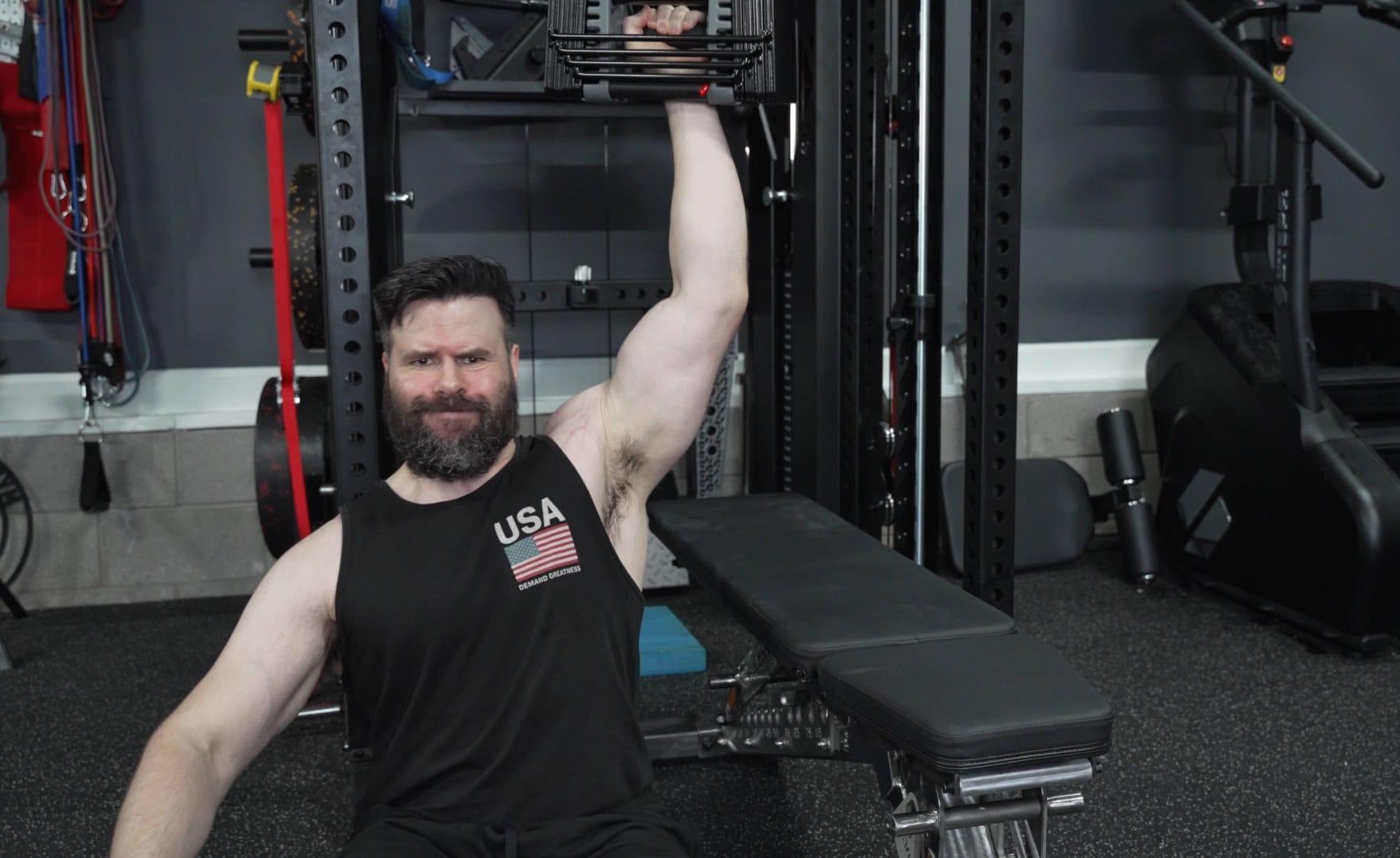
Buy the PowerBlock Elite EXP if:
- You’re fine with rubber grips, or you prefer them
- You want auto-lock and don’t want to remember a manual lever
- 90 lbs per hand covers your training
Look elsewhere if:
- You want knurled steel grips, in which case the Elite USA costs less all-in
- You’d rather buy direct from PowerBlock and use a coupon code
- You’ll need more than 90 lbs, in which case get the Pro 100 EXP
- Noise is a concern, since urethane models are quieter
- You own an Elite USA and are shopping for expansion kits, since EXP kits don’t fit it properly
PowerBlock Elite EXP FAQ
Why isn’t the PowerBlock Elite EXP sold on PowerBlock.com?
PowerBlock sells it only through third-party retailers like Amazon and Dick’s Sporting Goods. That means retailer pricing, and PowerBlock coupon codes don’t apply to it.
Is the Elite EXP or the Elite USA better?
It depends on the grip you want. If TPR is fine, the EXP costs less and adds auto-lock. If you want knurled steel, the Elite USA costs less once you add third-party grips to an EXP, and it has US-made plates.
Can I put knurled grips on a PowerBlock Elite EXP?
Only from a third-party fabricator. PowerBlock’s Elite USA knurled grips don’t fit the EXP. JD Gym Equipped sells a pair for about $185, and Average Joe Innovations sells them for about $120.
Do Elite USA expansion kits fit the Elite EXP?
No. A USA kit won’t seat on an EXP at all, and an EXP kit sits above the stack with a big gap on a USA base, which makes the dumbbell feel loose. Buy the kit that matches your model.
How can I tell if I have an Elite EXP or an Elite USA?
Check the lock lever. The EXP has auto-lock, while the USA has a manual three-position lever with a red middle position.
How heavy does the PowerBlock Elite EXP go?
90 lbs per hand fully expanded, adjustable down to 5 lbs in 2.5 lb increments, across three stages of 50, 70, and 90 lbs.
How big is the PowerBlock Elite EXP?
16 inches long, 6 inches wide, and 6.25 inches tall at 90 lbs, which is 3.21 inches shorter than a maxed-out Pro 100 EXP.
My Rating
PowerBlock Elite EXP
The PowerBlock Elite EXP is the imported sister model to the Elite USA. It's sold through Amazon and other retailers, not PowerBlock.com. It has the same compact welded steel blocks and closed handle, expands to 90 lbs in three stages, and adds auto-lock for the micro weights. The grip is the downside. It only comes with a contoured TPR grip. Adding aftermarket knurled grips pushes the total cost past the Elite USA. This model makes sense if you want auto-lock or don't care about the grip.
4.2
Pros
- Auto-lock on the micro weight slot, which the Elite USA lacks
- About $50 to $70 less than the Elite USA if TPR grips suit you
- 2.5 lb increments with micro weights
- Compact at 16 inches, 3.21 inches shorter than a Pro 100 EXP
- Welded all-steel build for long-term durability
- Expandable to 90 lbs in three stages
- EZ bar, straight bar & rotating kettlebell handle attachments
Cons
- TPR grips only, with no factory knurled option
- Third-party knurled grips push the total above an Elite USA
- PowerBlock coupon codes don't apply to the dumbbells
- Louder and less comfortable on the thighs than urethane models
- Closed handle can feel restrictive for larger hands
PowerBlock Elite EXP Review: Final Verdict
The Elite EXP is a good dumbbell overall. The build is the same welded steel as the Elite USA, and auto-lock saves you a step on every micro-weight change.
I believe the main decision factor comes down to the grip. If you want knurled steel, buying an EXP and upgrading it costs more than buying an Elite USA, which comes knurled.
If rubber grips suit how you train, though, the PowerBlock Elite EXP is the cheaper way to get 90 lbs per hand from PowerBlock, and you get auto-lock along the way.
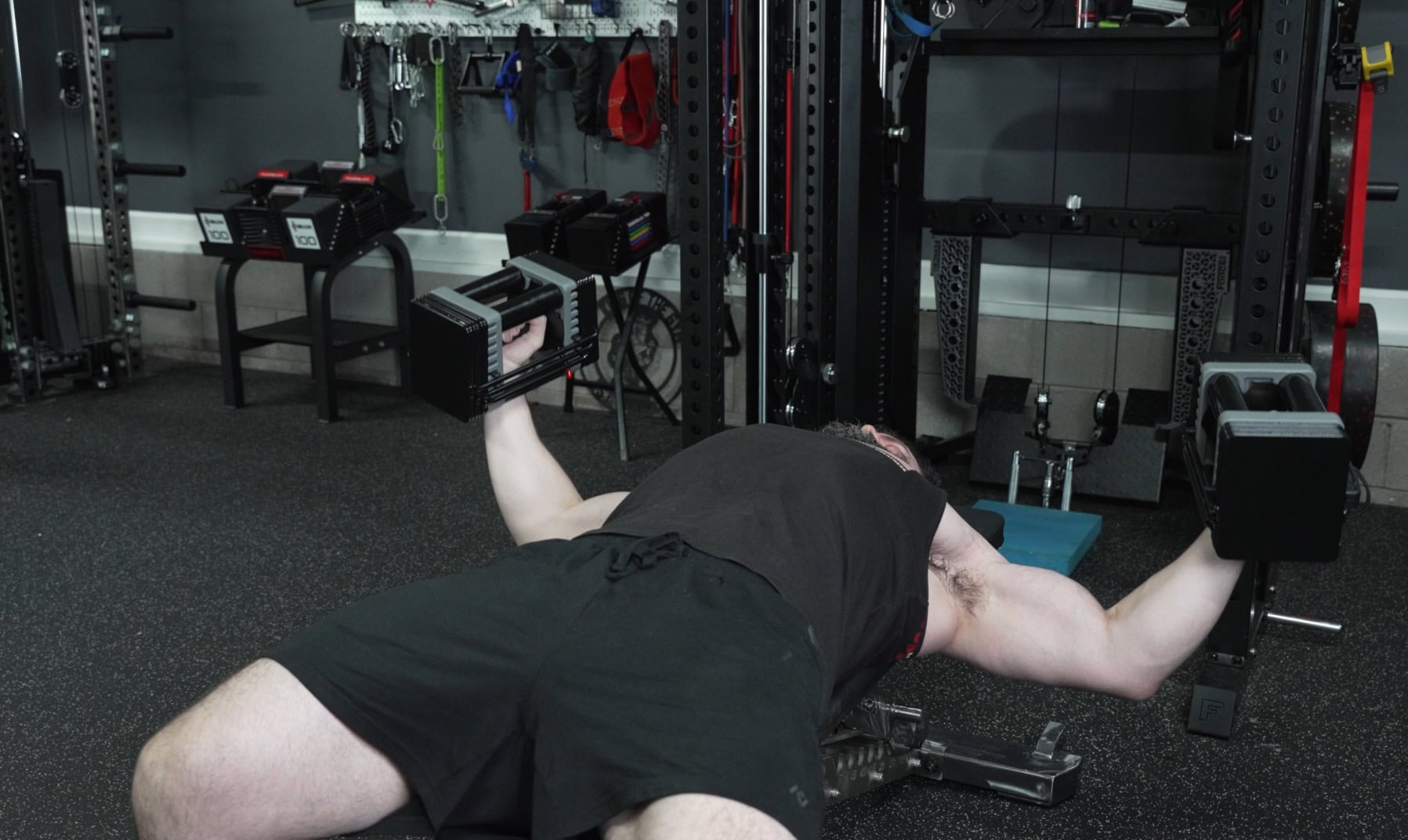
If you’ve decided to get it, you can check the current Elite EXP price here on Amazon.
Related PowerBlock Reviews
- PowerBlock Dumbbells: The Complete Buying Guide
- PowerBlock Dumbbells Review: Pros & Cons
- PowerBlock Elite USA vs Elite EXP
- PowerBlock Elite USA 90 Review
- PowerBlock Pro 50 Review
- PowerBlock Pro 32 Review
- PowerBlock Sport 24 Review
- PowerBlock Pro vs Elite
- PowerBlock Elite vs Sport
- PowerBlock Knurled Handles Review
- Best Adjustable Dumbbells (All Brands)