
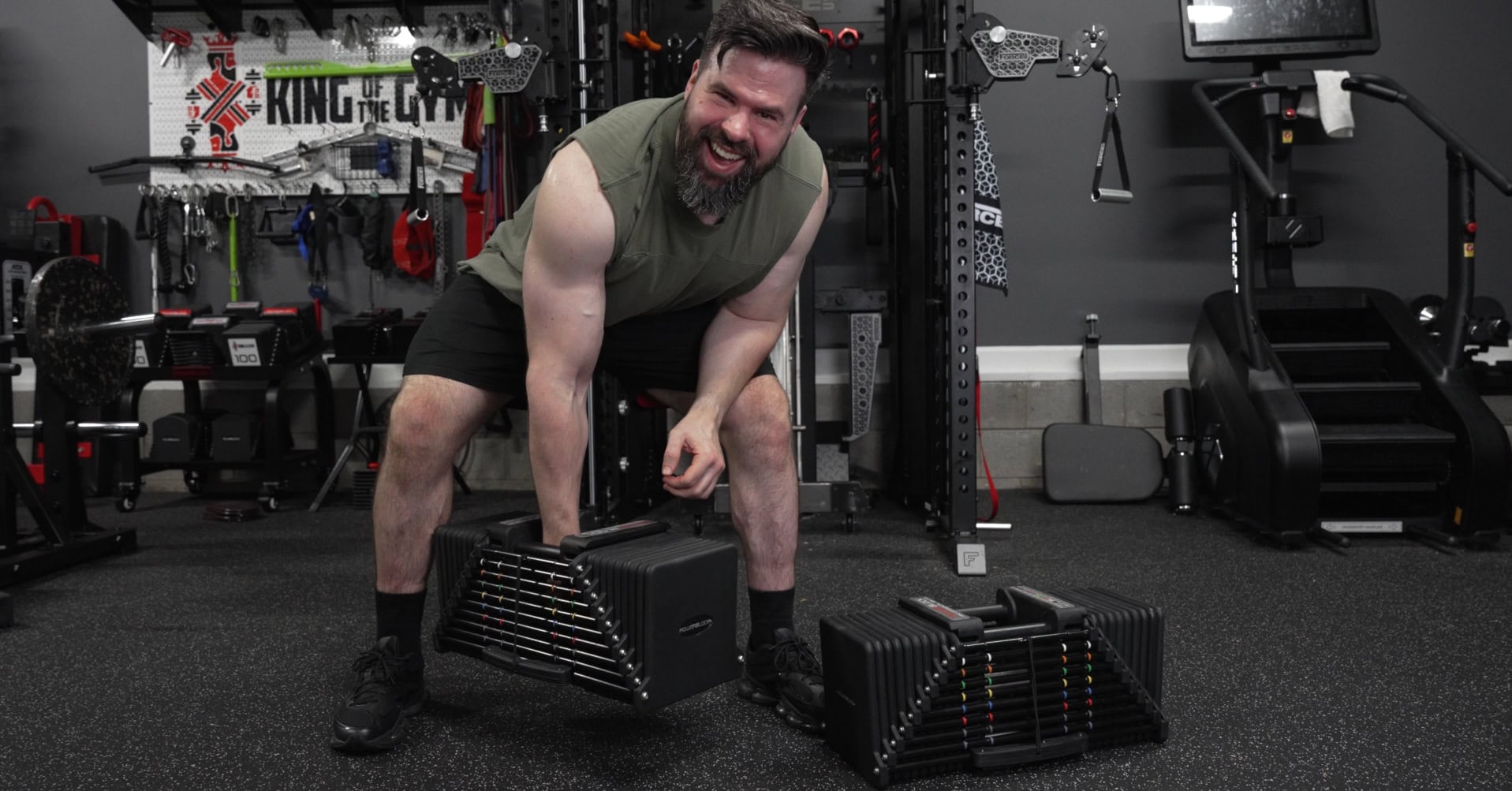
The PowerBlock Commercial Pro 125/175 is the heaviest quick-changing adjustable dumbbell on the market. It starts as a 125 lb set, then one expansion kit takes it to 175 lbs per hand, and it comes with a heavy-duty rolling stand included.
I’ve tested it side by side with every other current PowerBlock model to see exactly how it stacks up.
So, in this PowerBlock Commercial Pro 125/175 review, I’ll cover who needs this much weight, whether to buy the 125 or the 175, what you give up for the high weight capacity, how it feels to use, how it compares to other heavy PowerBlock models, and more.
| Model | Pros & Cons | Rating |
|---|---|---|
PowerBlock Commercial Pro 125/175 | Pros:
| Rated 4.3 out of 5 |
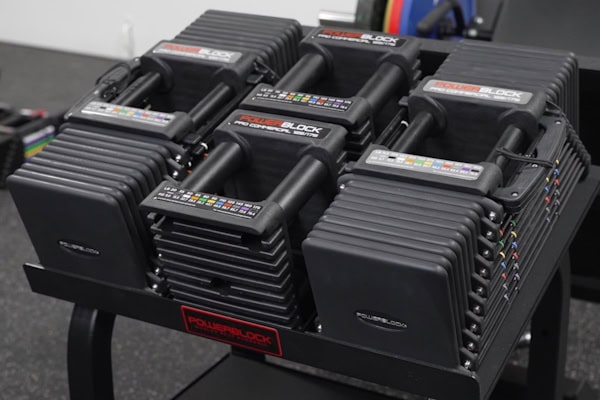


Table of Contents
Who Needs 175 lbs Per Hand?
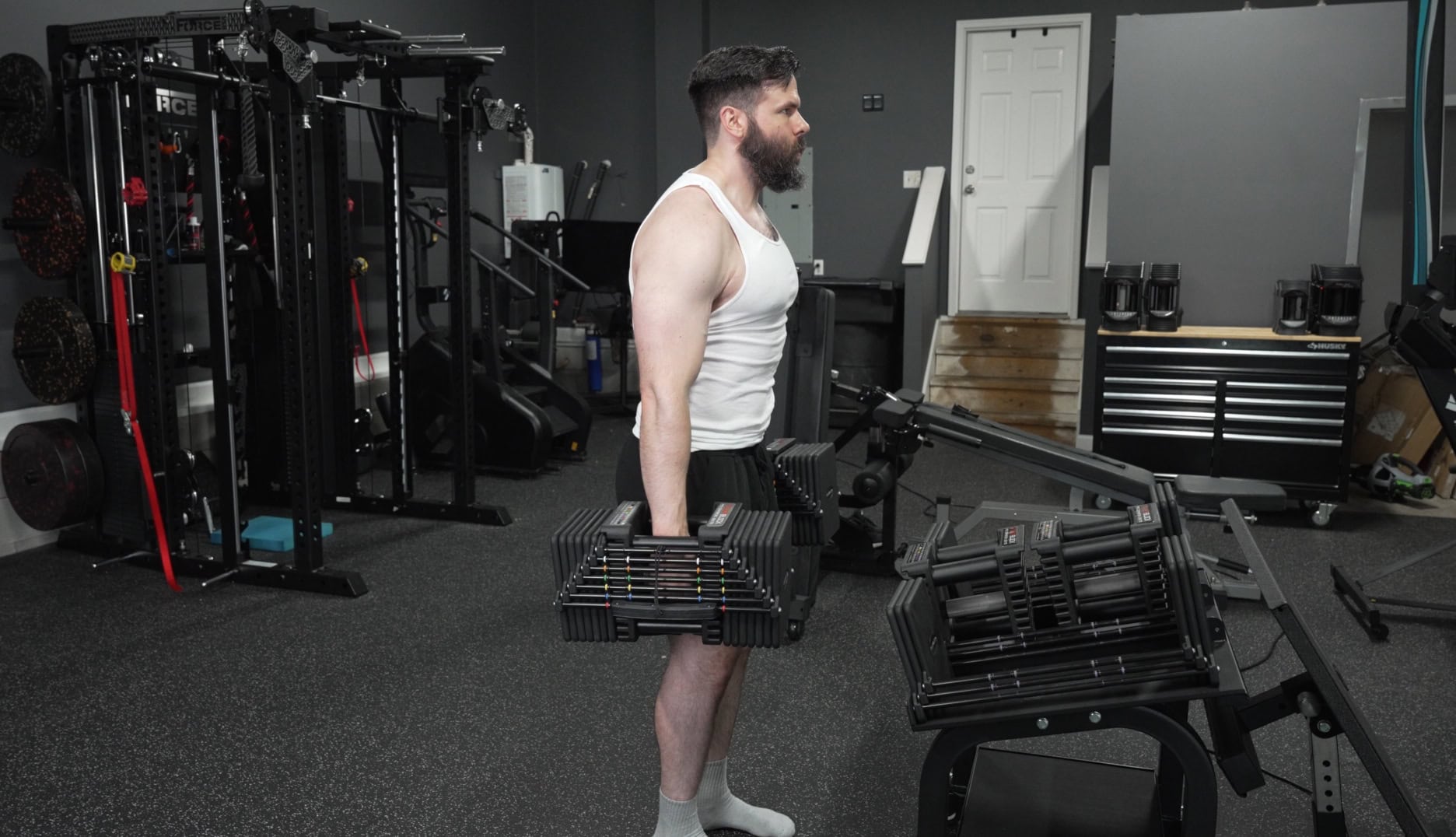
Most people reading this PowerBlock Commercial Pro 125/175 review probably don’t need this model; just gonna say that up front. This set costs a hefty $2,049 to $2,469, and its tradeoffs for price and bulkiness only pay off when you get into the heavier weight ranges.
But it does make sense for these buyers:
- Strong lifters whose heavy dumbbell presses and rows already sit at or above 100 lbs per hand
- College and pro training facilities, which is where you’ll see these most often
- Home gym owners who want a single set that covers their heaviest dumbbell work and have the budget for it
If your heaviest dumbbell work stays under 100 lbs, buy the Commercial Pro 100 instead. It’s my favorite PowerBlock overall, and the rest of this review explains why the 125/175’s extra weight capacity comes with some trade-offs that you may or may not be okay with.
PowerBlock Commercial Pro 125/175 Specs
| Spec | Detail |
|---|---|
| Weight range | 12.5 to 125 lbs per hand, or 12.5 to 175 lbs with the expansion kit |
| Increments | 7.5 lbs through the 125 lb base range |
| Adjustment | Selector pin plus swappable handles |
| Handles | 12.5 lb pair and 20 lb pair |
| Block weight | 15 lbs (base set) |
| Grip | 38 mm knurled stainless steel |
| Handle design | Closed frame with bare steel columns |
| Plates | Urethane-coated steel, flex frame |
| Weight indicators | Colored rings, both sides |
| Rail hardware | Stainless steel |
| Dimensions (L×W×H) | 21″ × 8.8″ × 9.1″ at 175 lbs |
| Stand | Commercial Pro Max Stand included ($429 value) |
| Attachments | None |
| Warranty | 1 year commercial, 5 years if used only at home |
| Price | $2,049 (125), $2,469 (175), $420 expansion kit |
125 or 175: Which Should You Buy?
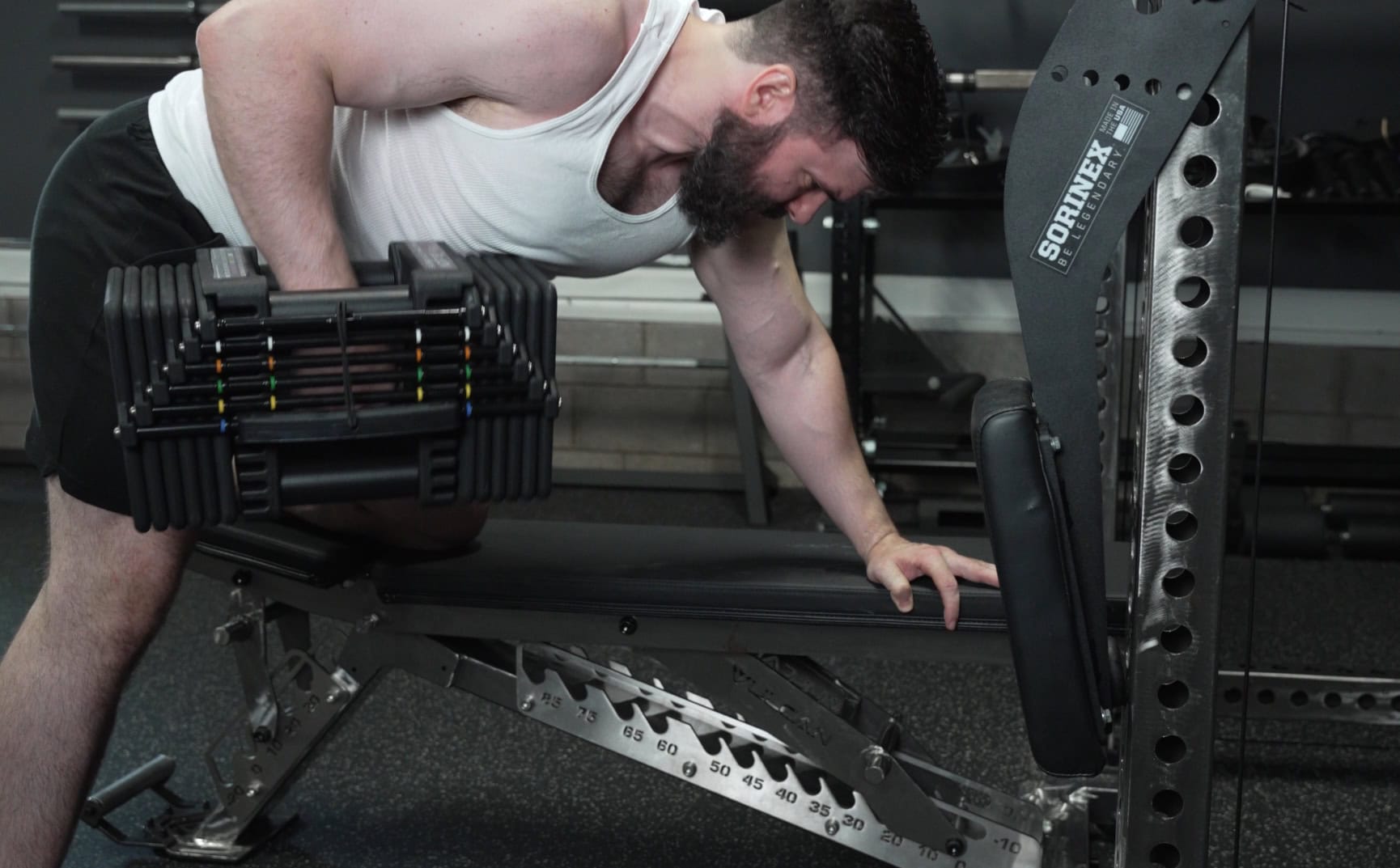
The 125 and the 175 are the same dumbbell.
The PowerBlock Commercial Pro 125 is the base set, and a $420 expansion kit turns it into the PowerBlock Commercial Pro 175.
The totals match to the dollar. $2,049 plus $420 is $2,469, which is the price of the 175 bought outright. Both versions include the Pro Max Stand. Staging the purchase over time doesn’t increase the price.
So the decision follows the same rule I use for every expandable PowerBlock. Buy the 175 now if you know you’ll lift above 125 lbs per hand. If you’re not sure, buy the 125 and pocket the $420 in savings until you need the extra weight.
How the PowerBlock Commercial Pro 125/175 Adjusts
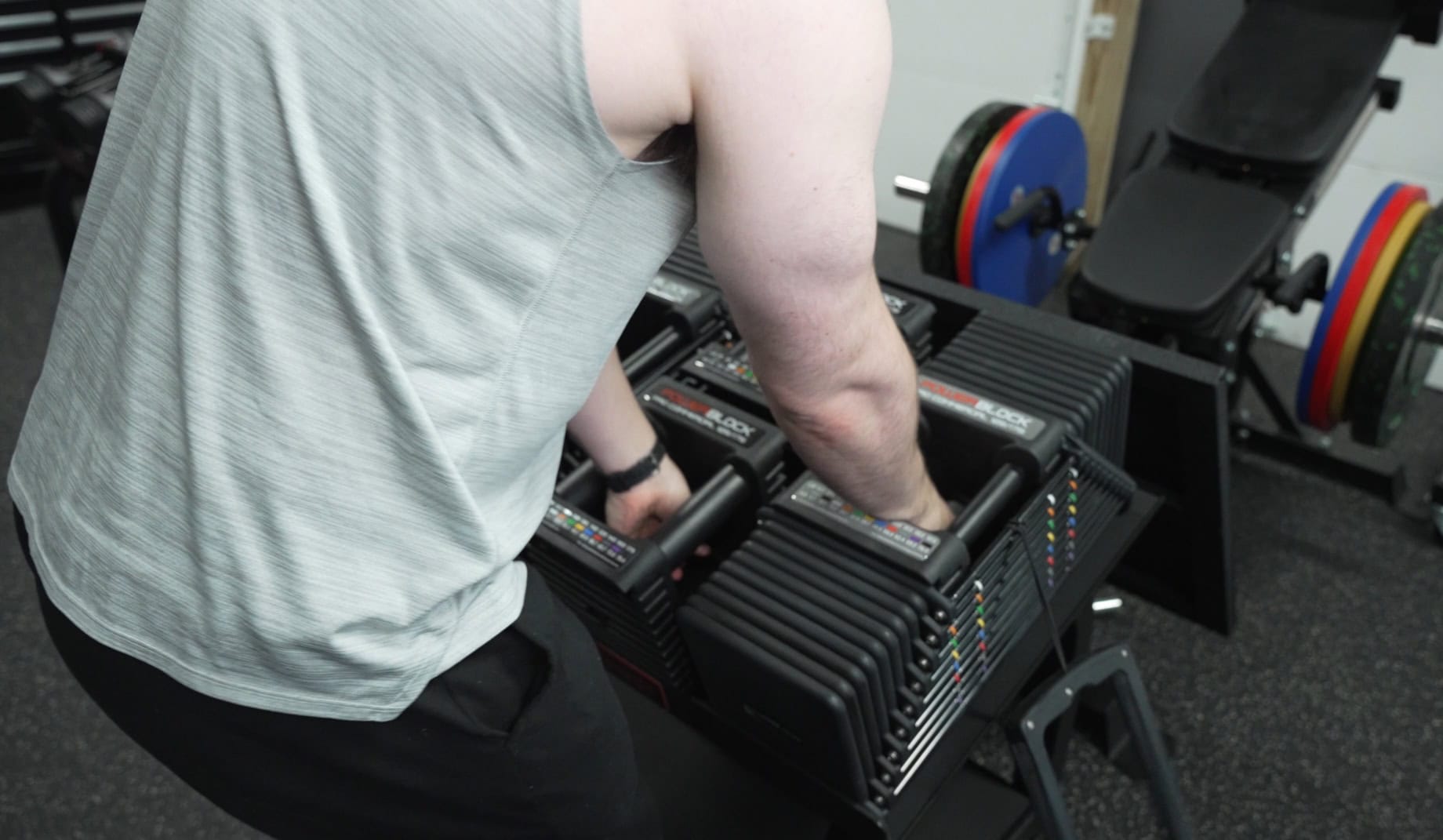
Every PowerBlock is self-contained. A handle sits inside a nested stack of weight plates, a magnetic nylon selector pin slides through the rail at the weight setting you choose, and you lift out exactly that load.
You don’t need a cradle or base, so you can change the weight on the floor, on a bench, or anywhere flat.
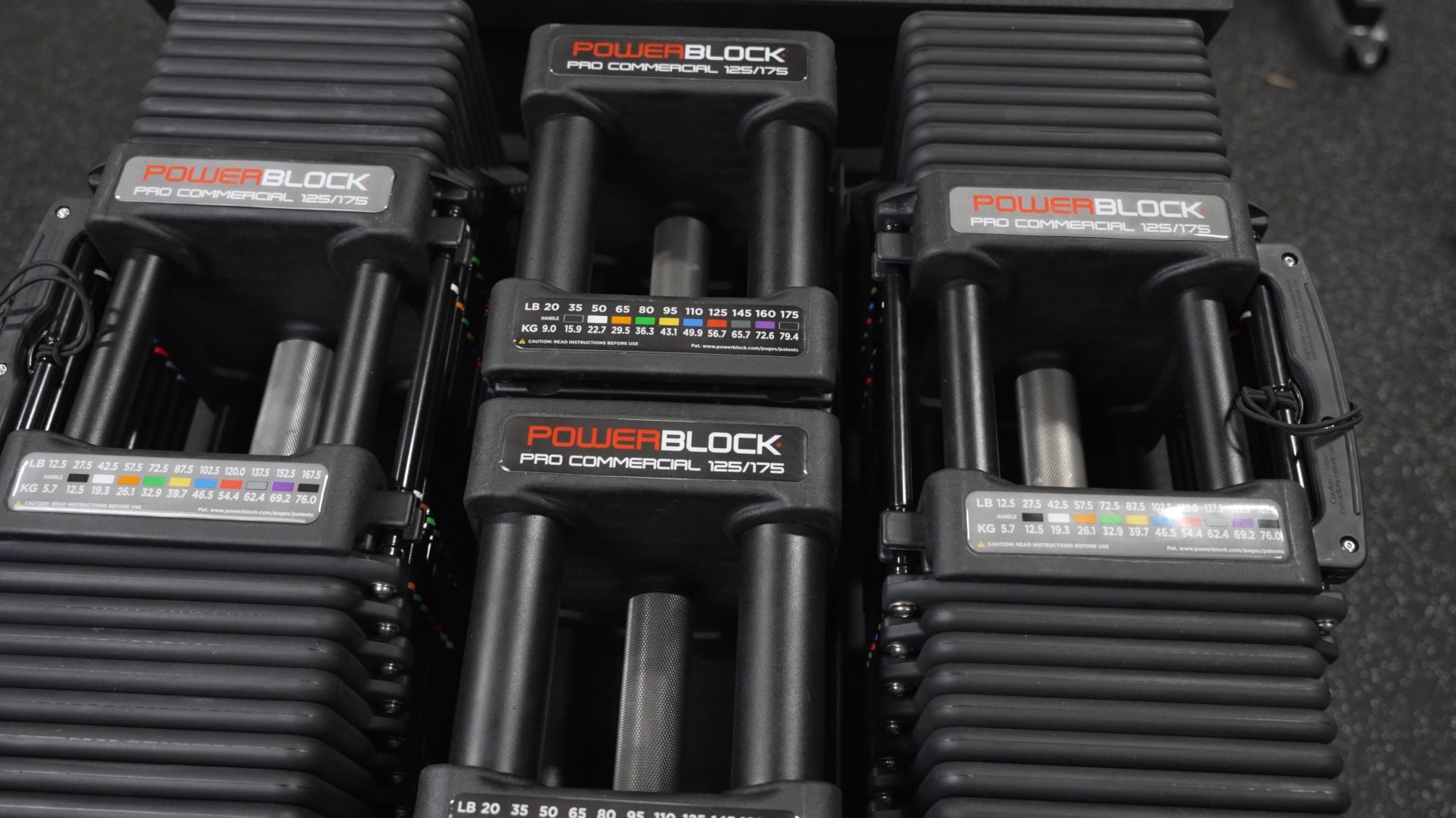
The commercial sets differ in how they cover the weights between the main plates. Most of the residential PowerBlocks use 2.5 lb micro weights in the handles for getting smaller increments. Whereas the PowerBlock Commercial Pro 125/175 uses two pairs of swappable handles instead: one at 12.5 lbs and one at 20 lbs.
With 15 lb plates, moving the pin changes the weight by 15 lbs, and swapping handles covers the 7.5 lb increments in between. Swapping a handle is faster than loading and unloading micro weights. And with no loose cylinders in the handle, the balance stays the same from one weight setting to the next.
What You Give Up for 175 lbs
Coarse Increments at the Light End
This is the biggest tradeoff. Definitely think about this one before you pull the trigger on buying.
For heavy compound lifts, 7.5 lb jumps are normal progression. That is, moving from 95 to 102.5 on a row or a press is a reasonable jump.
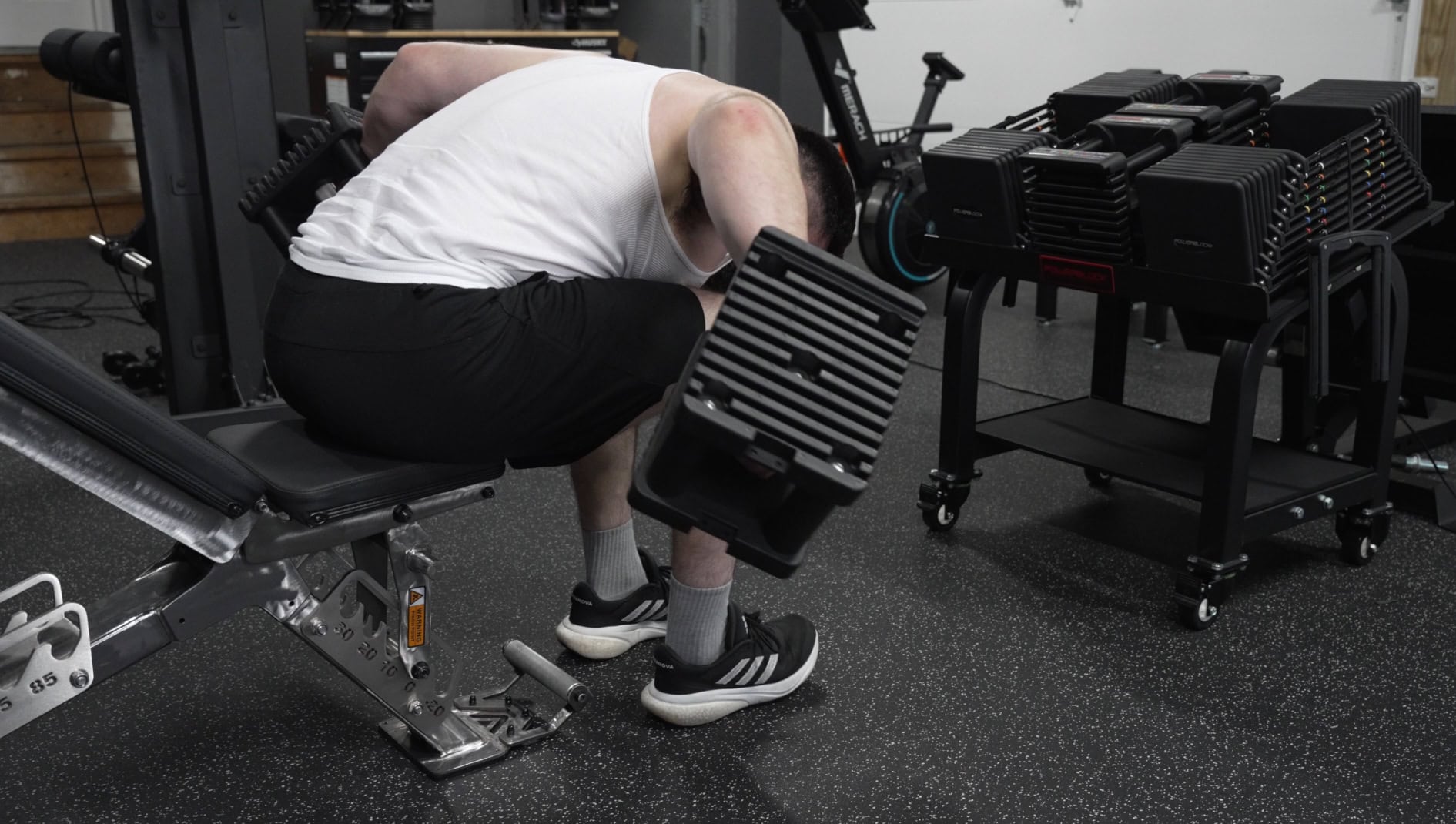
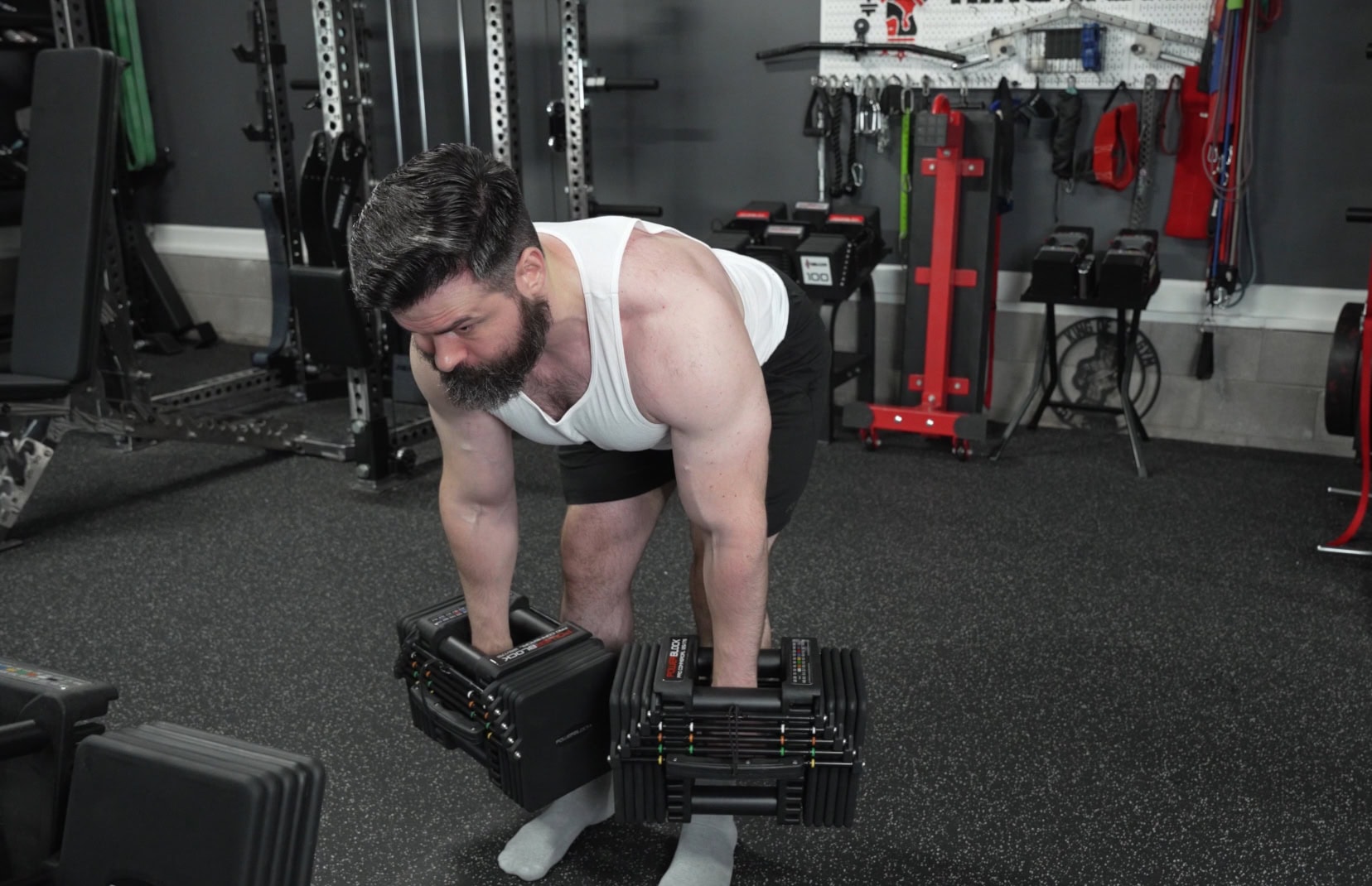
At the light end, it’s a different story. The two lightest settings are 12.5 and 20 lbs, so lateral raises and rear delt flyes jump 60% in one increment change. If these will be your only dumbbells and you do a lot of lighter accessory work, those big increments will frustrate you.
For comparison, the Commercial Pro 100 moves in 5 lb increments, and the residential micro-weight models move in 2.5 lb jumps.
Bulk
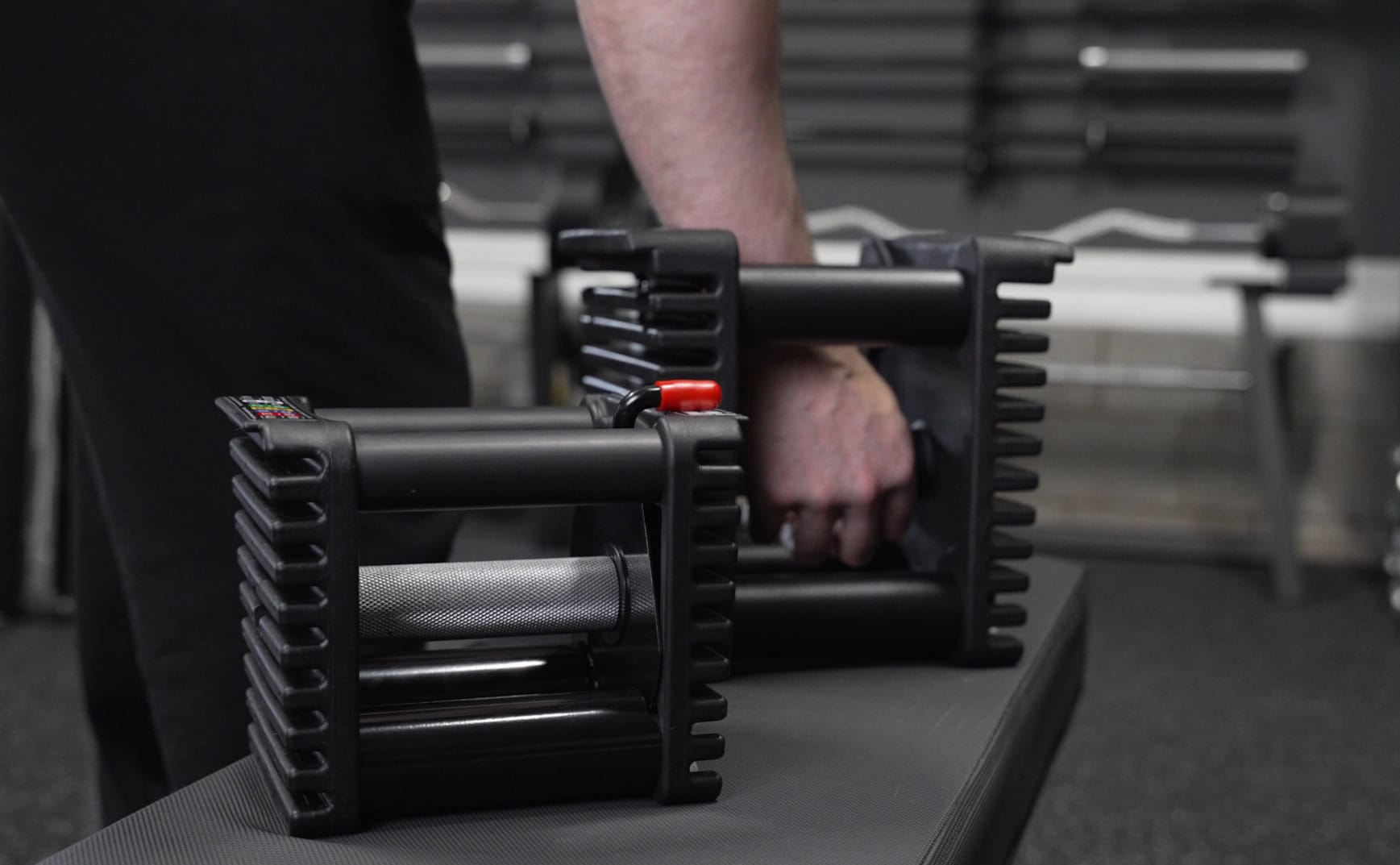
Compared to the Commercial Pro 100, the 125/175 set is about 1.25 inches wider and 1.375 inches taller.
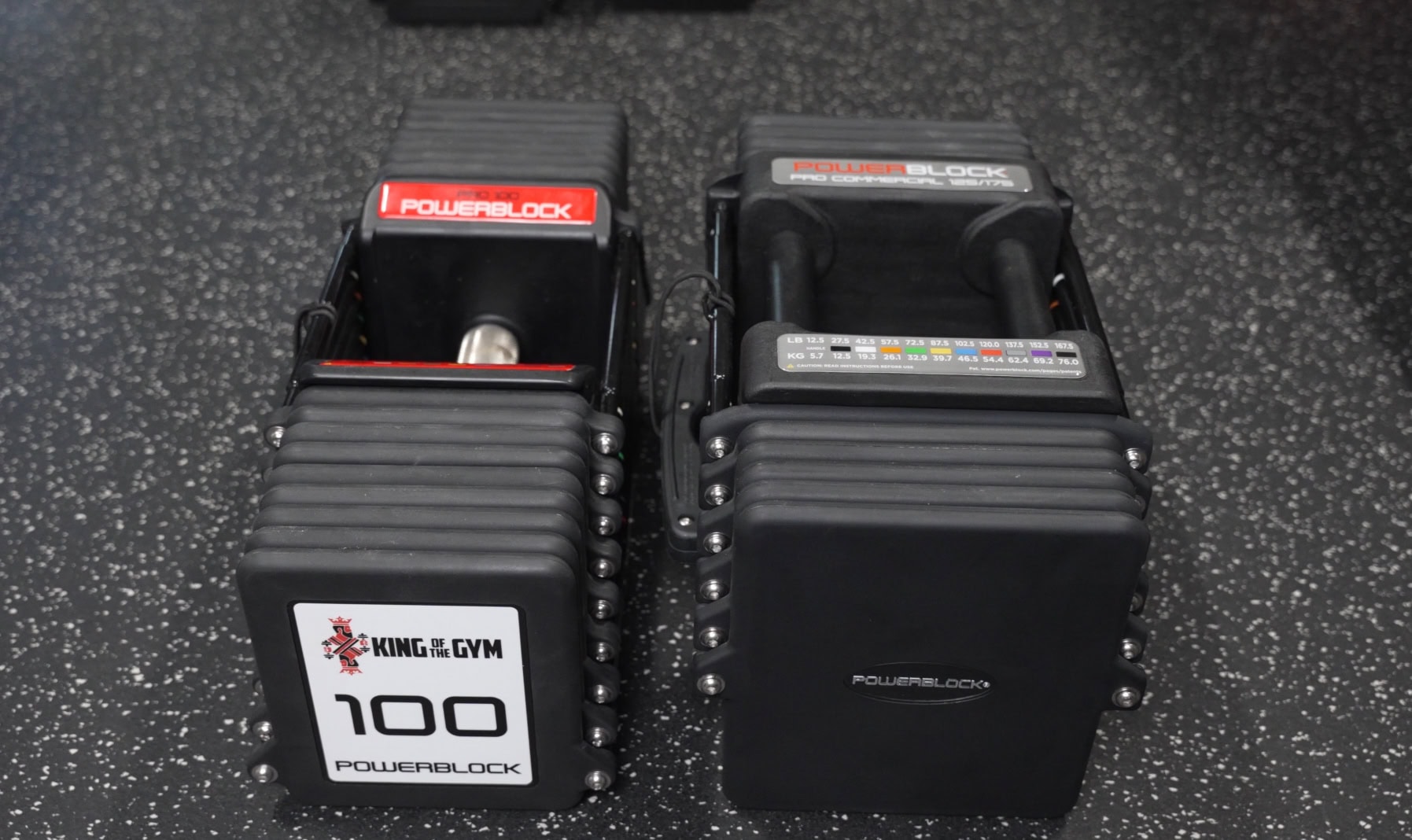
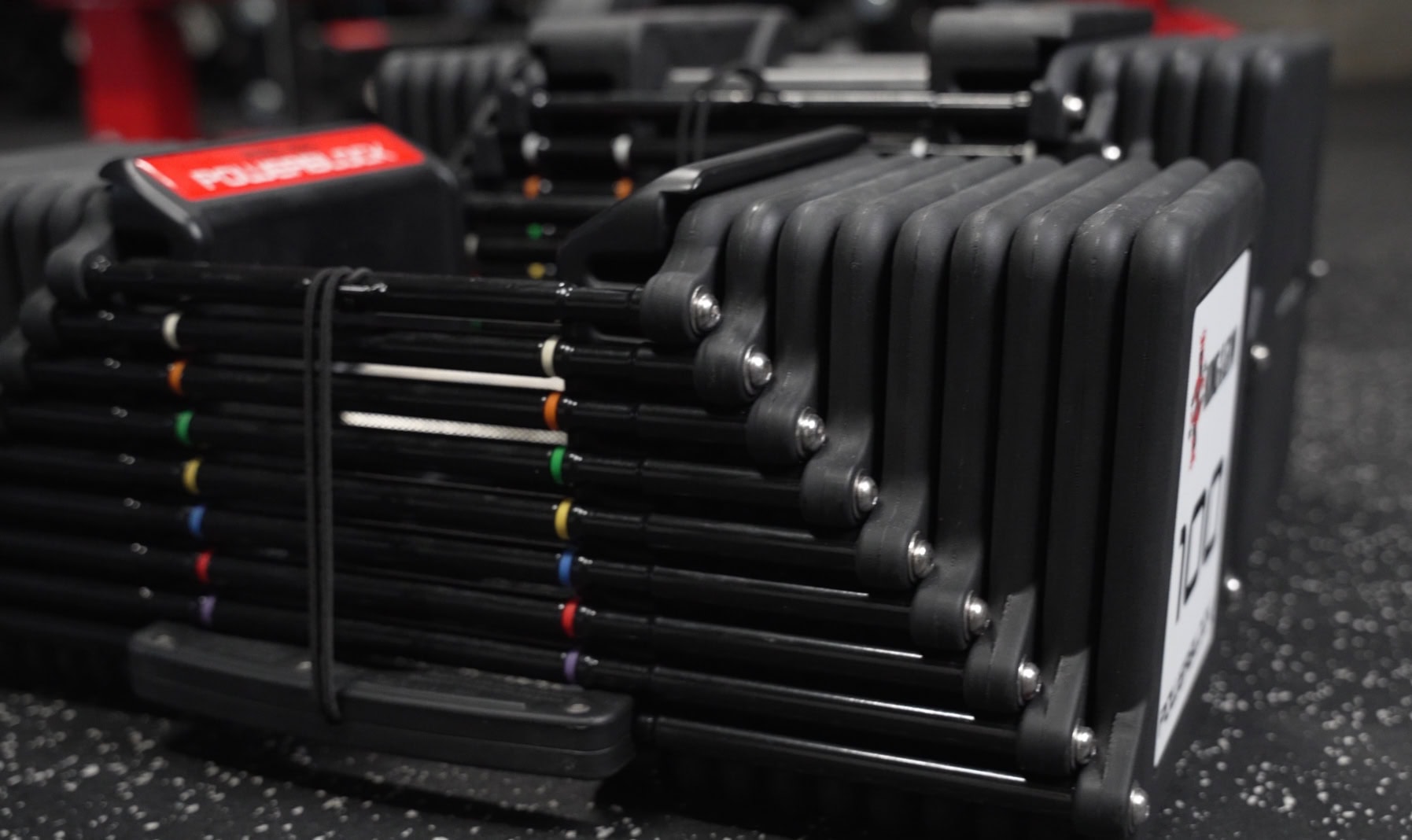
Your hand also sits deeper inside the frame, so the blocks reach your body sooner.
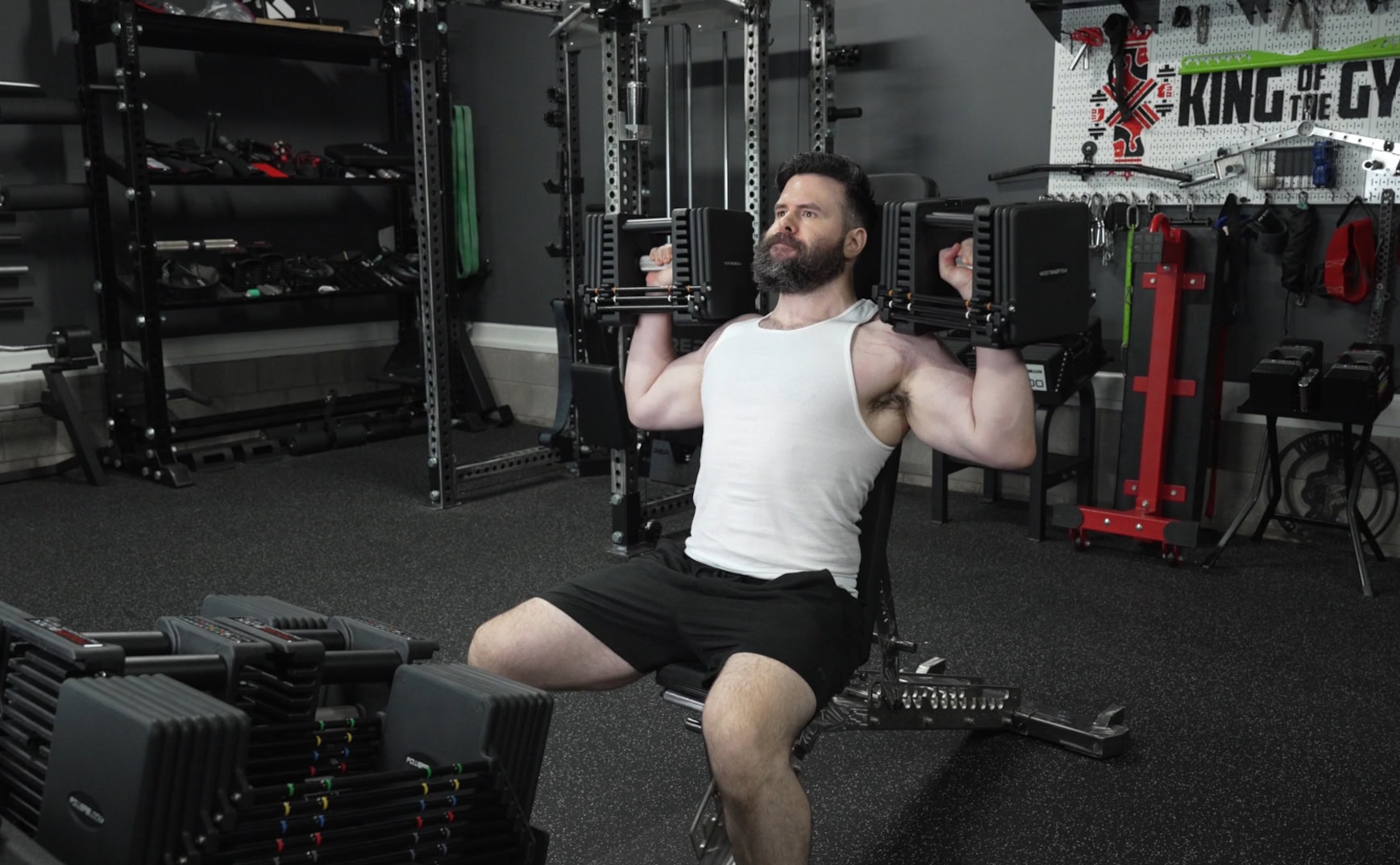
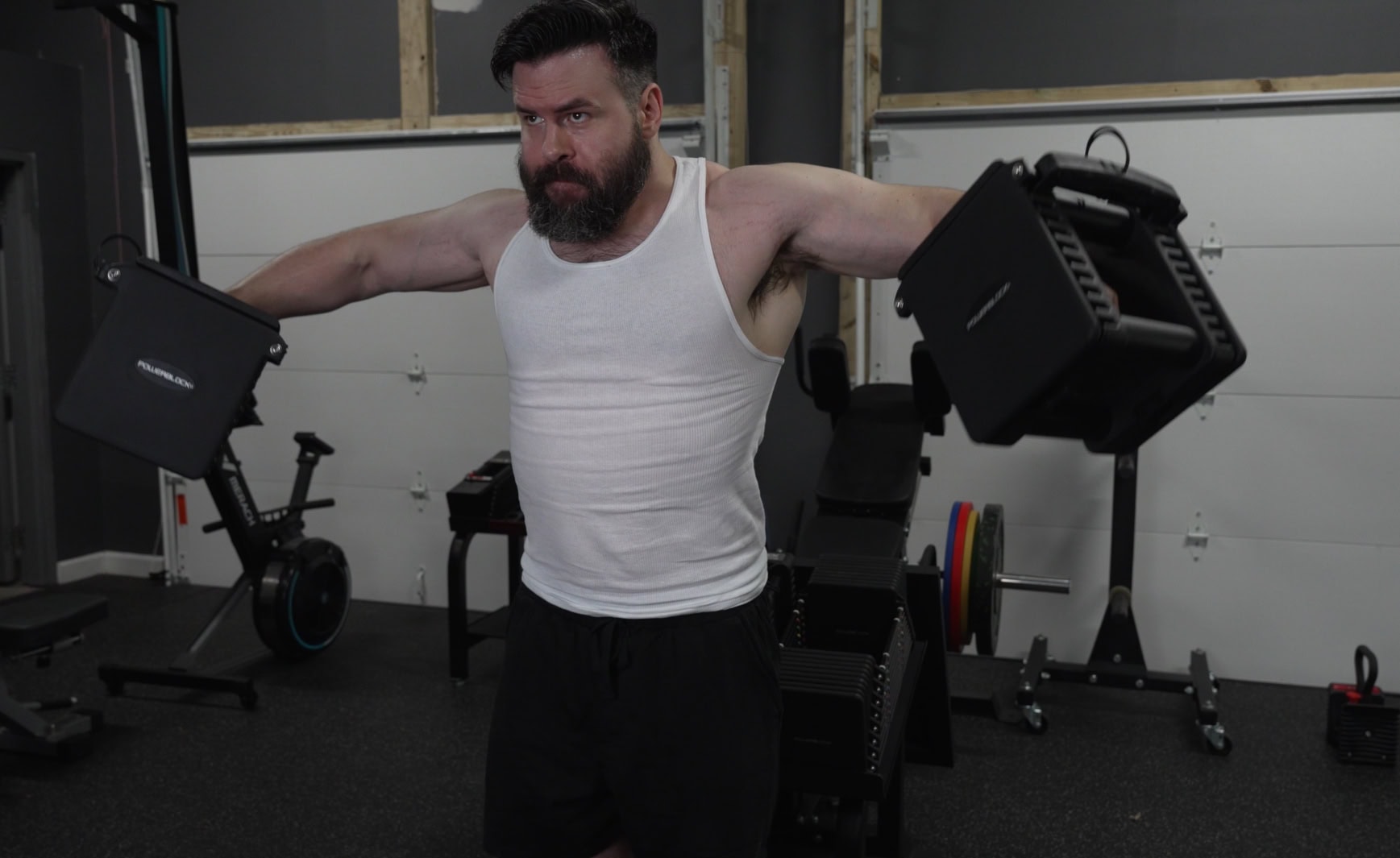
On shoulder press, I still get a full range of motion, but at the bottom of a deep stretch, the blocks tap my shoulders.
No Attachments
The PowerBlock Commercial Pro 125/175 works with none of the bar or kettlebell attachments PowerBlock sells.

If a bar or a rotating kettlebell handle is part of your plan, the Pro 100 EXP and Commercial Pro 100 both work with the full Pro 100 attachment family.
Price
At $2,049 to $2,469, this is the most expensive set PowerBlock makes. The cost per pound section later on in this review puts that number in context, but it’s still a lot of money for one pair of dumbbells.
The Size Advantage I Didn’t Expect
For this PowerBlock Commercial Pro 125/175 review, I compared lengths at matched weights, and the result surprised me.
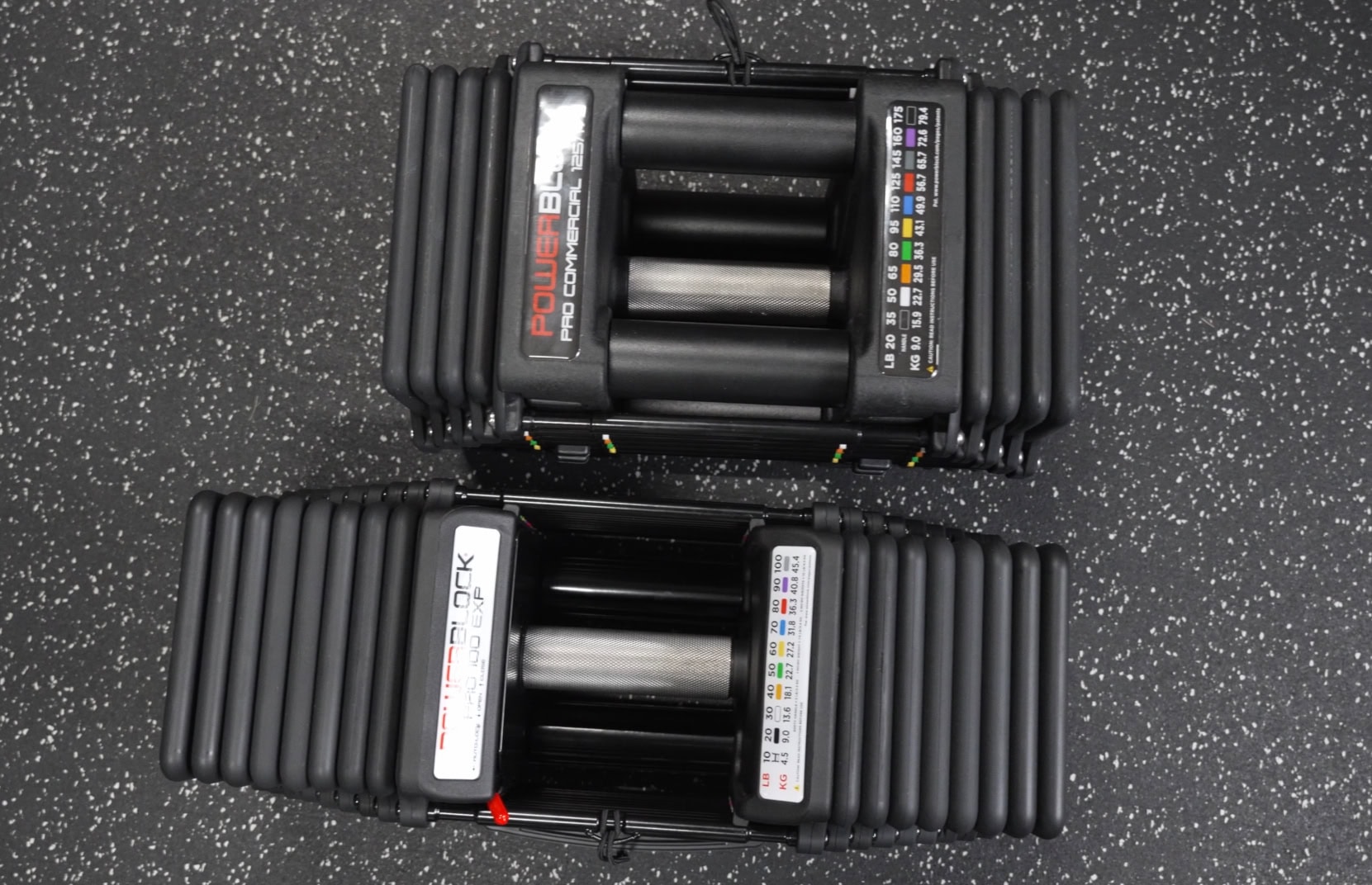
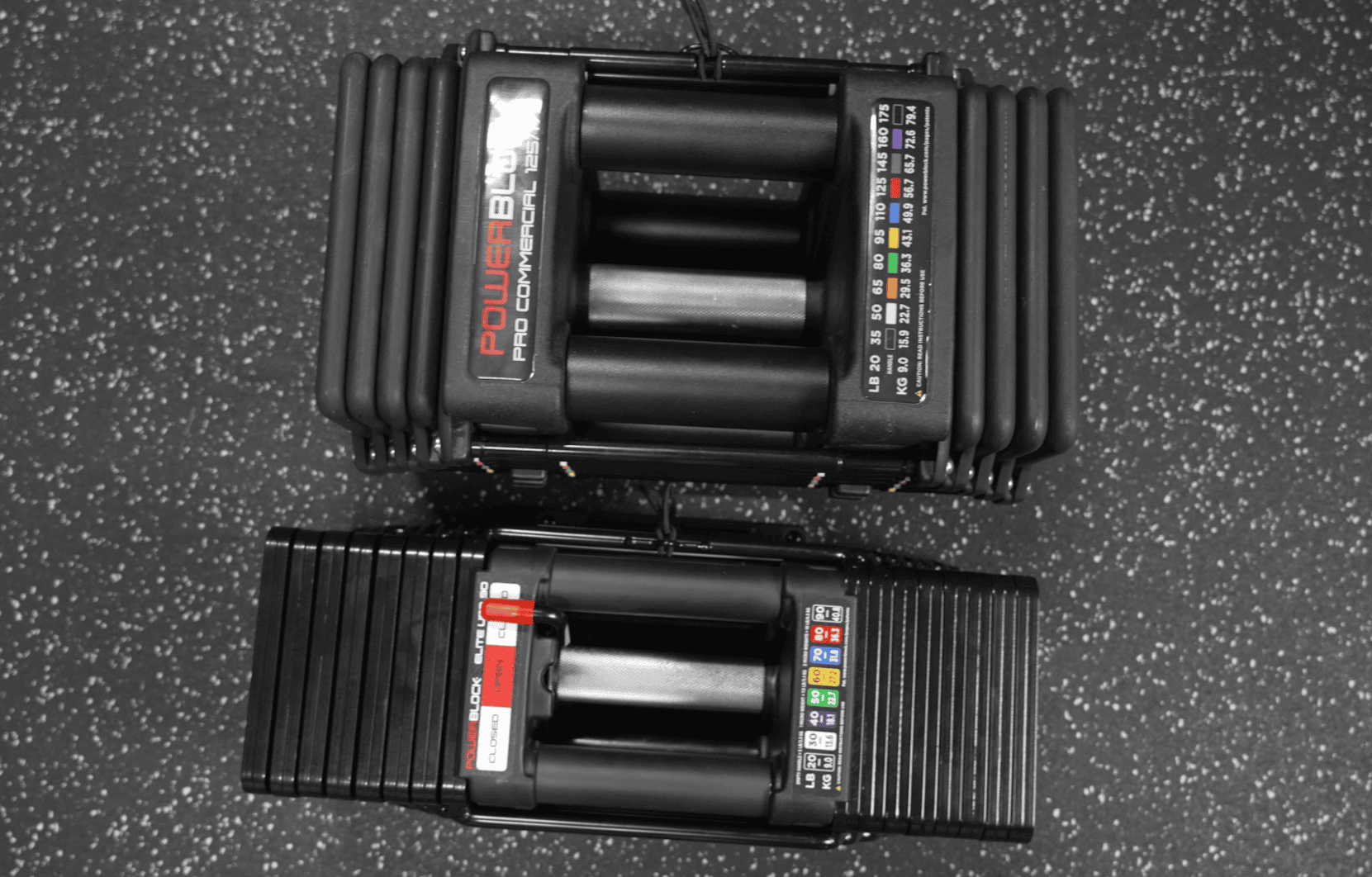
Despite being wider and taller (or really, because of it), the PowerBlock Commercial Pro 125/175 is shorter than the other heavy PowerBlocks at the same weight.
When set to about 100 lbs, it’s a full 3.5 inches shorter than a maxed-out Pro 100. At about 90 lbs, it’s roughly 1.5 inches shorter than the Elite models.
Length is the dimension you feel most on pressing, because it determines how close the dumbbells can come together at lockout. On a heavy dumbbell bench press at a given weight, this set gives you more room than any other heavy PowerBlock.
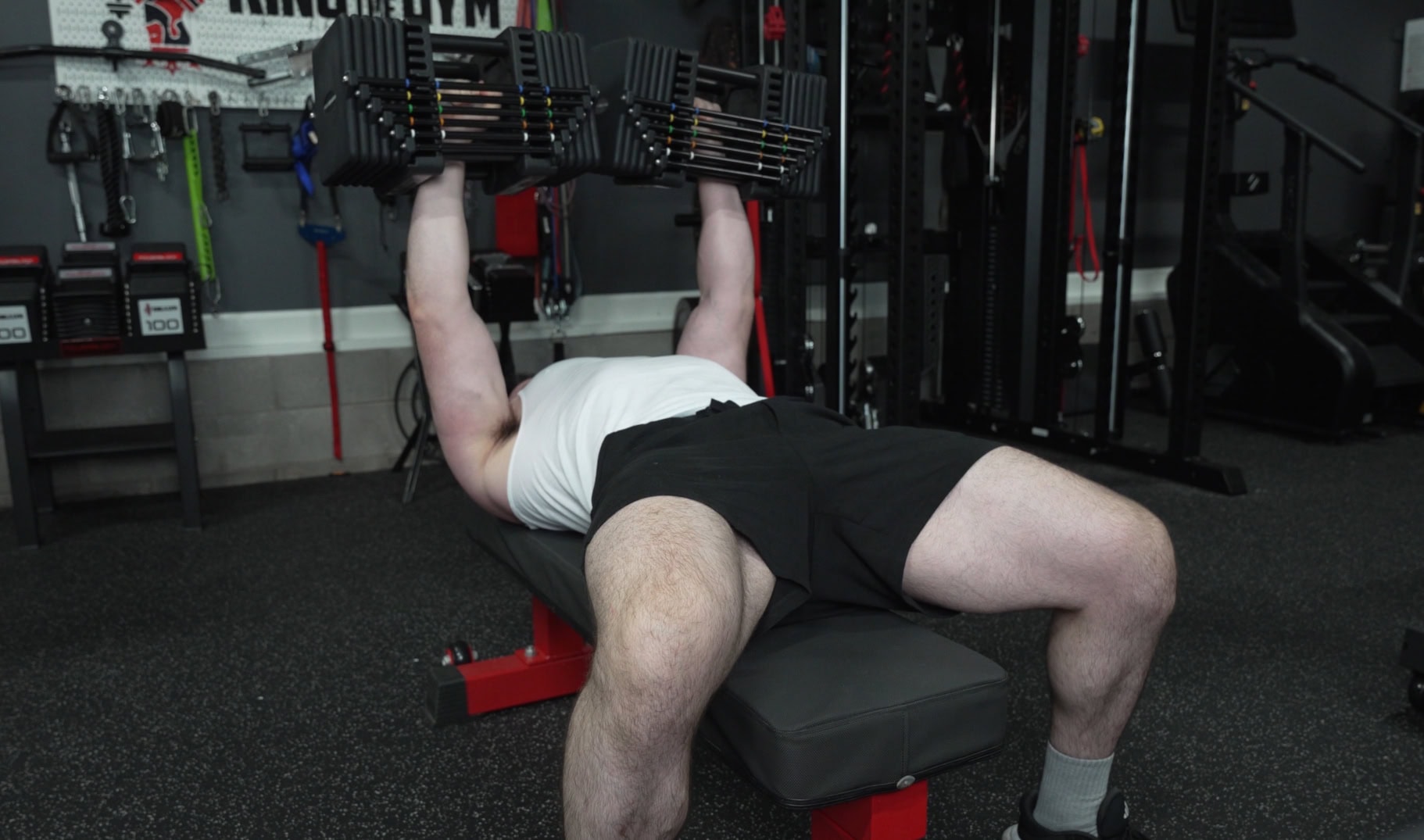
At a full 175 lbs, it measures 21 inches long, which does make it the longest PowerBlock in the lineup. Per pound of weight it carries, though, it’s still the most compact heavy set PowerBlock makes: about 0.12 inches of length per pound, against roughly 0.19 for a maxed Pro 100 and 0.18 for a maxed Elite.
Grip and Handle
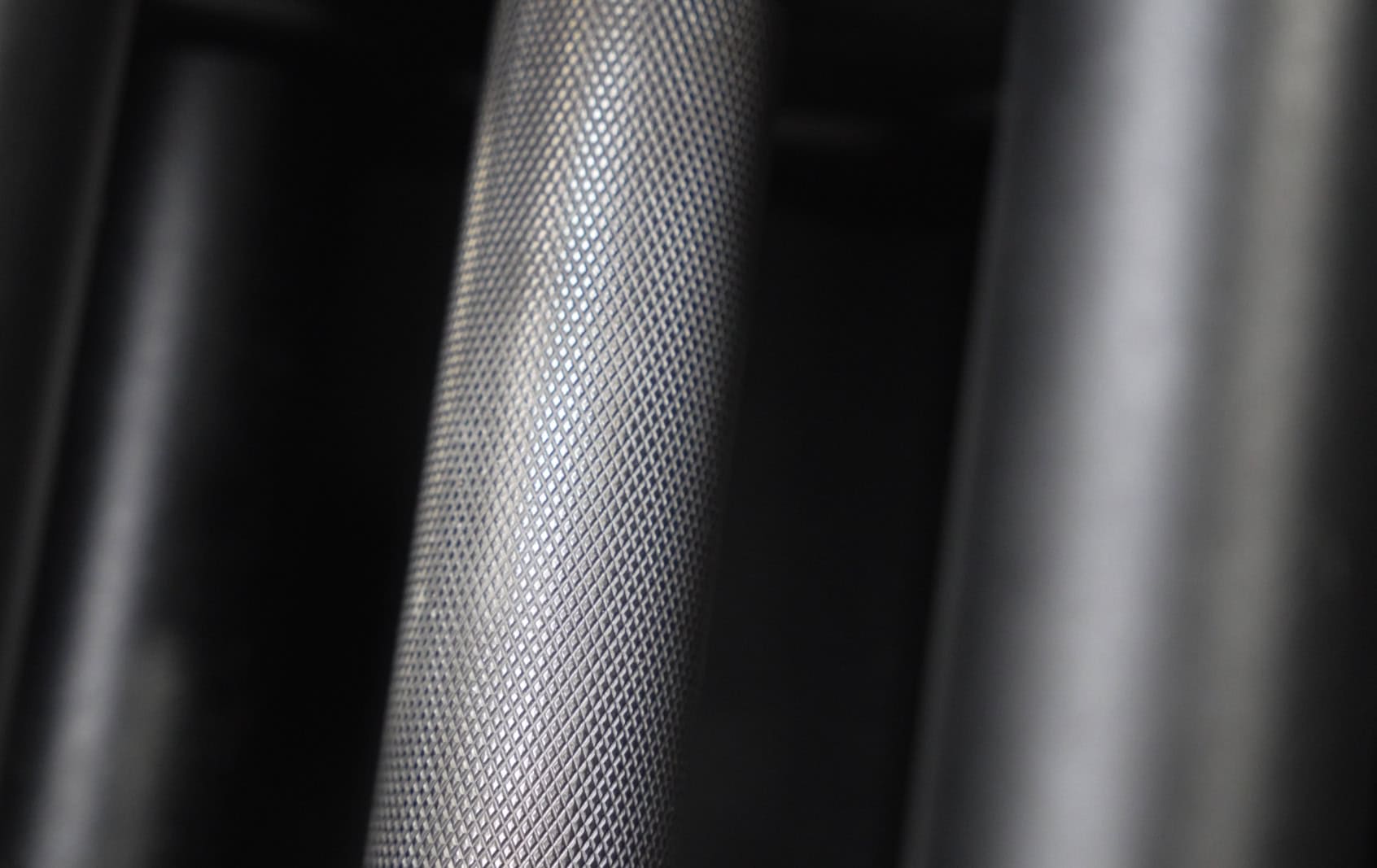
The grip is 38 mm knurled stainless steel, with the same medium-intensity knurl as the Pro 100 EXP and Commercial Pro 100. It’s thick enough to fill the hand and holds securely under heavy loads. I personally prefer it to the 32 mm grips on the Elite USA model.
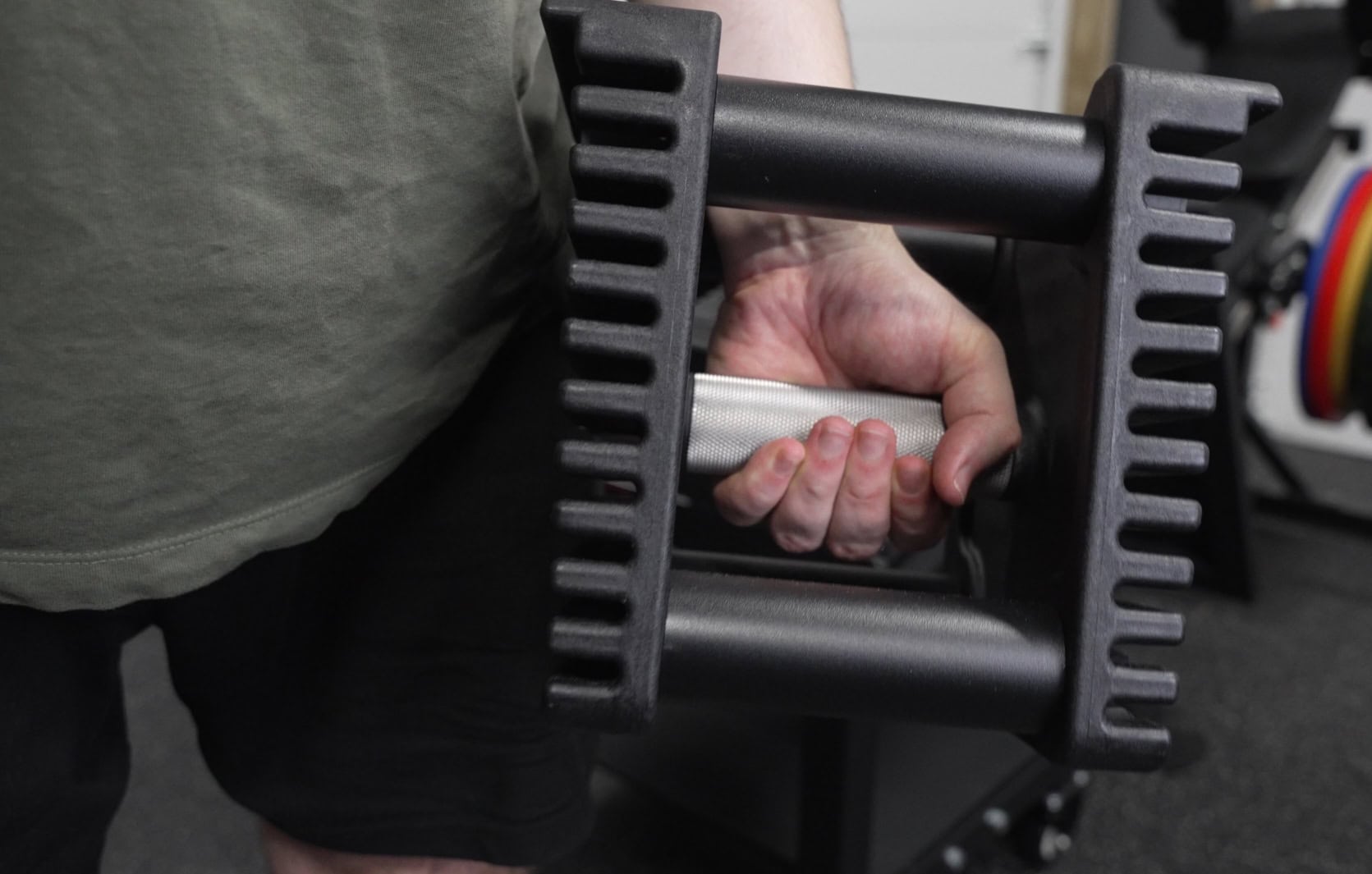
The handle is a closed, squared-off frame rather than the open handle, wedge-shaped design on all the other Pro Models. The columns at the top can act as wrist supports in the way the padded ones do on the Elite models.
However, the supports are bare powder-coated steel rather than padded and they’re also spaced further apart, so it may not be as easy to prop against your forearm.
The Elite’s closed handle feels cramped to a lot of lifters with bigger hands. The handles on the 125/175 are so much larger overall that the problem doesn’t carry over. If you found the Elite restrictive, you won’t here.
Balance and Build
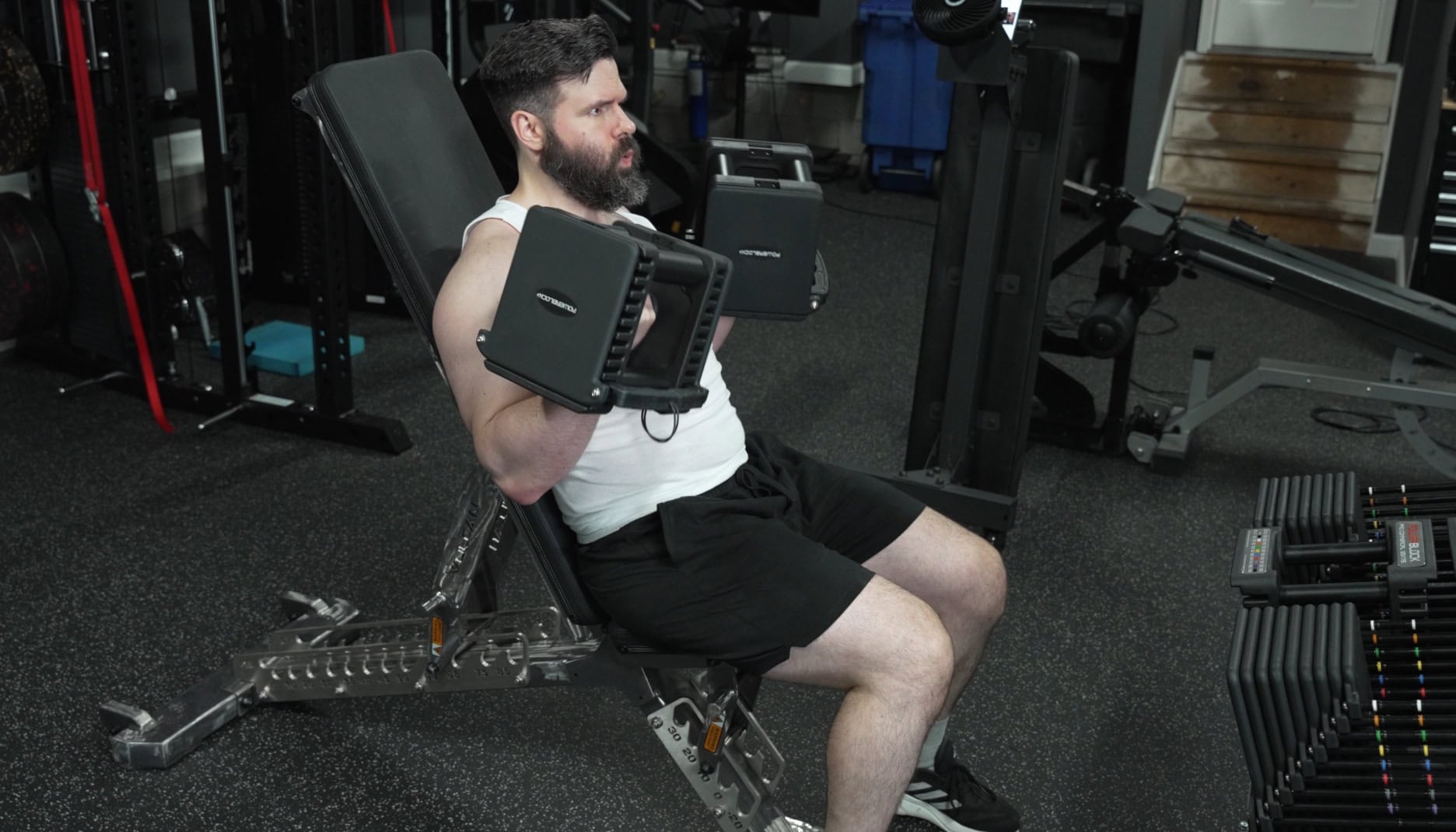
The PowerBlock Commercial Pro 125/175 balances better than any micro-weight model in the lineup. With no cylinders in the handle, the center of gravity doesn’t shift depending on if/how many micro-weights you have installed. However, it trails the Commercial Pro 100 slightly in terms of balance, mostly because it’s a bigger unit. Like every PowerBlock dumbbell, some of the weight sits out in the side rails, so it won’t feel identical to a fixed dumbbell.
The build matches the Commercial Pro 100, but scaled up. The urethane-coated plates on PowerBlock’s flex frame keep racking and lifting quieter and make the dumbbells comfortable to drop/rest onto your thighs.
The ring indicators sit on both sides of the plates, so you can see the which color-coded weight setting you’re selecting from either direction (compare to the Elite models where the color-coding is only on side of the plates).
The hardware joining the rails to the urethane is stainless steel instead of the black zinc used on residential sets, which holds up better over years, particularly in a humid garage enviroment.
You’ll most often see PowerBlock Commercial Pro 125/175 sets in college and pro athletic training rooms. But I’ve also seen plenty of them in the home gyms of very strong lifters. So don’t let the “Commercial” category scare you away from these if you otherwise like them.
What It Costs Per Pound
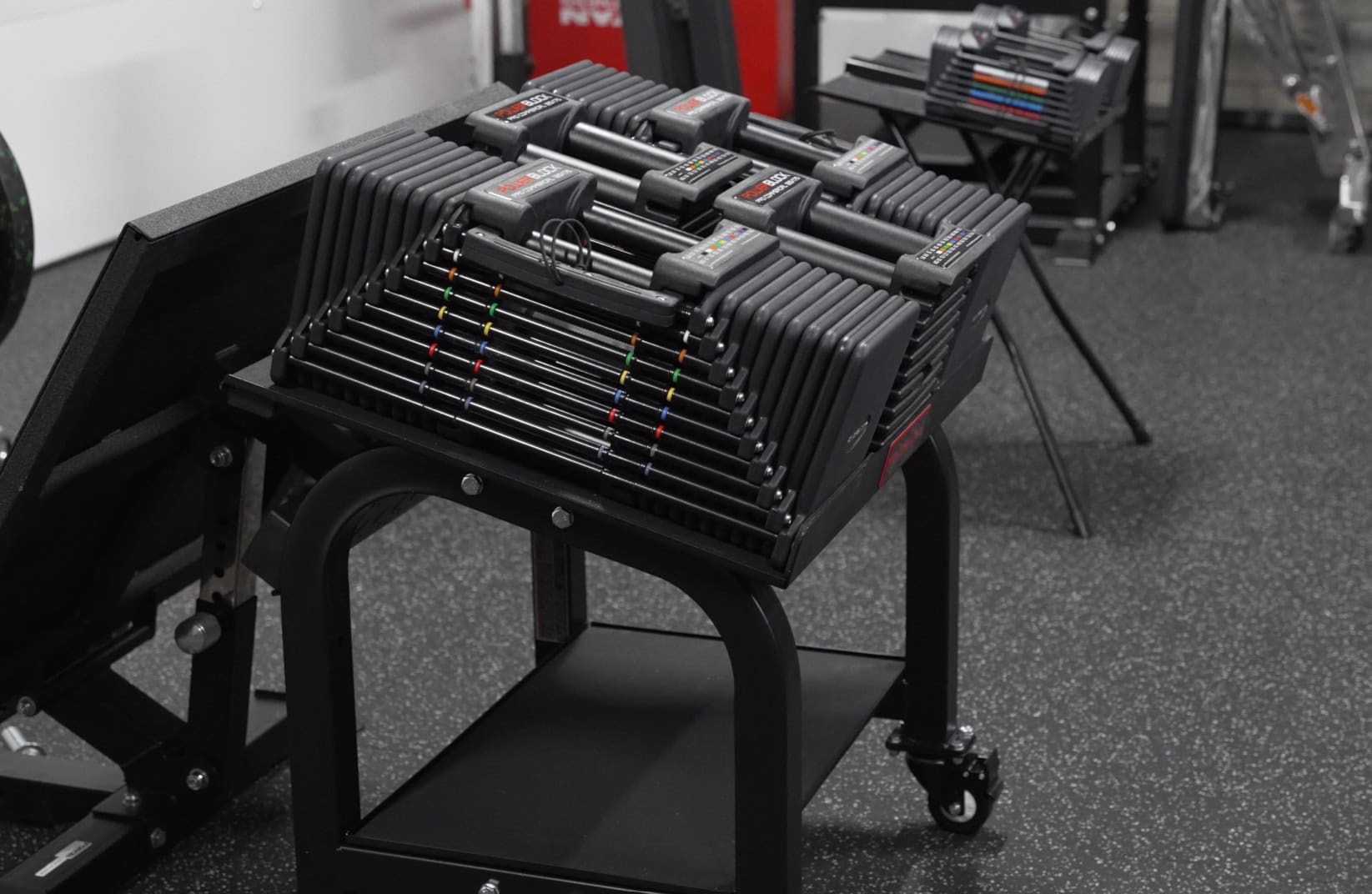
The sticker looks steep (and indeed, it is), but it becomes a bit more reasonable when you divide it by the 125/175’s weight capacity. So I’ll show you what the cost per pound looks like in the table below:
| Set (with Pro Max Stand) | Price | Max per hand | Cost per lb of capacity |
|---|---|---|---|
| PowerBlock Commercial Pro 175 | $2,469 | 175 lbs | $14.11 |
| PowerBlock Commercial Pro 125 | $2,049 | 125 lbs | $16.39 |
| Commercial Pro 100 | $1,759 | 100 lbs | $17.59 |
With the stands matched, the 175 is the cheapest heavy commercial PowerBlock per pound. It adds 75 lbs of capacity over the Commercial Pro 100 for $710 more.
The comparison that makes the price look like a good deal is fixed dumbbells. Covering 15 to 175 lbs in standard 5 lb steps takes 33 pairs, about 6,270 lbs of iron, and a multi-tier rack to hold it all. Of course, fixed dumbbells give you finer increments, but the 125/175 set puts that same weight range into one compact pair of dumbbells on one rolling stand.
One caveat: a low cost per pound only counts if you actually use all those pounds. If you’ll never go past 100, the lower per-pound figure doesn’t help you, and the Commercial Pro 100 (or Pro 100 EXP) is the better buy.
The Included Pro Max Stand
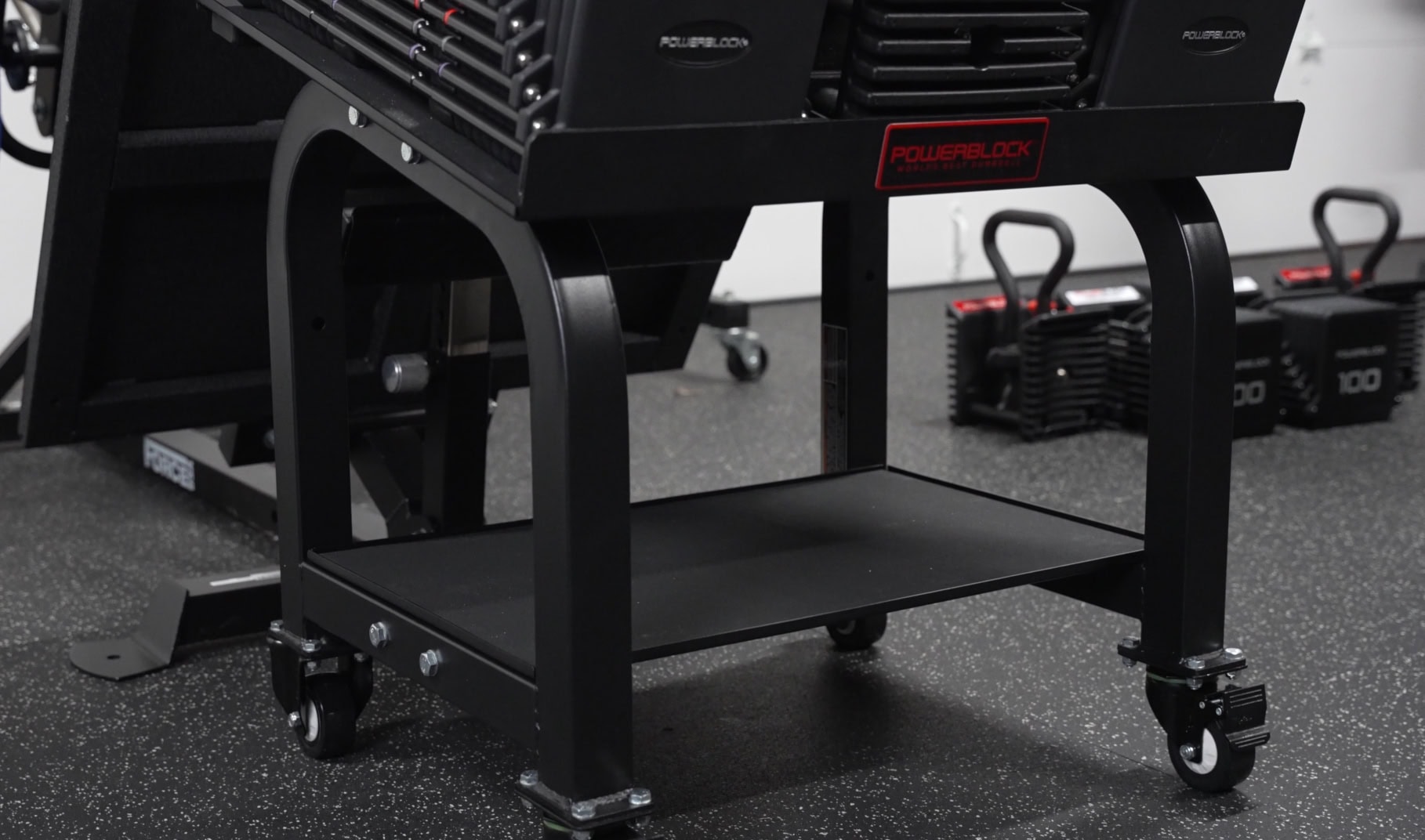
The Pro Max Stand comes with the set, and it’s the only PowerBlock stand that will fit this much weight. It sells for $429 on its own; and for what it’s worth, it’s also an uprgrade option at checkout for the Commercial Pro 100 model.
The locking caster wheels roll a fully loaded pair, over 350 lbs of total weight, around the gym without trouble, and they hold in place when locked. There’s a large lower shelf for storage, too, which definitely comes in handy for other PowerBlock items or general gym gear.
It’s utilitarian to look at, but it works very well.
Pair It With a Light Set
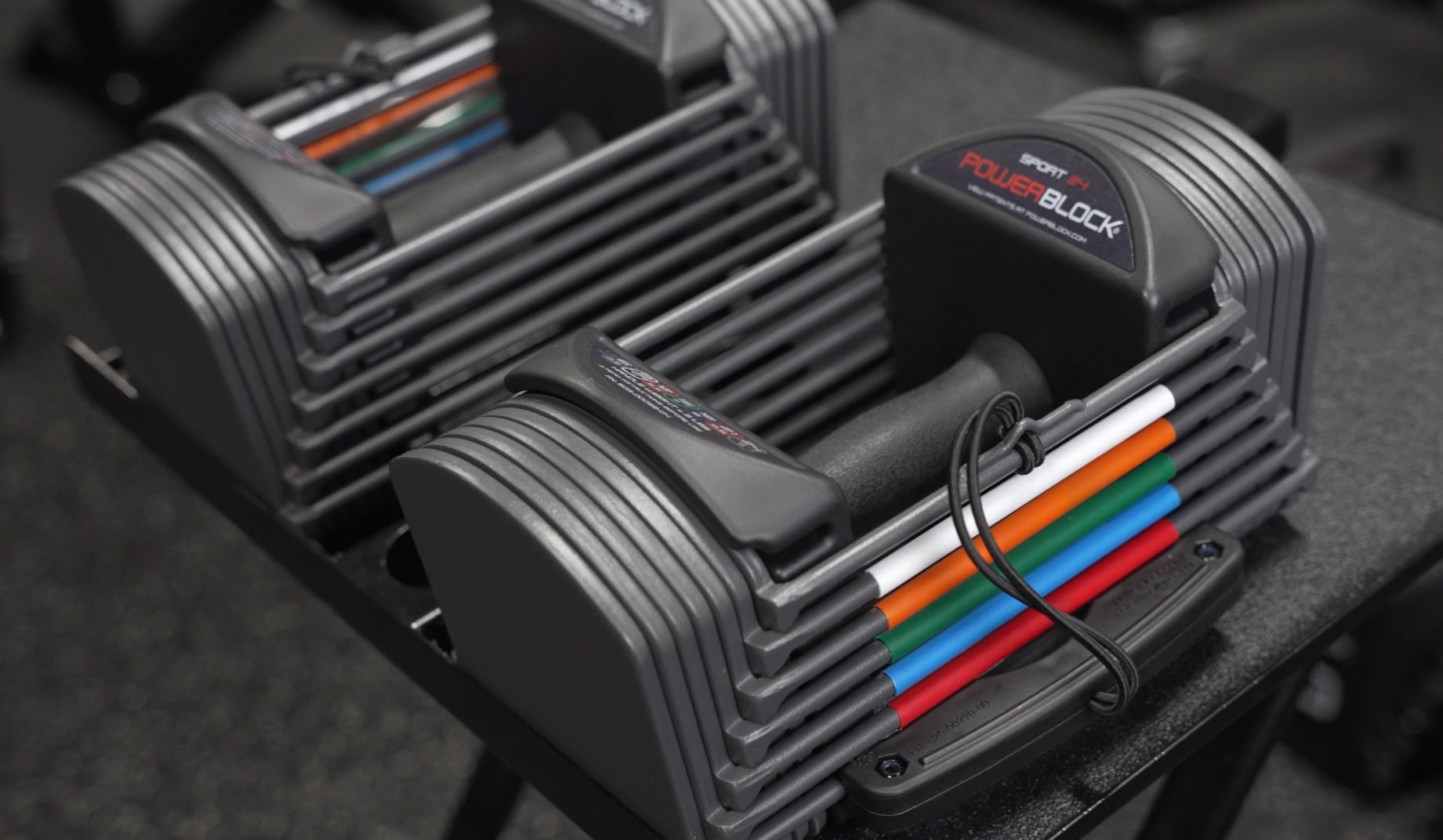
If these will be your only dumbbells, consider adding a light set to cover the gap between 12.5 and 20 lbs.
- Sport 24 ($219): 3 to 24 lbs in 3 lb steps, if you only need the lightest range.
- Pro 50 ($549): 5 to 50 lbs in 2.5 lb steps with no skipped increments.
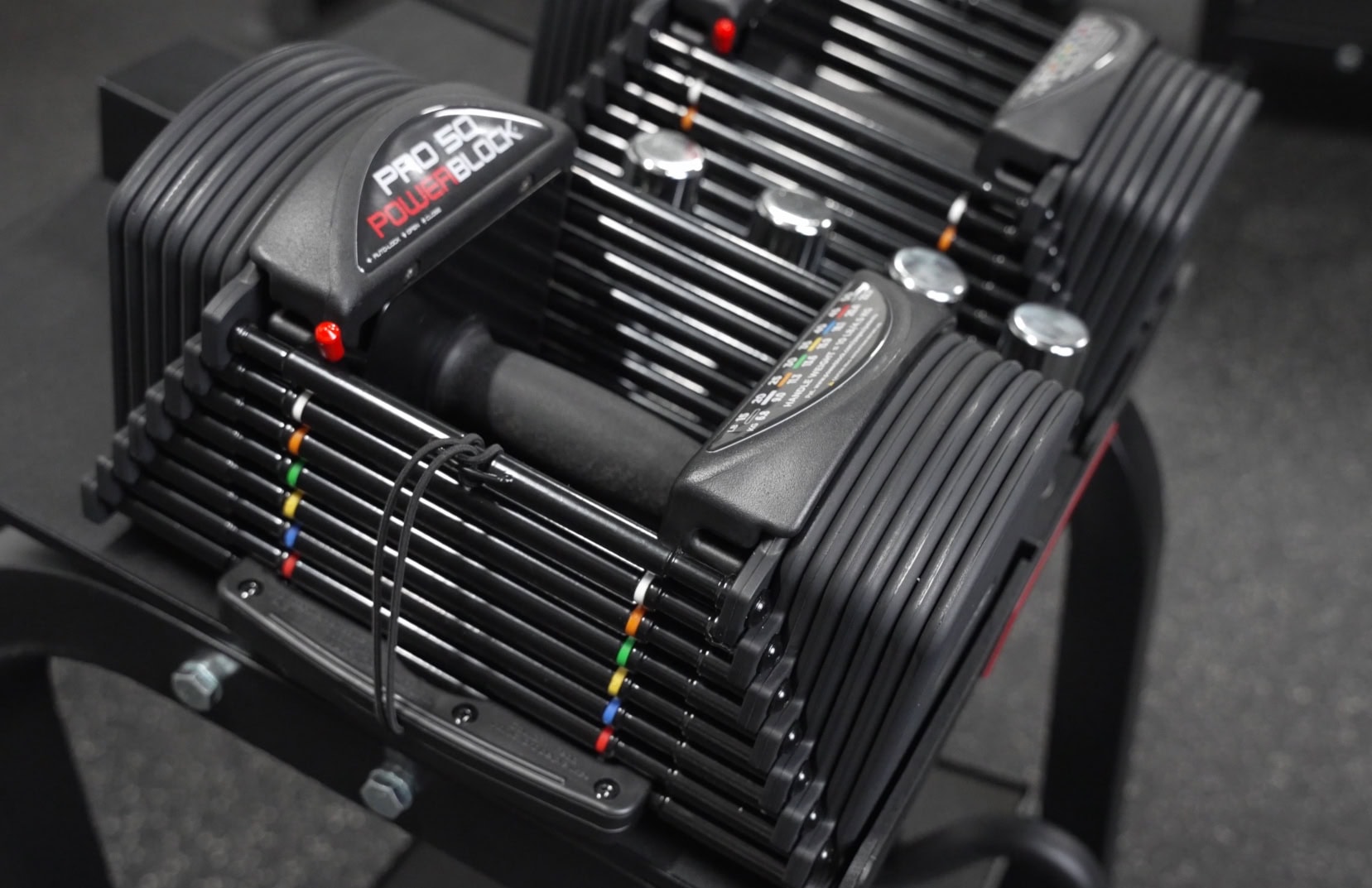
With a light set for raises and small-muscle work, you’d use the PowerBlock Commercial Pro 125/175 for compound lifts and heavy isolation movements only, where the 7.5 lb steps aren’t a problem.
Warranty
The commercial sets carry a 1 year commercial warranty.
However, PowerBlock confirmed to me directly that when a commercial set is used only in a residential setting, the 5 year residential warranty applies instead. So a home gym owner doesn’t give up coverage by buying commercial.
The warranty covers materials and workmanship defects. It excludes misuse, including drops from above 6 to 12 inches depending on the model.
Exercises No PowerBlock Can Do
This applies to the whole lineup, but it’s worth knowing before you spend over $2,000. The side rails keep you from gripping the ends of the dumbbell with two hands, which rules out:
- Bilateral overhead triceps extensions
- Dumbbell pullovers
- Goblet squats
However, the square cage design lets you do push-ups gripping the blocks for a deeper stretch, and renegade rows on a base that won’t roll the way a round dumbbell does.
PowerBlock Commercial Pro 125/175 Pros and Cons
Here’s the short version of this PowerBlock Commercial Pro 125/175 review.
Pros:
- Goes to an incredibly heavy 175 lbs per hand
- Buying the 125 and expanding later costs the same as buying the 175 outright
- 38 mm knurled stainless steel grips
- Swappable handles adjust faster than micro weights
- Better balanced than any micro-weight PowerBlock
- Shorter than other heavy PowerBlocks at matched weights
- Far more forearm room than the Elite’s closed handle
- Pro Max Stand with locking casters included ($429 value)
- Stainless steel rail hardware and commercial warranty
Cons:
- Larger 7.5 lb increments
- Very bulky in terms of width and height
- Your hand sits deep in the frame, so the blocks reach your body sooner
- Frame column wrist supports are bare steel
- No bar or kettlebell attachments
- Most expensive PowerBlock set ($2,049 to $2,469)
- Not as balanced as the Commercial Pro 100 due to bulkiness
PowerBlock Commercial Pro 125/175 vs Other PowerBlocks
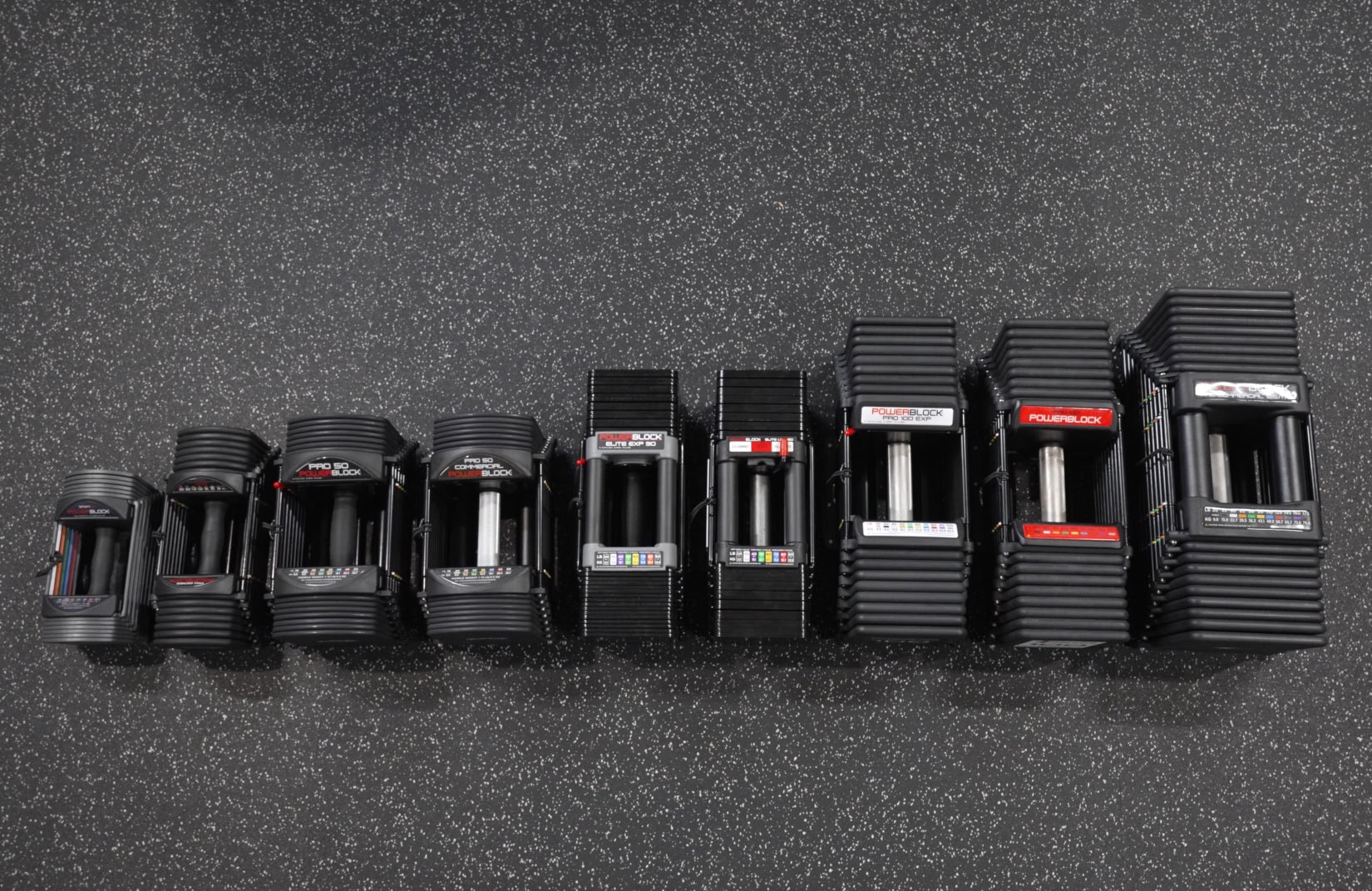
vs. Commercial Pro 100 ($1,649 with Pro Rack, $1,759 with Pro Max): my favorite PowerBlock overall. It’s more compact, balances slightly better, adjusts in 5 lb steps, and works with the Pro 100 attachments, including the rotating kettlebell handle. Step up to the 125/175 only if you need more than 100 lbs per hand. My Commercial Pro 100 review covers this model in depth.
vs. Pro 100 EXP ($1,196 maxed): the residential version of the Pro 100, with 2.5 lb micro weights and four expansion stages. No stand included. It’s what I recommend to most serious lifters.
vs. Elite USA 90 ($867 maxed): the best value in the lineup. Welded steel keeps it compact, knurled grips come standard, and it tops out at 90 lbs. My Elite USA 90 review discusses it in detail.
For the full lineup, read my complete PowerBlock dumbbells guide.
Who Should Buy the PowerBlock Commercial Pro 125/175
Buy the PowerBlock Commercial Pro 125/175 if:
- You need more than 100 lbs per hand, now or soon
- You’re equipping a college, pro, or commercial training facility
- 7.5 lb steps suit how you train, or you’ll add a light set for accessory work
- You have the budget for it (assuming you like the features, too)
Look elsewhere if:
- 100 lbs covers your heaviest dumbbell work, in which case get the Commercial Pro 100 or Pro 100 EXP
- You want a PowerBlock model with bar or kettlebell attachments
- You do a lot of light isolation work and don’t want a second set
- Value is your top priority, in which case get the Elite USA 90
PowerBlock Commercial Pro 125/175 FAQ
Is the PowerBlock Commercial Pro 125/175 worth it?
If you need more than 100 lbs per hand, yes. No other quick-change adjustable dumbbell on the market goes up to 175, and with the stands matched, it costs less per pound of capacity than the Commercial Pro 100. If 100 lbs is enough, the Commercial Pro 100 is the better buy.
Should I buy the Commercial Pro 125 or the 175?
Buy the 175 if you know you’ll lift above 125 lbs per hand. Otherwise, buy the 125. The $420 expansion kit brings it to exactly the 175’s price later, so waiting costs nothing.
How much weight does the PowerBlock Commercial Pro 175 hold?
175 lbs per hand fully expanded, adjustable down to 12.5 lbs.
Why does it adjust in 7.5 lb increments?
The plates weigh 15 lbs each, and the handles come in 12.5 and 20 lb pairs. Moving the pin changes the weight by 15 lbs, and swapping handles covers the 7.5 lb increments in between.
Does the PowerBlock Commercial Pro 125/175 come with a stand?
Yes. The Pro Max Stand is included. It sells for $429 on its own, has locking casters and a large lower shelf, and it’s the only PowerBlock stand rated for this much weight.
Does it work with any attachments?
No. It works with no bars or kettlebell handles. The Pro 32 is the only other current PowerBlock without attachment options.
Can I use a commercial set in a home gym?
Yes, and without losing coverage. PowerBlock confirmed to me that the 5 year residential warranty applies when a commercial set is used only in a residential setting.
How big is the PowerBlock Commercial Pro 175?
21 inches long, 8.8 inches wide, and 9.1 inches tall at the full 175 lbs. It’s wider and taller than the Commercial Pro 100, but shorter at matched weights, which helps on pressing movements.
My Rating
PowerBlock Commercial Pro 125/175
The PowerBlock Commercial Pro 125/175 is the only PowerBlock dumbbell that goes past 100 lbs per hand. The 125 and 175 are the same set at two capacities, and a single $420 kit takes the 125 up to 175. You change weight in 7.5 lb jumps using two swappable handle pairs (12.5 and 20 lbs) and 15 lb blocks. The grips are 38 mm knurled stainless steel, and the Pro Max Stand is included. It's bulky in width and height but shorter than the Pro 100 models at similar weights, which helps on heavy presses. The 7.5 lb jumps make it hard to progress on light isolation work.
4.3
Pros
- Goes to an incredibly heavy 175 lbs per hand
- Buying the 125 and expanding later costs the same as buying the 175 outright
- 38 mm knurled stainless steel grips
- Swappable handles adjust faster than micro weights
- Better balanced than any micro-weight PowerBlock
- Shorter than other heavy PowerBlocks at matched weights
- Far more forearm room than the Elite's closed handle
- Pro Max Stand with locking casters included ($429 value)
- Stainless steel rail hardware and commercial warranty
Cons
- Larger 7.5 lb increments
- Very bulky in terms of width and height
- Your hand sits deep in the frame, so the blocks reach your body sooner
- Frame column wrist supports are bare steel
- No bar or kettlebell attachments
- Most expensive PowerBlock set ($2,049 to $2,469)
- Not as balanced as the Commercial Pro 100 due to bulkiness
PowerBlock Commercial Pro 125/175 Review: Final Verdict
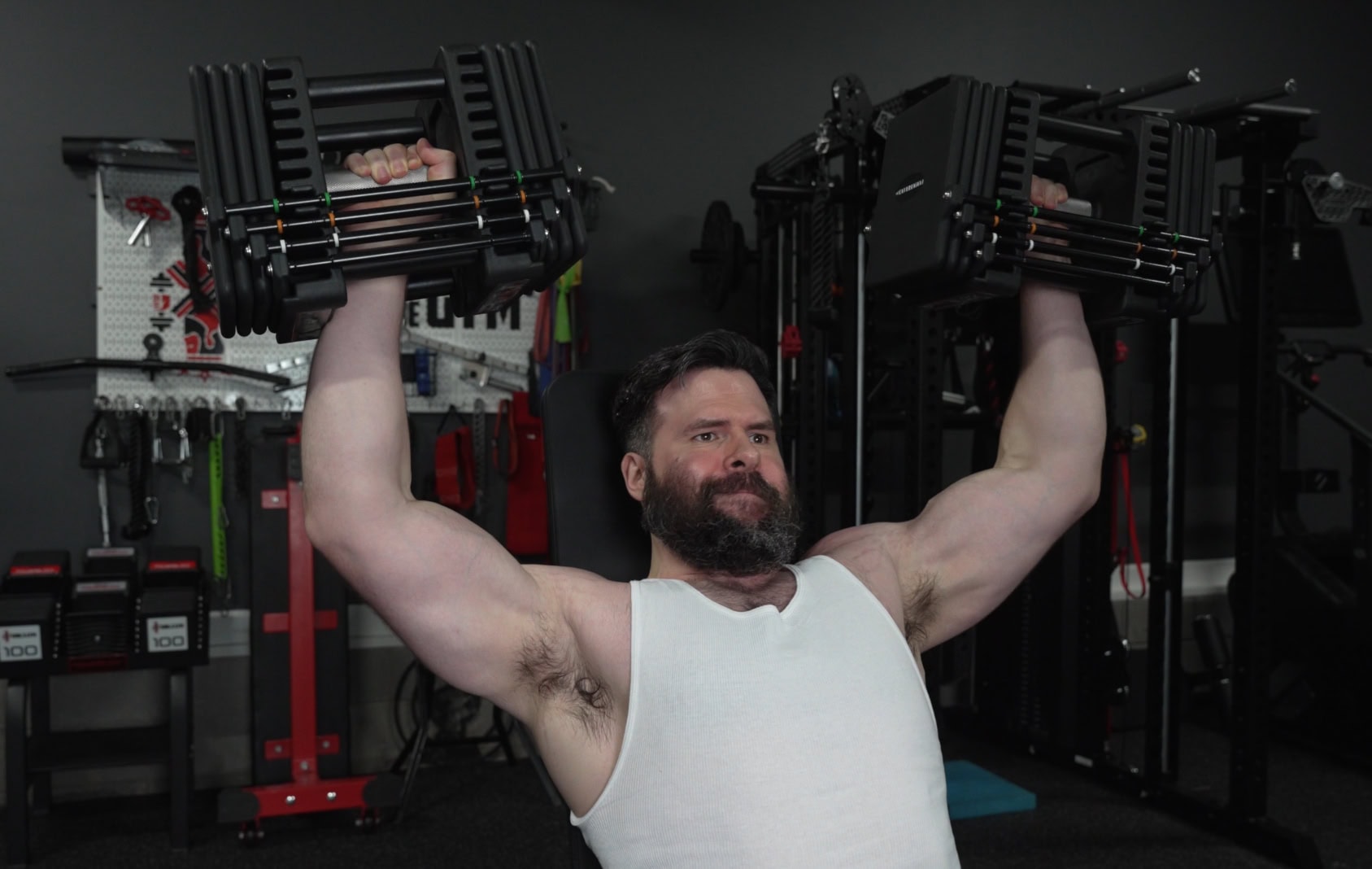
The PowerBlock Commercial Pro 125/175 does something no other quick-changing adjustable dumbbell does. It puts 175 lbs per hand into one pair of dumbbells on one rolling stand.
The weight, build, and grips justify the price; the stand is included, and with the stands matched, it’s the cheapest heavy commercial PowerBlock per pound of capacity.
While they’re compact lengthwise, you do need to be okay with their bulkier height/width. But I believe the biggest deciding factor is actually the 7.5 lb increment. If you need the weight and you’ll cover light accessory work with a second set (or you don’t mind dealing with bigger jumps on light movements), these are a great buy.
If they’d be your only dumbbells and you do a lot of small-muscle work, the big jumps in the lighter weight range will get old. And if you’ll never lift past 100 lbs per hand, the Commercial Pro 100 gives you a better dumbbell for less.
For lifters who’ve outgrown everything else PowerBlock makes, the PowerBlock Commercial Pro 125/175 is the set to buy.
Check the current price of the Commercial Pro 125 or the Commercial Pro 175, and use my code KING20 to save $20 on your order.
Related PowerBlock Reviews
- PowerBlock Dumbbells: The Complete Buying Guide
- PowerBlock Dumbbells Review: Pros & Cons
- PowerBlock Commercial Pro 100 Review
- PowerBlock Elite USA 90 Review
- PowerBlock Elite EXP Review
- PowerBlock Commercial Pro 50 Review
- PowerBlock Pro 50 Review
- PowerBlock Pro 32 Review
- PowerBlock Sport 24 Review
- PowerBlock Pro vs Elite
- PowerBlock Pro vs Sport
- PowerBlock Elite vs Sport
- PowerBlock Knurled Handles Review
- Best Adjustable Dumbbells (All Brands)